





















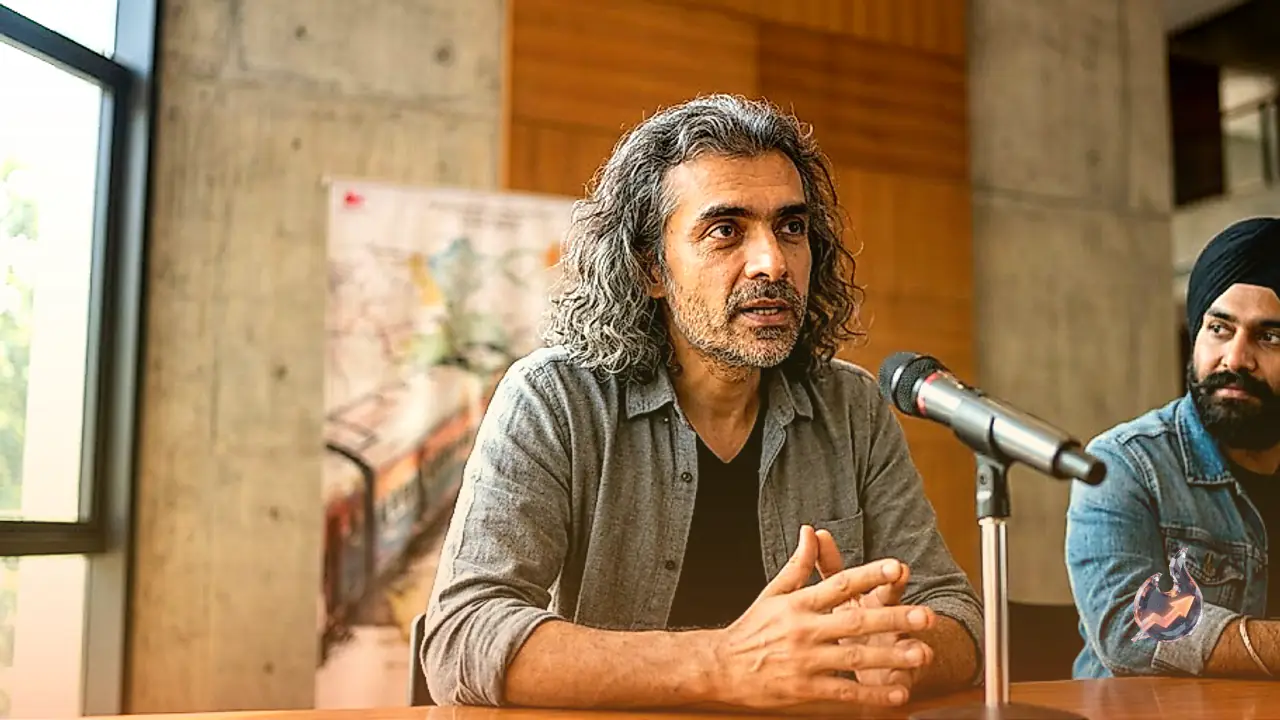

Renowned Bollywood filmmaker Imtiaz Ali is currently commanding public attention for two very distinct and significant milestones in his life. On the personal front, his twenty-six-year-old daughter Ida has recently taken a major step forward by getting engaged to her partner. On the professional front, his upcoming cinematic venture, "Main Wapas Aaunga," is generating considerable excitement. Set against the rich and evocative backdrop of Punjab, this project delves into the lingering trauma of the 1947 Partition, weaving a poignant and unique narrative of displacement and human connection. During a recent promotional visit to Chandigarh in connection with this film, the director shared profound reflections on national history, his creative process, and the deep-seated patriotism of Indian Muslims.
Relying on Historical Literature to Unpack the Pain of Partition
To do complete justice to a theme as sensitive and monumental as the division of the Indian subcontinent, Imtiaz Ali engaged in rigorous historical research before embarking on the film's production. He revealed that in order to grasp the complex dynamics of the India-Pakistan Partition and the specific socio-cultural history of Punjab during that era, he immersed himself in extensive reading and studied numerous films made on the subject. Among these resources, he highlighted the seminal work "Freedom at Midnight," co-authored by Larry Collins and Dominique Lapierre, as an indispensable and critical text for comprehending the geopolitical atmosphere of that chaotic period. However, he emphasized that while academic texts provided essential context, the core inspiration for "Main Wapas Aaunga" stems from the raw, lived realities of ordinary citizens whose lives were uprooted overnight by a hastily drawn boundary.
The Haste of the Radcliffe Line Across Two Distinct Timelines
The driving force behind this narrative remains the true accounts of individuals whose destinies were permanently altered by the sudden demarcation of the Radcliffe Line. To capture this transition, Imtiaz Ali structured the film across two contrasting eras. One timeline transports the audience back to the pre-Partition era of 1947, reflecting the cultural fabric of undivided India, while the other timeline focuses on the contemporary landscape of modern-day Punjab. Addressing the thematic essence of the movie, the filmmaker clarified that the story's objective is neither to foster affection nor to incite animosity toward Pakistan. He shared that during his extensive interactions with people while researching the film, not a single individual expressed feelings of hatred or hostility toward the people across the border, proving that human connection transcends political divides.
An Uncompromising Take on the Patriotism of Indian Muslims
During his interactions, Imtiaz Ali also directly addressed the hostile rhetoric often directed at the minority community, specifically the derogatory taunt urging Indian Muslims to "go to Pakistan." Rejecting this divisive narrative, the director offered a powerful and logical perspective on the matter. He pointed out that during the historic upheaval of 1947, Indian Muslims held the explicit choice to migrate to the newly created nation of Pakistan. By consciously deciding to stay back and remain in their ancestral homeland of India despite the immense uncertainties of the time, they demonstrated the ultimate expression of love and loyalty for their country. This historic choice, according to Ali, stands as the most profound testament to their patriotism, rendering any modern-day demands for proof of loyalty entirely redundant.
Defining the True Meaning of 'Home' and Identity
Concluding his thoughts, the filmmaker offered a deeply philosophical interpretation of what a "home" truly represents. According to him, a home is far more than a physical structure or a geographic location; it is fundamentally an emotional anchor tied to love and a sense of who we once were. Wherever there is love, that is where home resides. Drawing a parallel to Ishar, a pivotal character in "Main Wapas Aaunga," Ali suggested that almost every human being is on a subconscious quest to return to that core identity and emotional sanctuary where they feel most accepted, authentic, and whole.