





















Ukraine's military has significantly stepped up its campaign of drone strikes targeting Russian-annexed Crimea, expanding its focus from land-based logistics corridors to the critical maritime trade and supply routes that sustain the peninsula. This tactical evolution represents a key phase of what Ukrainian military officials call a "logistics lockdown," a strategic effort designed to isolate the occupied territory by cutting off all inbound and outbound supply chains. By utilizing advanced naval drones, Kyiv is systematically targeting the Sea of Azov and the Black Sea, turning these vital waterways into highly contested zones and directly undermining Moscow's ability to supply its military forces and civilian administration on the peninsula.
The Sea of Azov: A New Battleground for Unmanned Warfare
The Sea of Azov, a shallow and strategically vital body of water connected to the Black Sea by the narrow Kerch Strait, has emerged as the central theater of this maritime conflict. Robert Brovdi, the commander of Ukraine's drone forces who is widely known by his military call sign Magyar, has provided detailed updates on the scale of these operations. Brovdi reported that over a recent four-day window, at least 25 vessels have been targeted and set ablaze within the Sea of Azov. This body of water, which was once considered a secure domestic lake by Moscow, has now become a dangerous zone for shipping. The continuous deployment of high-speed, explosive-laden naval drones has disrupted Russian transit routes, dealing a direct blow to Vladimir Putin's personal guarantees regarding the stability and security of fuel deliveries to the region.
Targeting Russia's Shadow Fleet of Oil Tankers
The scale of the campaign is immense. Ukrainian military sources have spoken of up to 36 vessels being hit during this offensive. The majority of these targeted ships are believed to belong to Russia's "shadow fleet"—a network of commercial tankers used by Moscow to transport oil and circumvent international trade restrictions. Because some vessels may have been struck multiple times, and due to the chaotic nature of maritime warfare, the exact number of unique ships damaged remains difficult to verify independently. However, the operational impact is undeniable. The presence of these commercial oil tankers idling in the Sea of Azov near the northeastern coast of Crimea is a regular sight, due to the presence of a key onshore oil loading facility located at the Kerch port. Last month, Ukraine launched a targeted attack on this very port, and subsequent satellite imagery analysis indicated a significant decline in the number of tankers operating in the immediate vicinity in the days following the strike, demonstrating the immediate deterrent effect of Kyiv's maritime operations.
Eyewitness Accounts, Satellite Evidence, and Thermal Data
The reality of these strikes has been documented through extensive video evidence. Nighttime footage depicting the latest drone strikes began circulating widely on social media platforms early on Tuesday. Brovdi detailed a series of successive strikes occurring every single day between 6 and 9 July. Even Russian regional authorities have been forced to acknowledge the damage. Yuri Slyusar, the governor of Russia's Rostov region, confirmed that on Wednesday, two empty tankers were struck in the Taganrog Bay, which lies in the northeastern corner of the Sea of Azov. Despite being empty of cargo, the vessels were reported to still be actively burning as late as Thursday. Brovdi further revealed that two tankers targeted earlier in the week were loaded with approximately 7,000 tons of fuel each, transport routes originating from the Taganrog area and heading directly toward Crimea. Satellite images captured on Wednesday clearly showed a massive column of dark smoke rising from a ship positioned approximately 2.5 miles (or 4.2 kilometers) off the coast of Crimea. Thermal data from NASA indicated that this specific fire had been burning continuously from that coordinate since 6 July, marking it as a likely casualty of the initial wave of strikes initiated by Ukraine's drone units. The same imagery captured around 20 other vessels rapidly evacuating the area, fleeing south toward the relative expanse of the Black Sea.
Identifying the Casualties of the Maritime Blockade
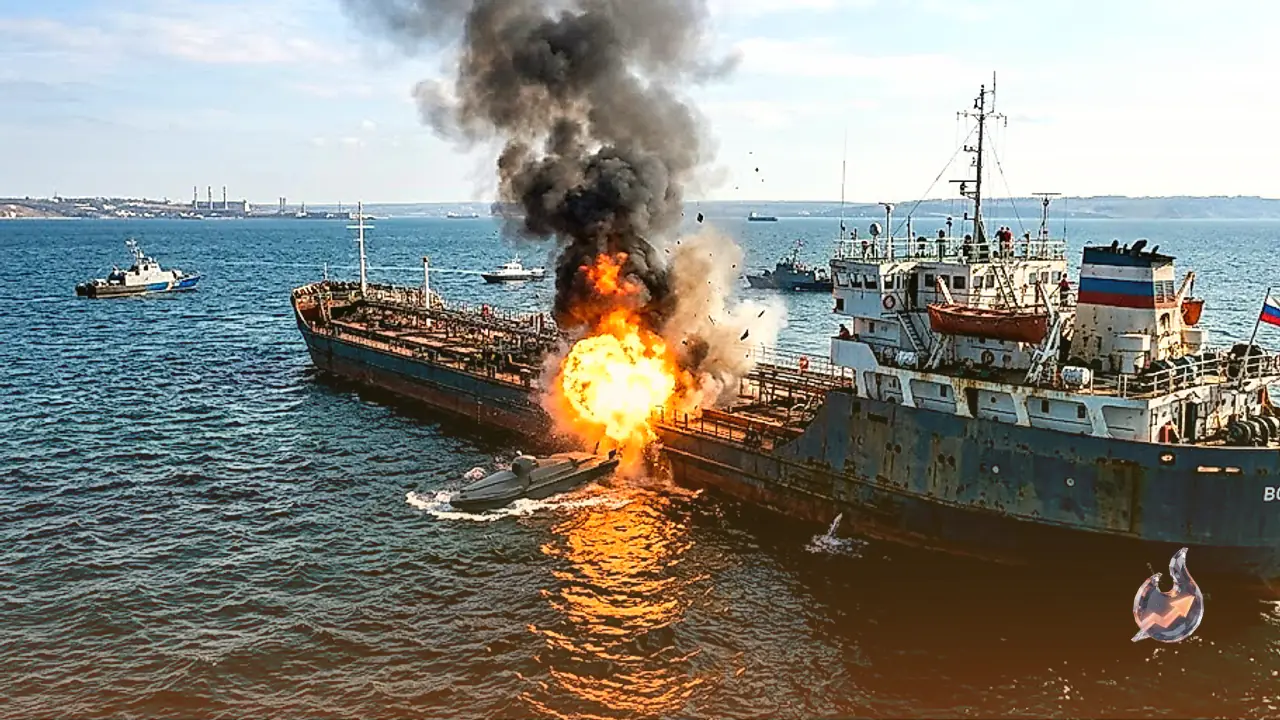
The head of Ukraine's Unmanned Systems Forces has explicitly identified several of the Russian tankers that have been targeted and hit during this intense campaign. Among the named vessels are Venera-3, Sanar-1, Sanar-17, Klimena, Thetis, Alexey Savrasov, and Penelopa. The strikes have not been confined solely to open-water transit. In the port of Kerch itself, a passenger ferry named SKS One and an adjacent bulk carrier were subjected to heavy attacks, with images of the aftermath quickly finding their way onto social media channels. The geography of the conflict shows that leaving the relatively confined waters of the Sea of Azov does not guarantee safety. On Wednesday, Ukraine's general staff released dramatic footage showing a sea drone targeting a sanctioned Russian tanker named Blue. The onboard camera footage from the drone captured its rapid approach, successfully dodging defensive gunfire from the ship's crew before the feed abruptly cut out just as the drone reached the tanker's hull. While the exact coordinates of this strike could not be independently verified, Ukrainian military officials stated that the attack took place near Yalta, a famous Black Sea resort city on the occupied southern coast of Crimea.
The Land-Sea Synergy: Striking Russia's Refining Infrastructure
This maritime offensive does not exist in a vacuum; it is highly coordinated with ongoing Ukrainian drone strikes targeting mainland Russian oil refineries and storage depots. These coordinated strikes have triggered widespread and severe fuel shortages throughout Russia, affecting even major metropolitan centers such as Moscow and St. Petersburg. Ukrainian President Volodymyr Zelensky has robustly defended this strategy. He argued that by targeting Russia's oil infrastructure, Kyiv is delivering a justified and proportional response to Russia's relentless strikes against Ukrainian civilian infrastructure. Zelensky emphasized that Russian citizens must "feel that it is their state that is waging war," thereby bringing the economic reality of the conflict home to the Russian public. To this end, Zelensky highlighted two additional successful drone strikes on oil storage depots located in the Tver and Stavropol regions—areas situated hundreds of kilometers away from the active front lines—as well as an unnamed oil terminal in the Rostov region, which is widely believed to be the Yug Rusi facility, located inland from Taganrog Bay. This strategy of escalation has drawn international attention. When US President Donald Trump met with Zelensky at the NATO summit in Ankara on Tuesday, Trump described the drone campaign as a notable escalation of the conflict. However, Trump also observed that "it's also an escalation that can help lead to an end," suggesting that raising the cost of the war for Moscow could ultimately force a diplomatic resolution.
The Strategic Retreat of the Black Sea Fleet
The sheer intensity and scale of these maritime drone operations have clearly overwhelmed Russian defensive capabilities in the region. Brovdi claimed that Ukrainian forces managed to strike 12 tankers in a single night, during the transition from Wednesday into Thursday. Notably, pro-war Russian media and commentators have not disputed the authenticity of the footage or the specific details of these claims. Instead, there has been a wave of frustration and criticism directed at the Russian military leadership. The prominent "Military Informant" Telegram channel lamented the defenseless state of the Russian tankers, describing their transit through these waters as akin to a "shooting gallery" for Ukrainian drone operators. The channel pointed out that these civilian and commercial vessels have absolutely no protective cover from the Russian Black Sea Fleet, which is currently struggling to defend even its own assets. Mikhail Zvinchuk, a well-known military analyst and the author of the influential "Rybar" Telegram channel, openly acknowledged this grim reality, noting that the Black Sea Fleet has essentially withdrawn from its forward positions and "now shut itself in at Novorossiysk," leaving the maritime supply lines completely exposed to Ukrainian sea drones.
Economic Strife and Fuel Rationing
These continuous strikes on maritime logistics and domestic refining capacity are delivering a painful blow to Russia's wartime economy, particularly within Crimea. In late June, Vladimir Putin estimated that Crimea's monthly fuel requirement stood at approximately 70,000 tons. At the time, Putin made a public promise to secure the peninsula's energy needs by significantly increasing fuel deliveries via both land-based rail corridors and maritime shipping routes. However, the volume of fuel carried by the tankers targeted in the Sea of Azov likely far exceeded that monthly estimate, meaning the disruption will have immediate and cascading effects. Currently, more than 90% of Russian regions are experiencing some form of fuel rationing or outright shortages, forcing Moscow to implement a strict ban on diesel exports. Long queues of vehicles have been reported at filling stations in major Russian cities. Inside Crimea itself, the Russian-appointed occupation authorities are struggling to manage severe disruptions to local power grids and public transportation networks. By successfully jeopardizing Russia's land-based supply routes and now systematically dismantling its maritime corridors, Ukraine's military is successfully tightening its grip on the occupied peninsula, throwing Russia's regional logistics into complete disarray.