























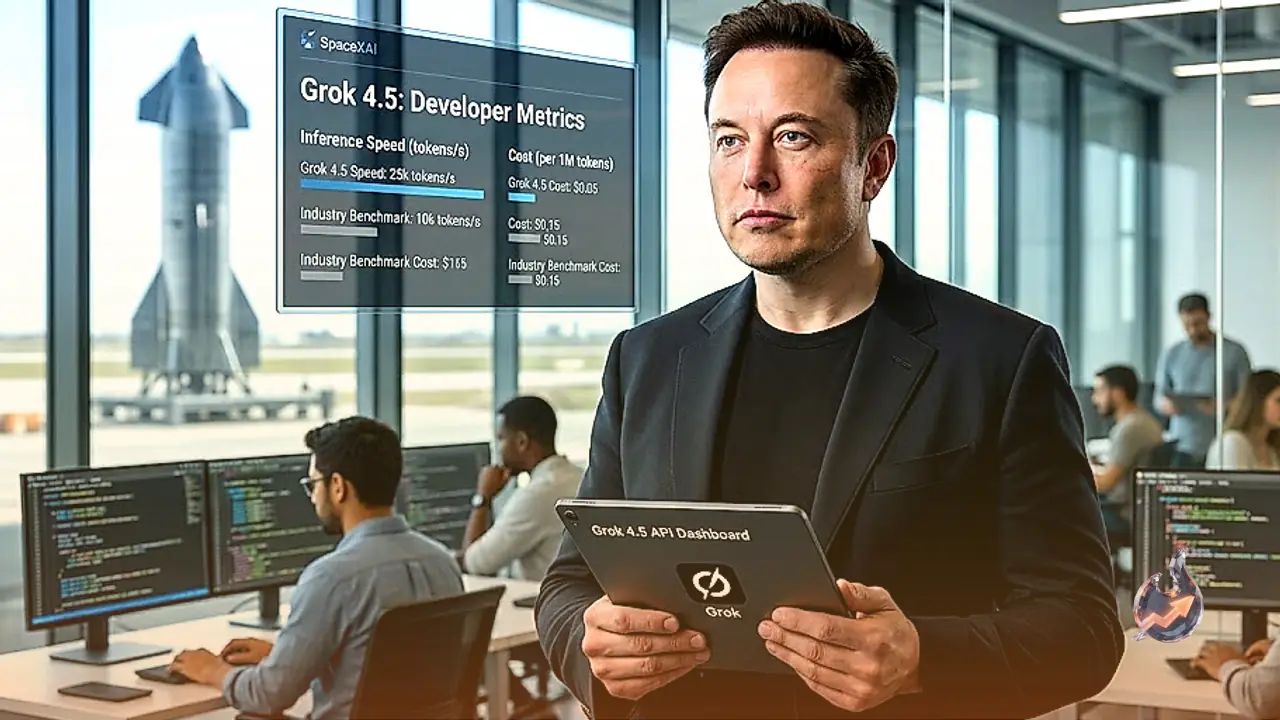

Elon Musk’s SpaceXAI released Grok 4.5 on Wednesday, marking its first major public model since the completion of the merger between SpaceX and xAI in February. The rollout coincides with the ongoing $60 billion deal for SpaceX to acquire Cursor. The model is specifically targeted at coders, engineers, and 'knowledge workers,' a diverse group ranging from software developers to legal teams reviewing contracts and finance experts building complex Excel models.
The Balance of Cost vs. Performance
The company is not positioning the model as the absolute performance leader, but rather as a highly cost-effective solution, especially for western-based models. Grok 4.5 is priced at $2 per million input tokens and $6 per million output. For context, Anthropic’s flagship Claude Opus 4.8 costs $5 for input and $25 for output, while OpenAI’s newly launched GPT 5.6 Sol model commands $5 for input and $30 for output. Musk took to X to clarify the positioning of his new model, describing it as roughly comparable to Opus 4.7, albeit significantly faster. He framed this as a conscious trade-off, prioritizing speed and cost-efficiency, citing real-world utility within engineering teams at Tesla and SpaceX as proof of concept.
Analyzing the Benchmark Results
SpaceXAI shared four sets of benchmark results, which reflect a mixed performance landscape. In DeepSWE 1.1, a metric that evaluates an AI’s ability to resolve real software bugs submitted by developers, Grok 4.5 achieved a 53% resolution rate. It trailed behind Claude Opus 4.8 at 59% and GPT 5.5 at 67%, with Anthropic’s Claude Fable 5 leading at 70%. On the SWE Bench Pro, which aggregates software engineering tasks, Grok 4.5 performed better with a 64.7% score, surpassing GPT 5.5’s 58.6%. However, Opus 4.8 remained ahead at 69.2%, and Fable 5 topped the field at 80.4%. It should be noted that the company’s comparisons focus on GPT 5.5 because GPT 5.6 was released on the same day, hours after the Grok announcement.
Training Infrastructure and Development
Grok 4.5 was trained in a collaborative effort with the newly acquired Cursor AI, utilizing tens of thousands of Nvidia GB300 GPUs housed within Colossus. This Memphis-based supercomputer boasts a total capacity across more than 200,000 GPUs. Despite utilizing this massive hardware footprint, the model remains competitive rather than being the absolute market leader, a pattern observed in previous SpaceXAI releases. The significant shift with Grok 4.5 lies in its aggressive pricing strategy and the nature of its training signals.
Efficiency Math and Practical Application
The core argument for Grok 4.5 is based on efficiency. During SWE Bench Pro tasks, Grok 4.5 utilized an average of 15,954 output tokens per job, whereas Opus 4.8 consumed 67,020 tokens for the same workload, representing a 4.2x efficiency gap. For teams running high-volume AI tasks, these savings compound significantly. Furthermore, the model operates at 80 tokens per second, placing it firmly in the 'fast-model' category. It was trained on developer session data provided by Cursor, including actual debugging traces and code edits. The model is available via API, on Hermes, and on Grok build, offering a context window of half a million tokens, or nearly 400,000 words. European users will have access starting in mid-July.