
Why Washington lost trust in Anthropic
A string of events over the past few weeks has pushed the relationship between the US government and AI company Anthropic to a breaking point, and at the heart of the dispute sits one of South Korea's biggest companies. According to a person close to the administration, the combination of concerns convinced the White House that it could no longer rely on Anthropic to keep its most advanced AI technology secure.
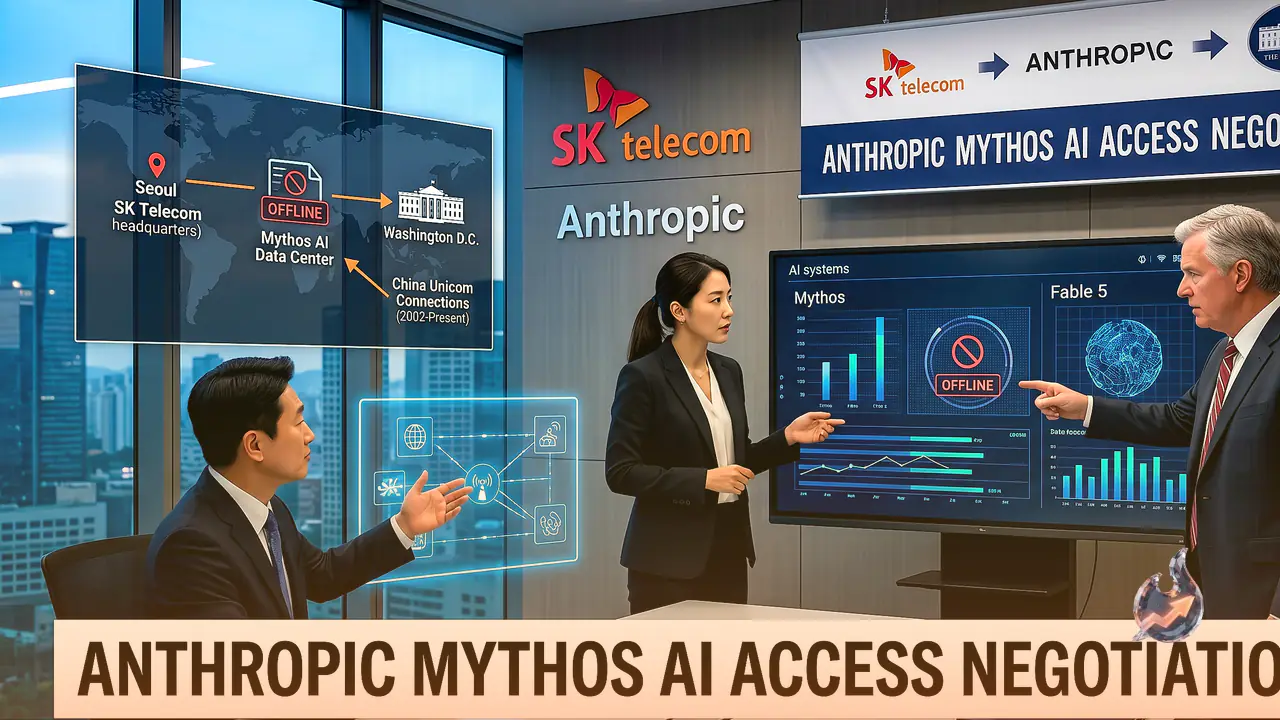
The flashpoint came on Friday, when the Trump administration directed Anthropic to cut off access to two of its systems, Mythos and Fable 5, for every foreign national, a category that even covered immigrants living inside the United States.
The Amazon warning over Fable 5
Part of what hardened that stance was a warning from Amazon. The company's researchers told the White House about weaknesses they had found in Fable 5, the heavily protected edition of Mythos that Anthropic made publicly available on June 9. According to those researchers, it was possible to slip past some of Fable 5's built-in safety limits and tap into the powerful cyber abilities of Mythos. Anthropic, along with independent cybersecurity specialists, has pushed back, arguing that whatever risks exist are not something specific to Claude.
A blanket shutdown rather than nationality checks
Faced with the order, Anthropic chose the broadest possible response. Sorting users by nationality would have been hard to carry out without trampling on privacy, so the company concluded it was simpler to switch off the models for everyone. Even after several days of talks, the two sides have not agreed on terms for restoring Claude Mythos and Fable 5, which remain offline.
Anthropic declined to comment. The White House and SK Telecom did not immediately respond to requests for comment.
Where South Korea enters the picture
TrendKia previously reported that officials in the Trump administration were rattled when they discovered that the list of organizations granted Mythos access included a "South Korean telecommunications company" they suspected of having ties to China. That earlier account stopped short of naming the business. Responding to it, SK Telecom told a Korean newspaper that the "anonymous insider's remarks in foreign media lack verified facts, and our company has no ties to China."
A person familiar with Anthropic's thinking said the company treats two things as unrelated: SK Telecom's access to Mythos on one side, and the vulnerabilities Amazon flagged on the other. This person pointed out that the formal letter Washington sent Anthropic, demanding that Claude Mythos and Fable 5 be limited to US nationals only, makes no mention of either the Korean firm or China.
What Project Glasswing is
Because Mythos is unusually good at sniffing out flaws in software, Anthropic initially handed early access only to a tight circle of organizations it trusted, under an initiative named Project Glasswing. Earlier this month the program widened, and SK Telecom, the largest wireless carrier in South Korea, joined roughly 150 companies that gained access to Mythos. Anthropic said the expansion followed "several weeks of close collaboration" with outside experts and the US government.
The Korean carrier has repeatedly backed Anthropic with money. That includes a $100 million investment in 2023, made alongside a commercial tie-up to build an AI model designed for the telecommunications business. SK Telecom was also just one of several Korean participants in Project Glasswing, joined by Samsung Electronics and the Korea Internet & Security Agency.
According to a person close to the AI lab, the White House had already asked Anthropic earlier this month, soon after the latest Glasswing expansion was announced, to pull SK Telecom's access to Mythos. The company did so right away, sources tell TrendKia, and at that point Washington did not threaten to slap export controls on the model.
SK Telecom's footprint in China
SK Telecom on its own does not seem to run sizable operations inside China. It does, however, belong to a far larger conglomerate, SK Group, whose member companies hold wide-ranging business interests across the country in areas such as semiconductors, energy and more.
The carrier's own China business is modest. Its annual report shows that in 2024 SK Telecom took in only about $1.9 million in revenue from China, mostly tied to investment activity, and had a staff of just seven people there.
Two decades of ties to China Unicom
Its history in the Chinese telecom market, though, goes back more than twenty years. In 2004 SK Telecom teamed up with China Unicom, a state-owned operator, to create a joint venture called UNISK, set up to deliver wireless internet and mobile content services in China. It ranked among the earliest joint ventures linking a foreign company with a Chinese carrier.
Two years later, in 2006, SK Telecom put $1 billion into convertible bonds issued by China Unicom's Hong Kong-listed arm, holdings that were ultimately turned into an equity stake of roughly 6.6 percent. The relationship later started to come apart. In 2009 SK Telecom sold its China Unicom stake back to the Chinese carrier for around $1.3 billion, while keeping a small financial connection to the venture. In its 2025 annual filing with the US Securities and Exchange Commission, SK Telecom recorded an investment in UNISK worth roughly $17 million.
Washington's long scrutiny of China Unicom
China Unicom itself has been in Washington's sights for years. In 2021, during the first Trump administration, the US curbed American investment in China Unicom as part of a wider campaign against Chinese firms it said were connected to the country's military and intelligence apparatus. This April, pointing to national security, the US Federal Communications Commission proposed blocking American telecom companies from interconnecting with China Unicom and other Chinese carriers, a step China Unicom recently cautioned could throw global communications into disarray.