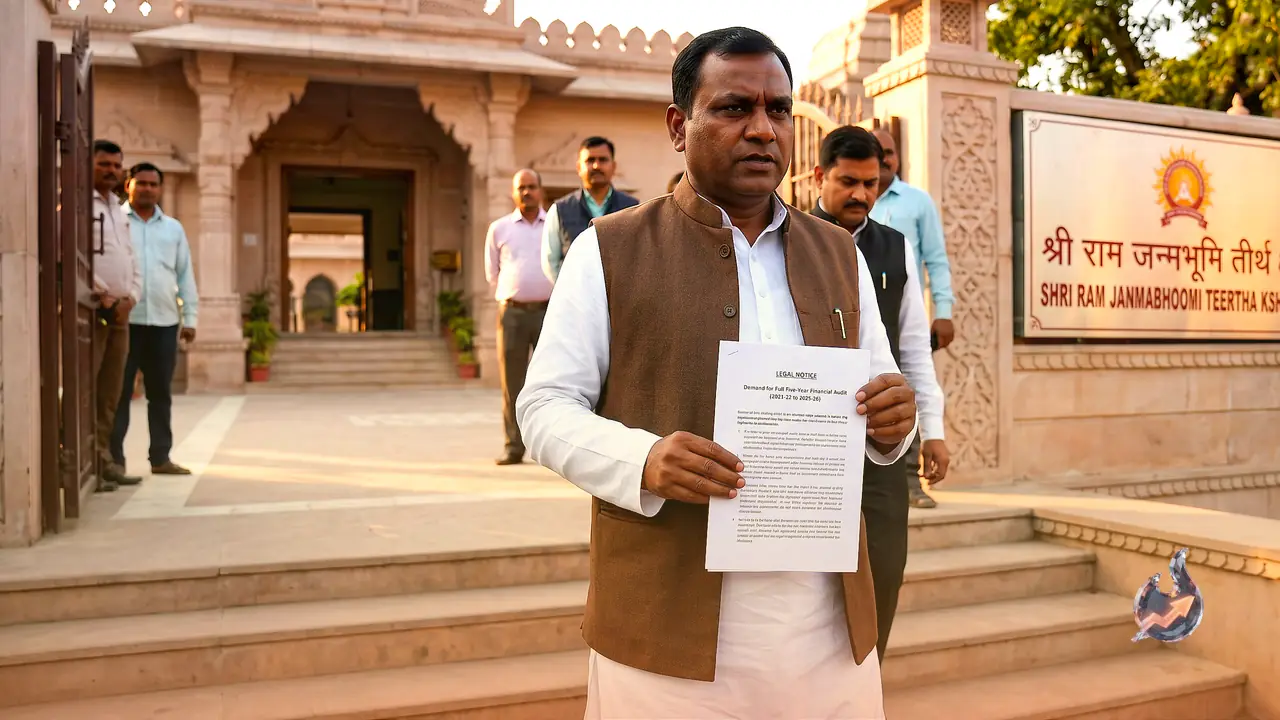

Legal Notice Puts Ram Temple Trust's Finances Under Scrutiny
Sudhkar Singh, the Rashtriya Janata Dal (RJD) Member of Parliament from Buxar in Bihar, has sent a formal legal notice to the Ram Janmabhoomi Teertha Kshetra Trust, seeking a full reckoning of every donation received and every expense incurred over five consecutive fiscal years. The notice, routed through Supreme Court advocate Satyam Singh Rajput, has been addressed to three of the trust's top functionaries: president Mahant Nritya Gopal Das, general secretary Champat Rai, and treasurer Swami Govind Dev Giri. It covers the period from fiscal year 2021-22 all the way through 2025-26.
An Extensive List of Documents Demanded
The notice spells out in detail exactly what the trust must produce. The required documents include audited balance sheets, a full statement of income and expenditure, the auditor's formal report, particulars of every piece of land purchased by the trust, and complete bank account details. Over and above domestic finances, the trust has also been asked to disclose any foreign contributions it received under the Foreign Contribution Regulation Act (FCRA). All of this information must be furnished within three days of receiving the notice, and the document makes clear that non-compliance will trigger further legal proceedings.
Transparency, Not Politics, Is the Stated Goal
Advocate Satyam Singh Rajput, who drafted and dispatched the notice, has been emphatic that no political or personal motivation lies behind the move. His core argument is straightforward: crores of devotees donate to the Ram Mandir out of deep religious faith, and the public has every right to know how that money is being managed. MP Sudhkar Singh has taken the same line, saying his only concern is transparency and that funds gathered through the faith of ordinary believers must be subject to a clear, open accounting. He also noted that questions surrounding the trust's land acquisitions, expenditure decisions, and audit records are not new and have been raised on earlier occasions as well.
The Laws Cited as the Basis for These Demands
The notice builds its legal case on multiple statutes. It points out that the Ram Janmabhoomi Teertha Kshetra Trust is registered under Section 80G of the Income Tax Act and manages funds contributed by the general public, a fact that in itself creates a duty of accountability toward those donors. Beyond that registration, the notice draws on the Indian Trust Act, the Income Tax Act, the Uttar Pradesh Public Trusts Act, and the Prevention of Money Laundering Act (PMLA). Collectively, these laws impose on public religious trusts an obligation to maintain their financial records properly and to make them accessible when there is a legitimate need.
A History of Controversy and an Ongoing SIT Probe
The notice does not land in a vacuum. Earlier reports had already alleged irregularities in the way donation amounts at the Ram Mandir were being recorded and accounted for. Those allegations prompted the Uttar Pradesh government to set up a Special Investigation Team (SIT) to examine the matter. Media reports that emerged around the same time claimed that during the investigation, significant sums of cash were recovered from some employees at the temple.