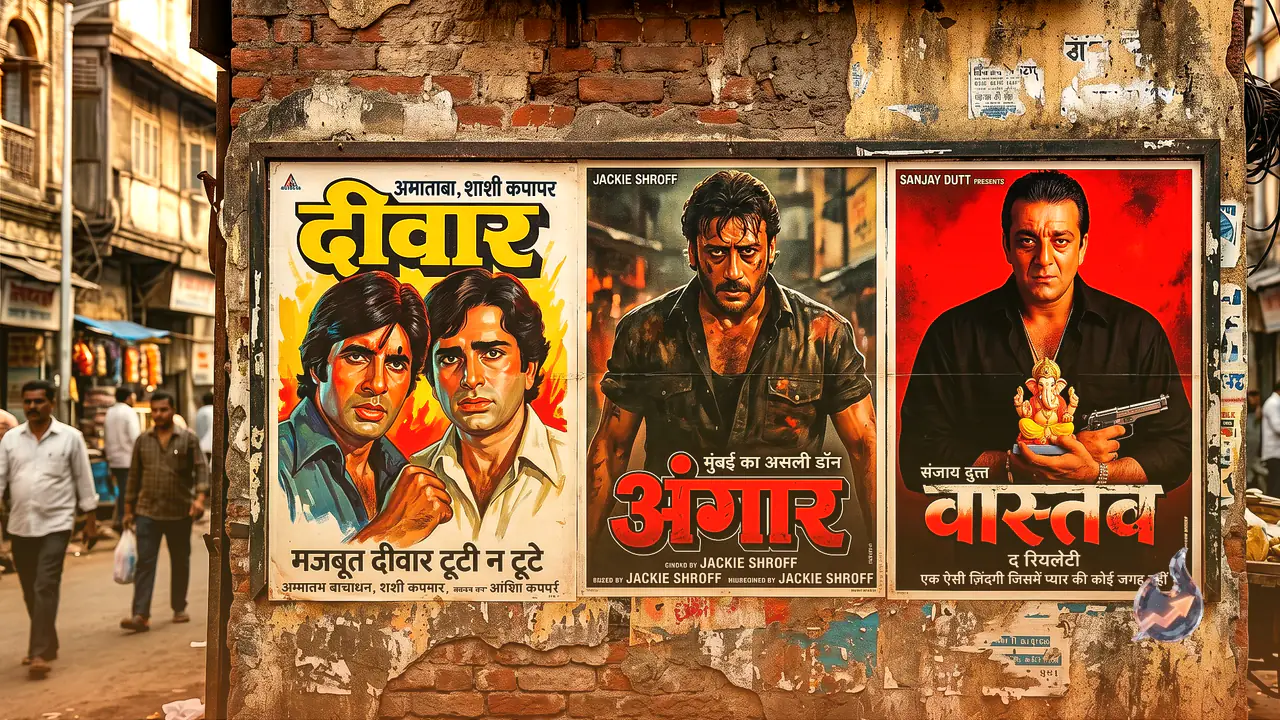

Hindi cinema has long been drawn to the shadows of Mumbai's underworld. The foundation was laid in the 1970s, when the screenwriting duo Salim-Javed pulled characters from the crime world straight into the heart of their stories, giving films a sharper edge and a new sense of thrill. The 1973 film 'Zanjeer' came out of exactly this thinking, and it turned Amitabh Bachchan into the 'Angry Young Man' overnight. In the same film, Pran appeared as 'Sher Khan', a character widely believed to be based on Mumbai's first don, Karim Lala. Through the 1960s, Karim Lala's grip on Mumbai was so strong that people would tremble with fear wherever he set foot. The years that followed produced three films that took the lives of real gangsters and placed them directly on the screen, Deewar, Angaar and Vastav.
Deewar: Written Off as a Flop, It Made History
1975 is counted among Bollywood's most memorable years. In that single year, films across very different genres arrived and dominated the box office. Alongside 'Sholay', another iconic film reached the screen that year, 'Deewar', released on 24 January 1975. Today it sits on Hindi cinema's list of 100 must watch films. Several of its dialogues are still on people's lips, especially 'Main aaj bhi phenke hue paise nahin uthata' and 'Mere paas maa hai', lines almost everyone has heard.
Apart from Amitabh Bachchan, the film featured Shashi Kapoor, Neetu Singh, Parveen Babi, Nirupa Roy, Iftekhar Khan and Madan Puri, yet in truth this was Amitabh's story. It was this film that placed him firmly on the throne of stardom. The direction was handled by Yash Chopra.
The real reason 'Deewar' made history was its story. It carried a clear reflection of the life of Mumbai's underworld don Haji Mastan, and many of the film's scenes line up with his real life. Haji Mastan too began life as a coolie at the Mazgaon dockyard, and later stood up against the Pathan gang. In the film, Vijay Verma, played by Amitabh Bachchan, does exactly the same, refusing flatly to pay hafta, and it is here that the audience's sympathy shifts to Vijay. What makes it interesting is that at the premiere, most people from the industry had assumed the film would flop, but the opposite happened. The moment it released, the film rewrote history and collected 4.25 crore rupees. It stood fourth on the list of the highest earning films of 1975.
Angaar: Two Stories of Karim Lala and Amar Naik
1975 also saw another gangster-based film, 'Dharmatma', run successfully in theatres. Then, in 1992, came the crime action drama 'Angaar'. This multi-starrer placed Jackie Shroff, Kader Khan, Mazhar Khan and Nana Patekar in lead roles, while Dimple Kapadia appeared in an important part. The music director Aadesh Shrivastava was seen in a small role. The film was directed by Shashilal K. Nair, with the story and screenplay written by Sujit Sen, the dialogues penned by Kader Khan, and production handled by Shashilal K. Nair and SM Arif.
'Angaar' is considered to be based on the life of Mumbai's first underworld don, Karim Lala. In the film, Kader Khan played the character of Jahangir Khan, said to be inspired by Karim Lala. The story's second strand connects to Jaikishan, played by Jackie Shroff, an unemployed young man living in a Mumbai slum. He refuses to pay hafta in his locality, and this is what brings him into conflict with Jahangir Khan's gang.
Jackie Shroff's character is believed to have been inspired by the Mumbai gangster Amar Naik. Amar Naik's family once ran a vegetable cart on the street. He too refused to pay hafta and thrashed the goons in public, and from that very day he became the chief of the Mantuka area. People called him 'Mumbai ka Ravan'. He had an old feud with the Arun Gawli gang. On 10 July 1996, Amar Naik was killed in an encounter at Agripada in Mumbai. In this film, Nana Patekar played the villain.
'Angaar' succeeded both in earnings and in recognition. It won 3 Filmfare Awards and one National Award, while the Best Dialogue honour went to Kader Khan. Made on a budget of 2 crore, the film collected around 7.5 crore rupees and proved to be a box office hit.
Vastav: Chhota Rajan's Life and Sanjay Dutt's Triumph
The third film based on a real gangster, 'Vastav, The Reality', arrived in 1999. Released on 7 October 1999, this action-crime film was made under the direction of Mahesh Manjrekar, who also wrote the story and screenplay himself. It was his first film as a director. The dialogues were written by Imtiaz Hussain.
The film brought together performers like Sanjay Dutt, Namrata Shirodkar, Deepak Tijori, Mohan Joshi, Shivaji Satam, Reema Lagoo, Paresh Rawal and Sanjay Narvekar. Sanjay Dutt played the character of Raghunath, alias Raghu Namdev Shivalkar, while Sanjay Narvekar appeared as Dedh Footiya. For this role, Sanjay Dutt won the Best Actor Filmfare Award. The music was composed by Jatin-Lalit, with lyrics by Sameer. The film's song 'Meri duniya hai tujhmein kahin' became quite popular.
The story of 'Vastav, The Reality' was based on the life of Mumbai's underworld don Chhota Rajan. The film shows how a boy from an ordinary family, pushed by circumstances, is gradually drawn into the world of crime. Chhota Rajan's real name was Rajendra Sadashiv Nikhilje, and he lived with his family in Tilak Nagar, Chembur, Mumbai. Rajendra Sadashiv used to sell tickets in black outside Shankar cinema. Once, when the police caught him, he snatched a lathi from a policeman and beat him with it. This act made him a talking point overnight, and after returning from jail he stepped into the world of gangsters.