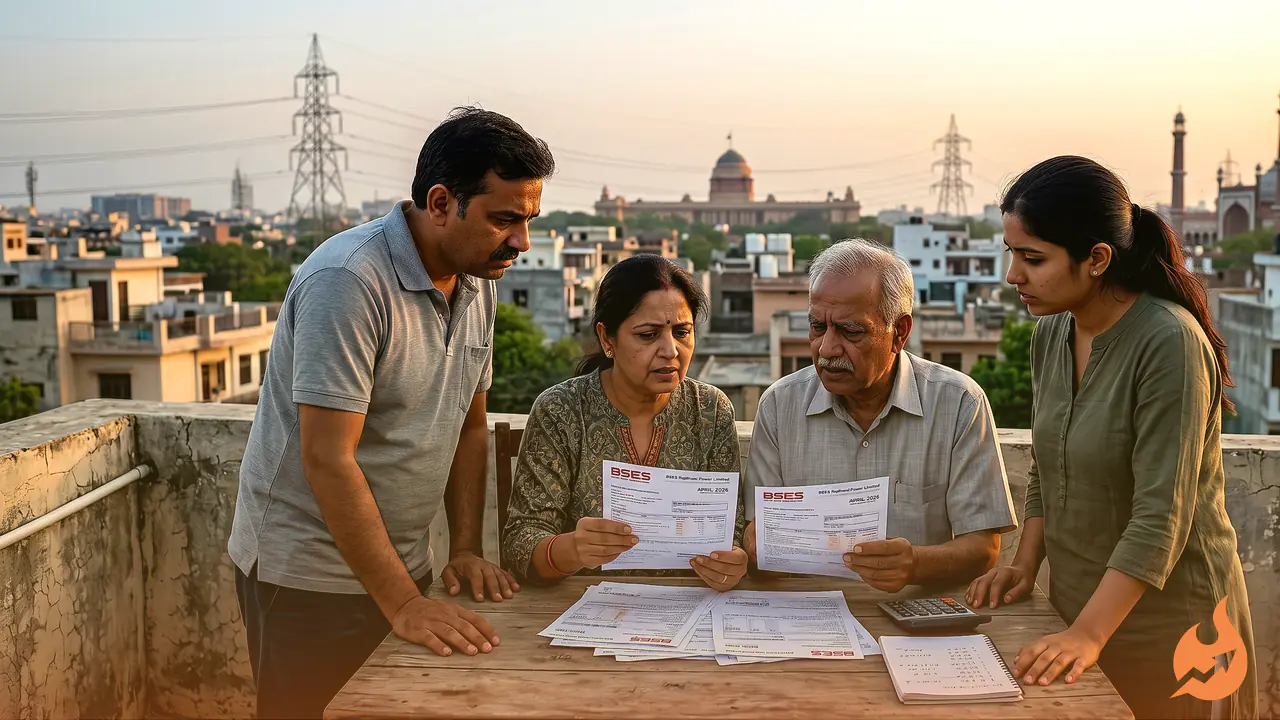

As a brutal summer grips the capital, there is news that will pinch the pockets of Delhi's electricity consumers. The Delhi Electricity Regulatory Commission (DERC) has passed an order that will make the city's power rate shift every single month from now on. The Commission has allowed all three distribution companies — BRPL, BYPL and TPDDL — to recover the April 2026 Power Purchase Adjustment Charge (PPAC/FPPAS) from consumers.
The Big Shift: A Monthly Charge Now
Until now, Delhi's PPAC was fixed and collected on a quarterly basis. This is the capital's first monthly PPAC order, which means distribution companies will now levy the charge month after month. In plain terms, your electricity rate can now change — and rise — every month.
How Much Bills Rise, Area by Area
Three power distribution companies operate across Delhi, and the impact of PPAC will differ from one zone to another. Consumers living in the Tata Power area will now pay 1% more, while those in BSES territory will see their bills go up by 2.5% to 3.5%.
What DERC's Order Actually Approved
The Commission sanctioned far less than what the companies had sought. Here is the breakdown:
- BRPL: 17.94% — the company had demanded 31.55%, of which only a much smaller share was cleared.
- BYPL: 17.43% — approved after trimming a demand of 35.26%.
- TPDDL: 16% — fully approved, after the required documents were submitted.
So What Exactly Is PPAC?
PPAC is a statutory mechanism for passing on swings in the cost of buying power — such as coal and fuel prices — to consumers. More than 25 states and Union Territories across the country have already adopted it. This is not an arbitrary move either: it is mandatory under the Hon'ble APTEL order of 2011, the Electricity Act and the Ministry of Power's directives of 2021-2022.
DERC has also permitted recovery of amounts above the automatic 10% ceiling. The idea is to ensure that distribution companies (DISCOMs) can pay power generators on time. Without PPAC, DISCOMs could face a liquidity crunch, and that burden eventually lands back on consumers in the form of interest.
What It Means for Delhi Residents
The effect will not be the same for every consumer:
- Subsidised consumers — no impact: The Delhi government's subsidy is based on the number of units, not the bill amount. So ordinary households drawing subsidy of up to 200 to 500 units will see no additional rise in their bills because of PPAC.
- Non-subsidised consumers: Heavy power users, commercial connections and high-unit domestic consumers could face an extra surcharge of 7% to 18% for April 2026.
- The new Component "F": From July 2026 onwards, there is a provision to adjust any earlier under-recovery within the cap, so that companies do not suffer a permanent loss.
Why the Decision Is Seen as Necessary
In April 2026, rising coal and fuel prices along with higher import costs sharply pushed up the cost of buying power. On the other hand, the CERC already gives central government companies such as NTPC and NHPC a full monthly pass-through. Following the same model, Delhi is now rolling out a monthly PPAC.