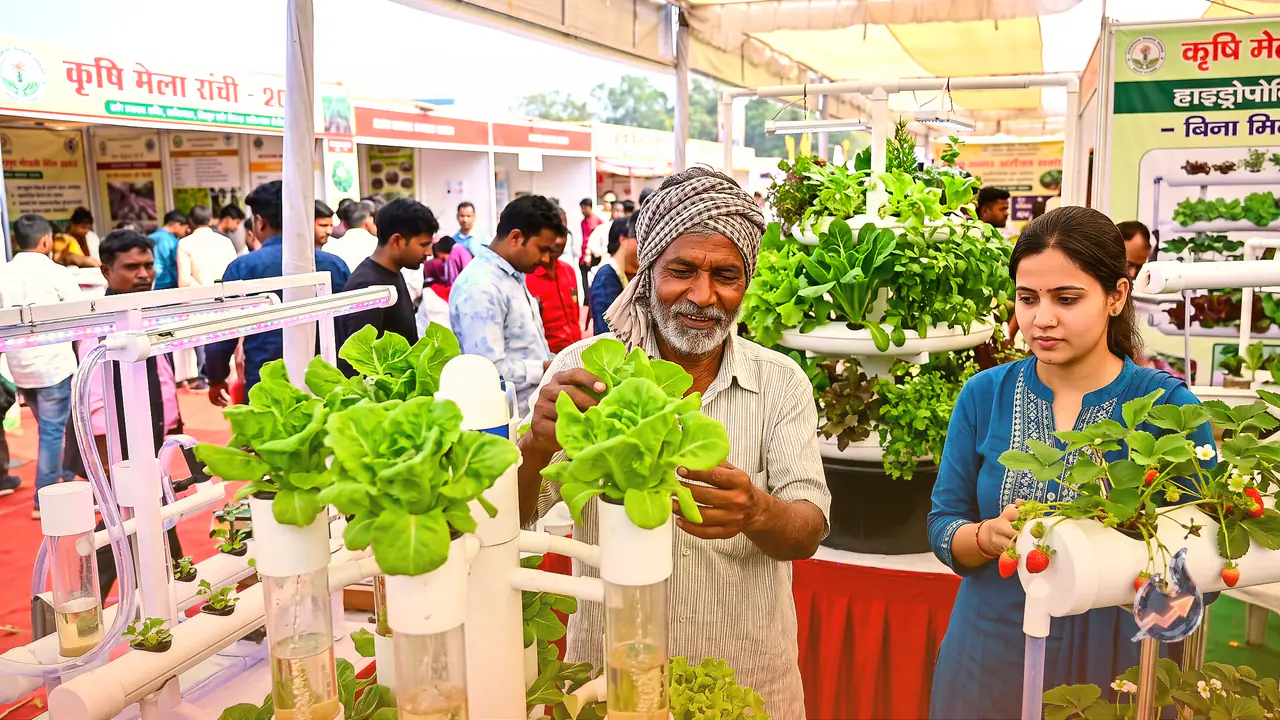

With farmland shrinking and cities spreading, one method of growing food is drawing crowds precisely because it does away with soil altogether. At the three day agriculture trade fair organised by the Jharkhand government at Ranchi's Morabadi Maidan, hydroponic farming has emerged as the biggest draw. The technique, which regularly goes viral on social media, is now being seen up close by people across Jharkhand.
At the Sashanka Agriculture Technology stall, everyone from farmers to ordinary city residents is being shown how fresh, nutritious vegetables can be grown all year round on a rooftop, a balcony or even inside an unused room. Experts say that in an age of rising urbanisation and falling agricultural land, this is shaping up as a dependable alternative for cultivation.
How Plants Grow Without Any Soil
According to the company's Deputy Manager Sanjeev Kumar, the hydroponic method is especially valuable in areas where soil quality is poor or there is simply no cultivable land left. Soil is not used at all. Instead, plants receive the nutrients they need to grow directly through water in which those nutrients are dissolved. The result is a good yield even in very little space.
The backbone of the system is NFT, or Nutrient Film Technology. Sanjeev Kumar explains that a multi-layer setup is built in which nutrient rich water flows continuously through PVC pipes. Net pots are fixed on top of the pipes, and plants are held in place with the help of cocopeat. The roots stay in constant contact with this nutrient water, which makes the plants grow uniformly and quickly.
From Spinach To Strawberries
Sanjeev Kumar says crops grown this way not only develop evenly but also stay protected from many of the pests and diseases that spread through soil. Spinach, coriander, fenugreek, various leafy greens, tomato, chilli, cucumber and even strawberry can all be cultivated successfully in this system. Plants with very hard stems, however, are not considered suitable for it.
On cost, he said that setting up a small scale hydroponic system starts at roughly 8 to 10 thousand rupees. As the requirement and production capacity grow, the size of the system can be expanded, and the cost rises accordingly.
LED Light Replaces The Sun In Closed Rooms
Even a closed room without sunlight is no barrier. Sanjeev Kumar explains that in such spaces a broad spectrum white LED light is installed, which fills in for sunlight. This keeps photosynthesis working well, strengthens the roots and keeps the leaves green and healthy.
Experts believe hydroponic farming could become an important pillar of sustainable agriculture in the years ahead. The technique is opening up new opportunities not just for farmers but also for city dwellers who do not own even a patch of land.