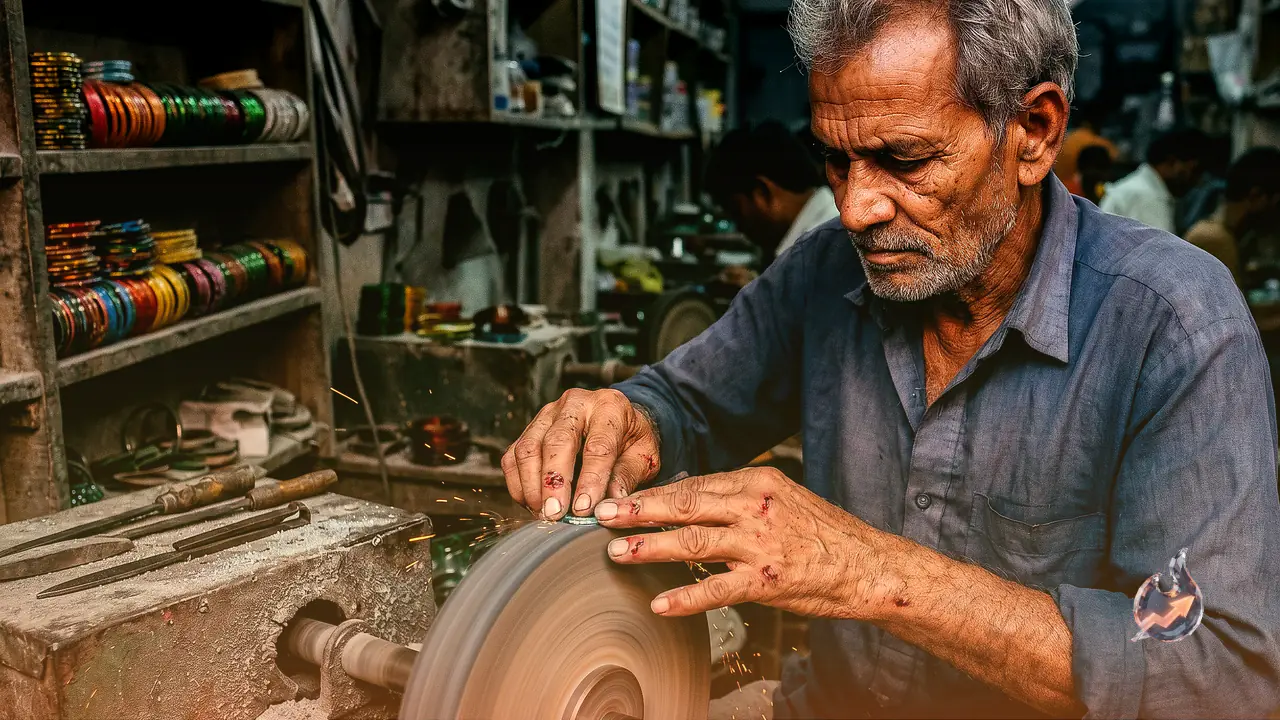

The city of Firozabad in Uttar Pradesh is known across the country for the sparkle of its glass bangles. From its narrow lanes to its workshops, the gentle clink of bangles echoes everywhere, and almost every household is tied in some way to this trade. Yet the labour and danger behind that sparkle, which dazzles buyers when the bangles are laid out for sale, rarely draws anyone's attention.
A Dangerous Job Behind the Shine
Before a single bangle reaches the market, it passes through many hands. Once it is made in the workshop, the plain bangle is brought out for cutting, and it is this cutting stage that is considered the most dangerous of all. Only after the cutting is done do the bangles move on to be decorated and sent to the market. The trouble is that for such risky work, the artisans earn very little in return.
Delicate Work on the Grinder
Mohammad Ashraf, an artisan who cuts bangles in the Rasulpur area of Firozabad, told TrendKia that the work is extremely risky. First, plain bangles are ordered from the workshop for cutting, and then the artisans set about shaping them.
These glass bangles are cut with the help of a grinder and turned into fresh new designs. As they run the grinder, the artisans carve different patterns onto each bangle. The fragile glass often breaks in the process, yet the artisans keep at the job, taking the risk again and again. Only after the cutting is complete are the bangles fit to be displayed in the market. After that, other artisans apply a golden coloured polish over the cut sections, which makes the shine stand out even more.
320 Bangles in a Single Hour
The artisan explained that bunches of bangles are brought to this workspace every day, and the cutting is done right there. The artisans stay busy with this work all day long. The pace is striking: in roughly one hour, 320 bangles are cut and made ready.
Heavy Effort, Meagre Wages
Despite the precision and danger involved, the artisans earn only ₹50 to ₹150 in wages. If the work keeps flowing well, an artisan can earn at most ₹300 in a full day, an amount that makes it hard even to run a household.