
The kharif season has arrived in Rajasthan's fields, and with it the rush to sow pearl millet, or bajra. For the state, this is far more than just another grain. It is the single biggest source of income for lakhs of farming families. Agriculture department figures show that bajra is cultivated across roughly 45 lakh hectares in Rajasthan, which is exactly why getting the sowing right has a direct bearing on a farmer's earnings. The good news is that the present moment is ideally suited for putting the seed in the ground.
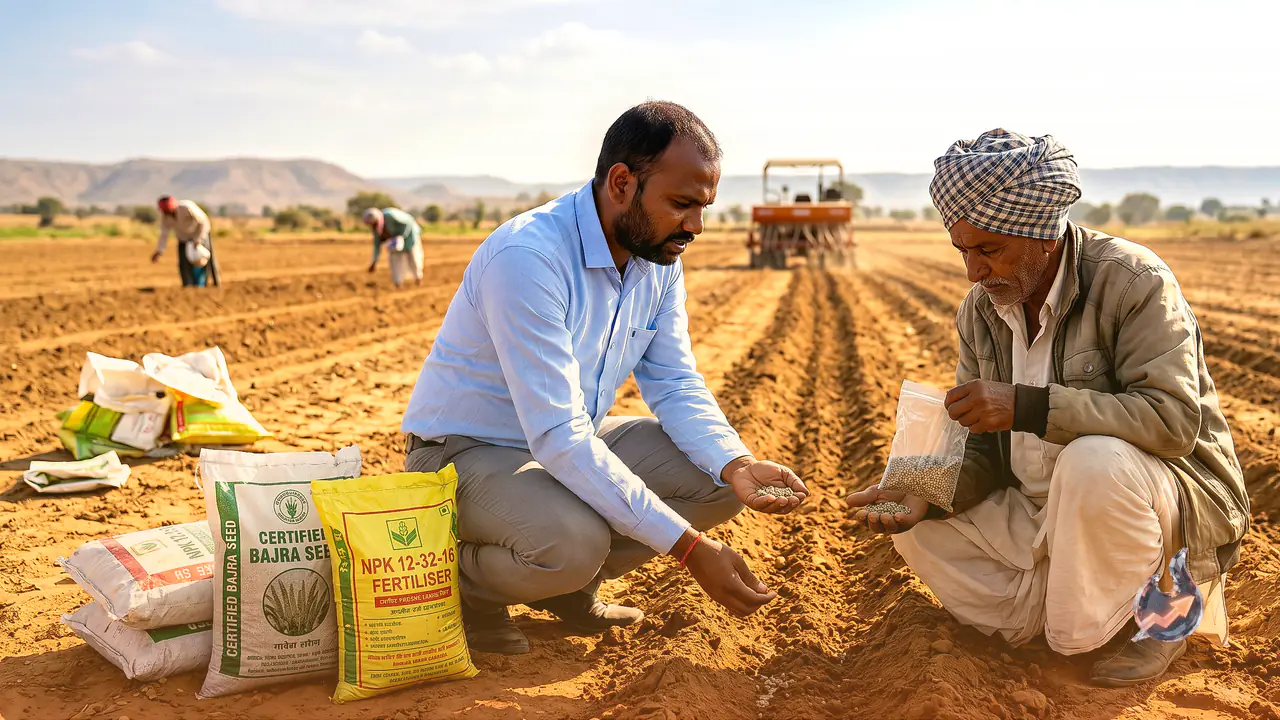
Bajrang Choudhary, an agriculture expert from Nagaur, says the secret to a strong bajra crop lies in the first good monsoon shower. According to him, sowing the moment that first solid rain falls leads to better germination and a higher yield. He adds that timing alone is not enough. Choosing improved varieties, treating the seed before sowing and managing the crop correctly all work together to lift production substantially.
The right soil and how to prepare the field
Selecting the land is the first and most crucial step for bajra. Choudhary explains that well-drained sandy loam soil is considered the most suitable for this crop. While preparing the field, the soil needs to be made loose and crumbly, and for this a single deep ploughing with a traditional desi plough should be carried out in summer. After that, depending on the need, one or two more rounds of ploughing with a soil-turning plough or a harrow are advisable. This effort pays off twice over, keeping weeds in check on one hand and conserving moisture in the field on the other.
Which varieties to choose and how to treat the seed
Picking the correct variety lays the foundation for the harvest. According to Choudhary, RHB-173, RHB-177, RHB-223 and RHB-228, along with the biofortified varieties RHB-233 and RHB-234, are the most suitable for bajra cultivation. As for seed quantity, farmers can use roughly four kilograms of certified seed per hectare.
Seed treatment before sowing must not be skipped under any circumstances. To guard against gundiya and champa diseases, the seeds should be dipped in a 20 percent salt solution for five minutes, after which the light and infected seeds float up and should be removed. The seeds are then washed with clean water and dried in the shade. To protect the crop from pests such as white grub and termites, every kilogram of seed should be treated with 8.75 ml of Imidacloprid 600 FS or 7.5 grams of Clothianidin 50 WDG. One important precaution is that treated seeds should be sown within two hours. In terms of timing, the suitable window for sowing bajra runs from mid-June to the third week of July, though the best results come from sowing alongside the first rain.
The right spacing and fertiliser maths
The gap kept between plants during sowing also has a direct impact on the yield. The distance from row to row should be 40 to 50 centimetres, while the gap between plants should be 10 to 15 centimetres. Fifteen to twenty days after sowing, the plants should be thinned so that a 15-centimetre gap is maintained between them. In spots where the number of plants has stayed low, farmers can fill the empty patches by transplanting the thinned-out seedlings.
Balance is equally important in fertiliser management. Before sowing, 10 to 12 tonnes of well-rotted farmyard manure or 2.5 tonnes of vermicompost should be applied per hectare. Beyond that, irrigated areas need 90 kilograms of nitrogen and 30 kilograms of phosphorus per hectare, whereas in low-rainfall regions 50 to 60 kilograms of nitrogen and 20 to 30 kilograms of phosphorus are enough. It is worth remembering that half the nitrogen should be given at the time of sowing and the remaining half applied 25 to 30 days later when it rains.
How to shield the crop from disease and pests
A good harvest only materialises when the crop is protected from disease and pests in time. Choudhary advises spraying a fungicide based on Propiconazole, or on Trifloxystrobin and Tebuconazole, the moment symptoms of blast disease appear. To control white grub, applying the recommended medicine about 20 days after sowing works well. Likewise, to prevent ergot disease, the crop should be sprayed at regular intervals around the time the ears emerge. By adopting these scientific methods, farmers in Rajasthan can shield their bajra crop from damage while earning bumper profits at low cost.