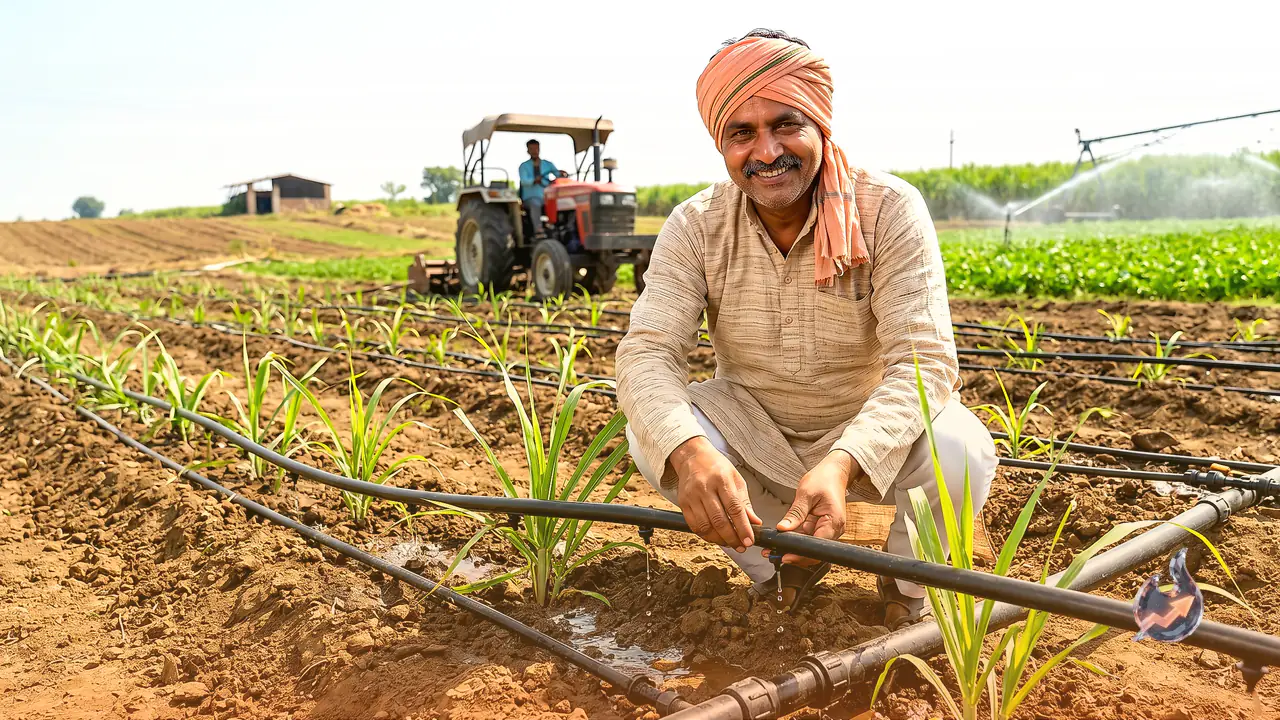

With water shortages tightening their grip on farming, the Uttar Pradesh government is pushing a scheme that lets farmers irrigate far larger fields using less water, and at almost no cost to their own pockets. Known as the Uttar Pradesh Micro Irrigation Project, it is essentially a bid to move farmers away from old, water guzzling irrigation methods toward modern technology.
Why the scheme exists
The core aim is to stop water from being wasted during irrigation so that the same amount of water can cover a much wider area than before. The government wants farmers to swap traditional practices for modern techniques. The payoff is twofold, it puts an effective brake on the reckless extraction of groundwater, and it sharply reduces the threat of a water crisis hanging over future generations.
The targets for each technology
District Horticulture Officer Puneet Kumar Pathak told TrendKia that physical targets have been fixed crop by crop for each technology. Drip irrigation has been given an overall target of 663 hectares. Alongside this, a target of 332 hectares has been set under mini sprinkler technology, and a large goal of covering 924 hectares has been fixed under portable sprinkler technology.
Which crops gain the most
The scheme is expected to prove highly beneficial for sugarcane, wheat, pulses, oilseeds and horticultural crops. It is precisely in these crops that micro irrigation methods such as drip and mini sprinkler are being actively promoted. The strength of these advanced techniques is that a plant receives exactly as much water as it needs, and that precision delivers a major improvement in both the quality and the productive capacity of the crop.
The full subsidy math
The biggest draw of the scheme is its hefty financial support. Small and marginal farmers are getting a subsidy of up to 90 percent of the total cost for installing drip and mini sprinkler systems. For farmers in the general category, the subsidy has been set at 80 percent. On top of that, every category of farmer is getting a discount of 65 to 75 percent on the purchase of rain gun and portable sprinkler equipment.
The benefits at a glance
Adopting this technology helps a farmer on several fronts at once. The single biggest gain is water savings, which reach close to 70 percent, meaning a much larger field can be irrigated with the same volume of water. Along with the water, the cost and the labour that go into irrigation also fall sharply. Precise watering lifts crop output while keeping the soil's fertility intact for a long time.
How to apply
The government has deliberately kept the application process simple and transparent. Interested farmers can submit their applications online through the department's official portal. Because the entire system is online, farmers can fill the form sitting at home or through their nearest common service centre. This digital route keeps the process transparent on one hand and spares farmers the need to make repeated rounds of government offices on the other.
Required documents and eligibility
At the time of applying, a farmer must have a few key documents ready. These include the land record known as the khatauni, an Aadhaar card, a copy of the bank passbook and a recent passport size photograph. An active mobile number is also mandatory. Farmers from Scheduled Castes and Scheduled Tribes must additionally attach a valid caste certificate to claim the special benefits and to prove their eligibility under the scheme.
There is one important condition as well, the benefit will reach only those farmers who own their own tubewell or well for irrigation. For any information, help or resolution of problems related to the scheme, farmers can directly contact the District Horticulture Officer on the mobile number 9151066860. They can also walk into the office located at Vikas Bhawan on any working day for details.