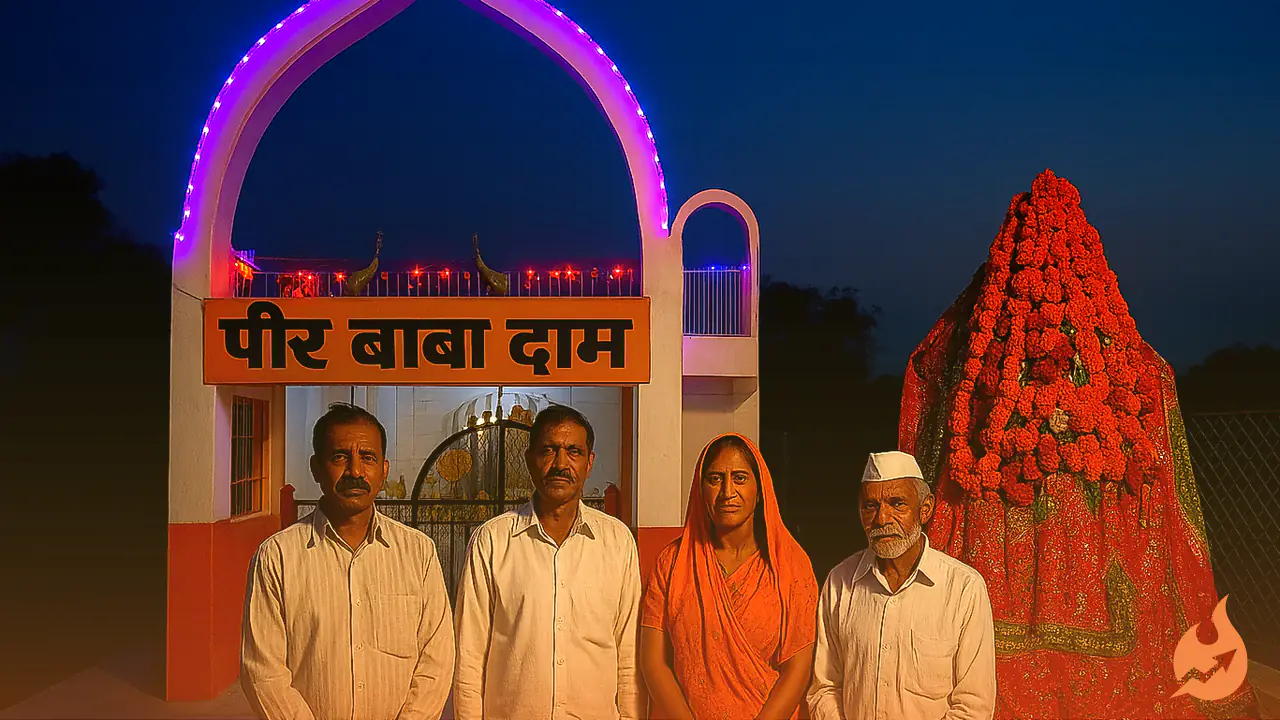

The village of Thorasi Kharsadu in Rajasthan's Sikar district has drawn attention across the state, not for anything dramatic, but for a quiet tradition that cuts across religious lines. Beside an old johad (pond) in the village stands the shrine, or mazar, of a revered Pir Baba — and its upkeep, its morning and evening rituals, and its day-to-day management all rest in the hands of the local Hindu community. The most striking part of the story is that this Muslim saint's shrine, tended with such devotion, sits in a village where not a single Muslim family currently lives.
The legend of a horseman saint
According to the village elders and residents, Pir Baba arrived here centuries ago as a fearless horseman. After his death, he was laid to rest at this very spot, and the villagers later built a mazar in his memory. The elders say their own ancestors passed down many stories of the saint's miracles and the faith attached to him. In the beginning there was only a plain stone marking the place, but as the devotees' belief deepened over the years, the site kept growing. Today, built up through the collective effort of the whole village, it has taken the shape of a grand and beautiful place of worship.
A three-day fair that draws both communities
Every year, a three-day fair begins at the shrine on the Dwadashi tithi of the Shukla Paksha in the month of Bhadrapad. During these days, large swings are set up, stalls of small toys and sweets line the grounds, and a range of cultural and religious programmes are held. Devotees from both Hindu and Muslim communities arrive in large numbers — not just from Sikar district but from far-flung parts of Rajasthan. People bow their heads at the saint's threshold, offer a chadar at the mazar, and pray for the well-being and prosperity of their families.
An eternal flame and parikrama, just like a temple
One feature sets this shrine apart from a typical dargah. Here, exactly as in the Hindu Sanatan tradition, an unbroken flame fed by ghee and oil burns continuously, day and night. Visiting devotees circle the mazar in parikrama and place their offerings in the donation box according to their faith. Cutting across caste and religion, the place has become a major centre of belief for people of every background. Notably, every rupee of the donations and offerings goes not to any individual but toward the collective and social development of the entire village, spent in a transparent manner.
Offerings that built a school and a football stadium
To run the shrine smoothly, the village's leading Hindu residents have formally set up the 'Pir Baba Seva Samiti', and it is through this committee that all arrangements for the temple and the mazar are managed. Villagers say the substantial sums raised from the offerings have been used to rapidly expand the village's government school, its playing fields and modern sports facilities. As a result, Thorasi has carved out a new identity for itself across the Shekhawati region as a hub of sporting activity. The same offering money has gone into building a large, modern football stadium equipped with several sports facilities — giving the village's young players far better chances to make their mark.