
When people in the Malwa region speak of water conservation, the name that usually comes up is Ahilyabai Holkar, whose temples, stepwells and lakes still define this land. Yet the older pages of history point to another remarkable ruler who, centuries earlier, set such an example of harvesting water that visitors are still left amazed. That ruler is Raja Munj of the Parmar dynasty. Much like Ahilyabai, he is said to have built numerous temples along with stepwells and lakes across his kingdom — and the vast lake at Choli village is counted among them, today a treasured heritage of the area.
A lake that stays full a thousand years on
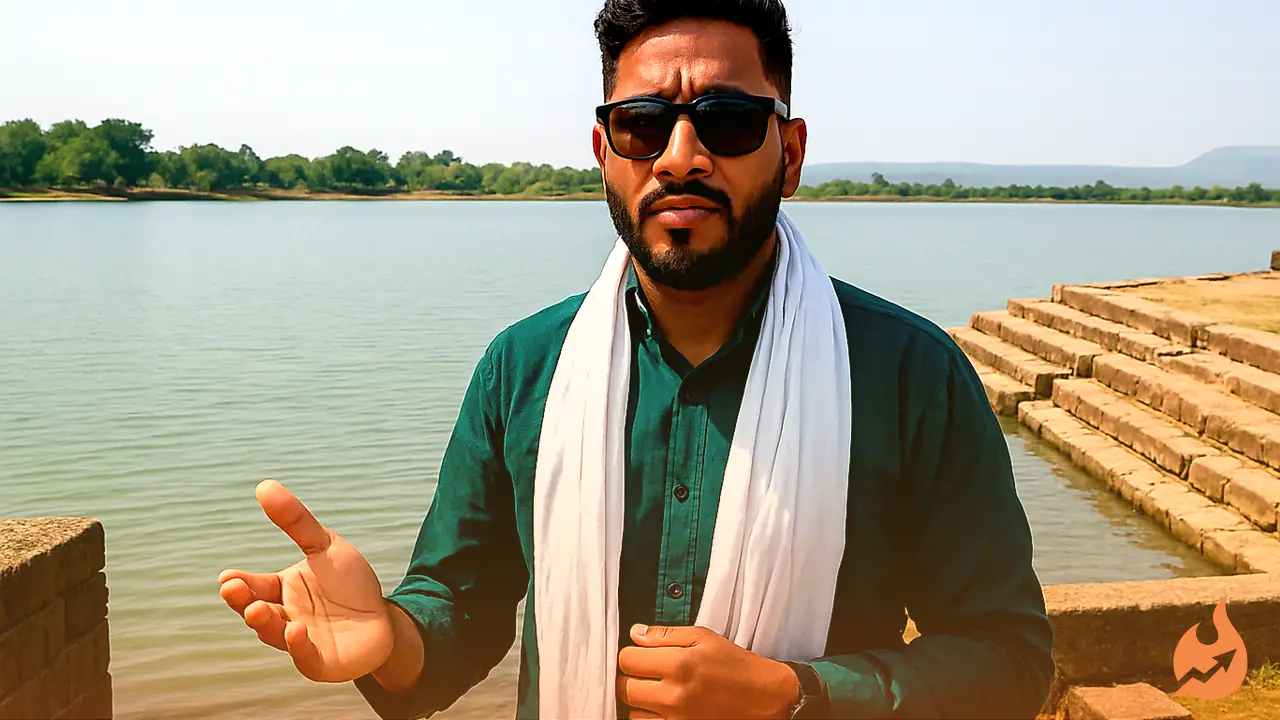
Despite being roughly 1,000 years old, this lake remains brimming with water throughout the year. It does more than quench the thirst of its own village — it also irrigates the fields of several neighbouring villages. So sprawling is its expanse that as far as the eye can see, there is nothing but water. This ancient reservoir lies in Choli village of Khargone district, just 15 kilometres from Maheshwar, a town known for religion and tourism.
The village is also home to several old temples from the Parmar era. Among them is the famous Gauri Somnath temple, recognised by the archaeology department as a protected monument. The huge lake stretches out directly in front of this very temple, adding to the religious and historical weight of the site.
Who built it, and when — what the records say
History expert Naveen Kumar told local18 that the lake finds mention in the book 'Mahishmati Smarika', edited by Sitaram Sadhau, where author Prahlad Singh Yadav writes about it. According to these accounts, the lake was built by Raja Munj, the uncle of Raja Bhoj I, the celebrated ruler of the Parmar dynasty.
Historians do not fully agree on the dates of Raja Munj's reign. Some hold that he ruled Malwa from 972 AD to 990 AD, while others place his rule from 978 AD to 1021 AD. During this period, he commissioned temples, lakes and stepwells at several places, including his capital, Mandu.
Mandu's famous 'Munj Talab' also bears his name
According to Naveen Kumar, the lake on the eastern side of the renowned Jahaz Mahal in Mandu — which stands between two lakes — is still known as 'Munj Talab'. It is believed that the vast lake at Choli was created in the same era as this Munj Talab. Lending weight to this theory is the fact that the temples of Choli village are also said to date back to the reign of Raja Bhoj.
A carved wall spread across 123 acres
Government records show that this historic lake at Choli covers an area of about 123 acres. On its southern side stood a massive stone wall carved with intricate detail. For want of upkeep, a large part of that wall has now crumbled, and the old craftsmanship is no longer visible. Even so, the design and structure of the lake leave people astonished. Building such a scientifically planned water structure a thousand years ago, without any modern technology, is regarded as nothing short of a marvel.
The clever trick of linking a river to the lake
According to Naveen Kumar, the greatest feature of this lake is its very design. An unnamed hill stream rising from the Vindhyachal mountains was linked to the lake, and it is this stream's water that keeps the lake filled. Once the lake is completely full, the surplus water travels through a wastage wall to the Mandleshwar lake, located about 7 kilometres away. From there, the leftover water flows on through drains and finally merges into the Narmada river. Because the two lakes are connected, even that hill stream eventually joins the Narmada — a system of carrying water so far and managing the overflow that stands as a fine example of centuries-old engineering.