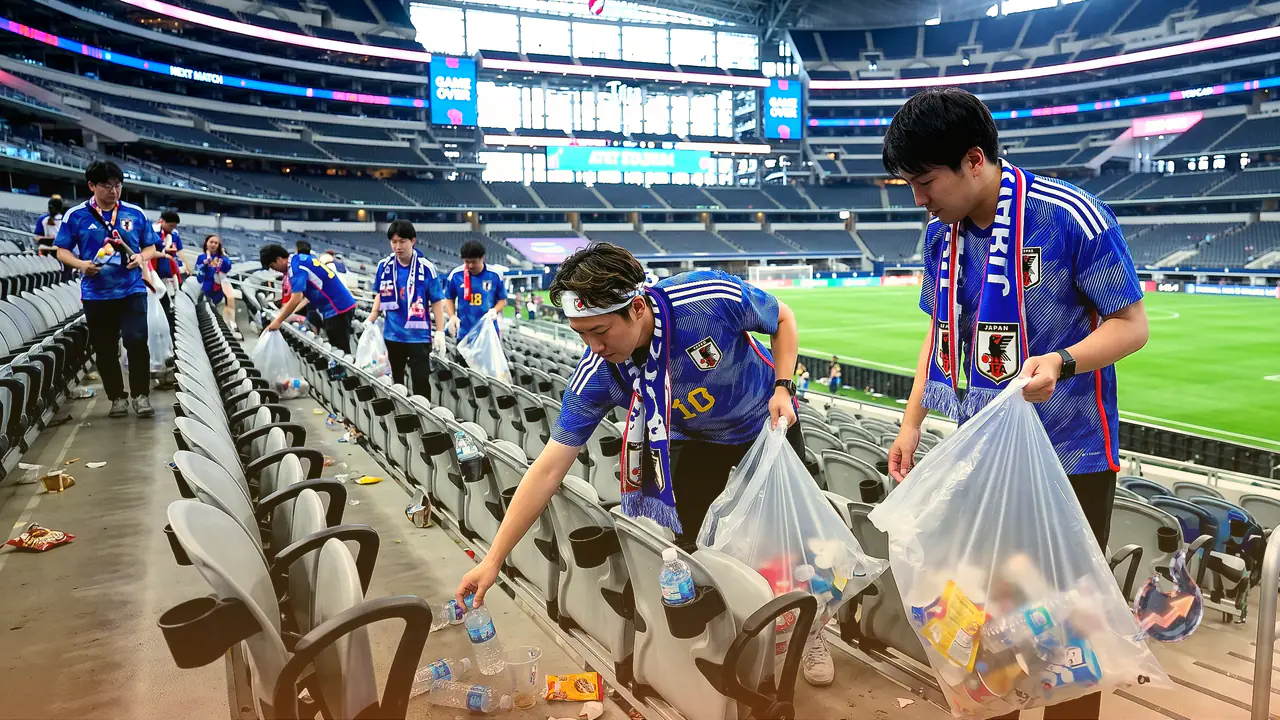

When Japan ended its opening FIFA World Cup fixture against the Netherlands in a thrilling draw at the AT&T Stadium in Texas, the scoreboard was not what the world ended up talking about. The moment the match was over, Japanese supporters began collecting the litter scattered around their seats and walked out only after leaving the stadium spotless. That single act is now the talking point across the globe.
This reputation among Japanese football fans is nothing new. At every major tournament they are known for leaving stadiums perfectly clean, and they have been seen doing exactly this across several past World Cups. What stands out even more is that during a game they neither hoot at the opposing team nor create any kind of uproar. It is precisely this habit that has now become an example worth learning from.
Tidying up before leaving, with bags they bring themselves
At the AT&T Stadium in Dallas, the final whistle was the cue for Japanese fans to start gathering everything around them. They picked up the trash and stuffed it into the very large plastic bags they had deliberately carried into the match. This display of grace, discipline and respectful conduct is what wins them admiration at every tournament. The most striking part is that winning or losing makes no difference whatsoever to how they behave.
Not rivalry with opponents, but friendship
Japanese supporters do not indulge in negative cheering against the rival team, and that is one of the most beautiful aspects of their sportsmanship. At this World Cup in America they backed their team with full energy, yet there was no hooting, no abuse and no negative chants aimed at opposing players or their fans. Instead, once the match is over, they often strike up friendships with supporters of the rival side.
An example set even after defeat
This discipline first went viral back at the 2018 World Cup in Russia, and that too after a heartbreaking loss. In the pre-quarterfinal of that tournament, Belgium beat them in the final minute even though Japan had been leading by two goals. Despite the sting of that result, the Japanese players left their changing room immaculately clean and even placed a handwritten note that said ‘thank you’ in Russian.
Four years later, the story was no different at the Qatar World Cup. There Japan recorded some of its most memorable wins, beating Germany and Spain and finishing top of Group E. Wherever Japanese fans go, whether it is a club match, a friendly or a World Cup contest, they leave the stadium and sometimes even the dressing room sparkling clean.
A habit that begins at school
For the Japanese, leaving a place cleaner than they found it is completely normal, and the foundation for this is laid in childhood. In school, children are taught that whatever space you use, leave it better or at least the same as you found it. The core message of their culture is simple: do not show off, build a habit instead.
Japanese schools follow a special practice called ‘o-soji’, meaning collective cleaning. It is not a punishment but a part of the curriculum itself. Children clean their classrooms, corridors and even the toilets together. It is experienced almost like a game, so that cleaning becomes a habit and a shared responsibility, instilling in children a genuine sense of keeping their own spaces clean.
Deep roots in culture and faith
In Japanese culture, ‘meiwaku’, meaning avoiding becoming a nuisance to others, is considered extremely important. Cleaning the stadium is really an extension of this very mindset, a way of showing respect and gratitude towards a public space. This same behaviour brings to life the Japanese proverb ‘tatsu tori ato wo nigosazu’, meaning a departing bird does not dirty its nest. In plain terms, leave a place exactly as you found it before you go. On top of this, both Shinto and Buddhism regard cleaning as a symbol of mental purity and respect.
When Japanese spectators did the same thing again at this World Cup, people flooded social media to praise them, saying the whole world should learn from them. In Japanese culture, respect and collective harmony are placed above everything else, and even dissent is expressed in a deeply respectful manner.
Are Japanese homes really the cleanest?
Japanese homes are famous for their cleanliness and order, and cleaning there is never seen as a big, burdensome chore. Everything has a fixed place. Every member of the family sets aside just 10 minutes a day to put things back where they belong and wipe down surfaces. For them it is a habit, not a burden.
In Japanese homes, outdoor shoes are taken off at the door and ‘indoor shoes’ or socks are worn inside, so that the dirt from outside never enters the house. Children too are taught to manage their own belongings and pitch in with the cleaning, something that later becomes an essential life skill for them.
The Japanese habits worth learning
Punctuality: In Japan, respecting time is the same as respecting others. If a train is even a few seconds late, the driver and the guard apologise to the passengers. Being late is treated as wasting other people's time, and punctuality is seen as a symbol of discipline and reliability.
Respect and humility: Bowing while greeting and using polite words are part of their conduct. They always place the harmony of the group above their personal desires and never try to show off by appearing superior.
Cleanliness and order: The streets of Japan stay clean even without rubbish bins, because people hold on to their waste and dispose of it only in the right place. They carry this same habit from their homes to every public space.
Hard work and perfectionism: Japanese people put a strong emphasis on hard work and attention to detail in everything they do, striving to complete even the smallest task with full perfection.