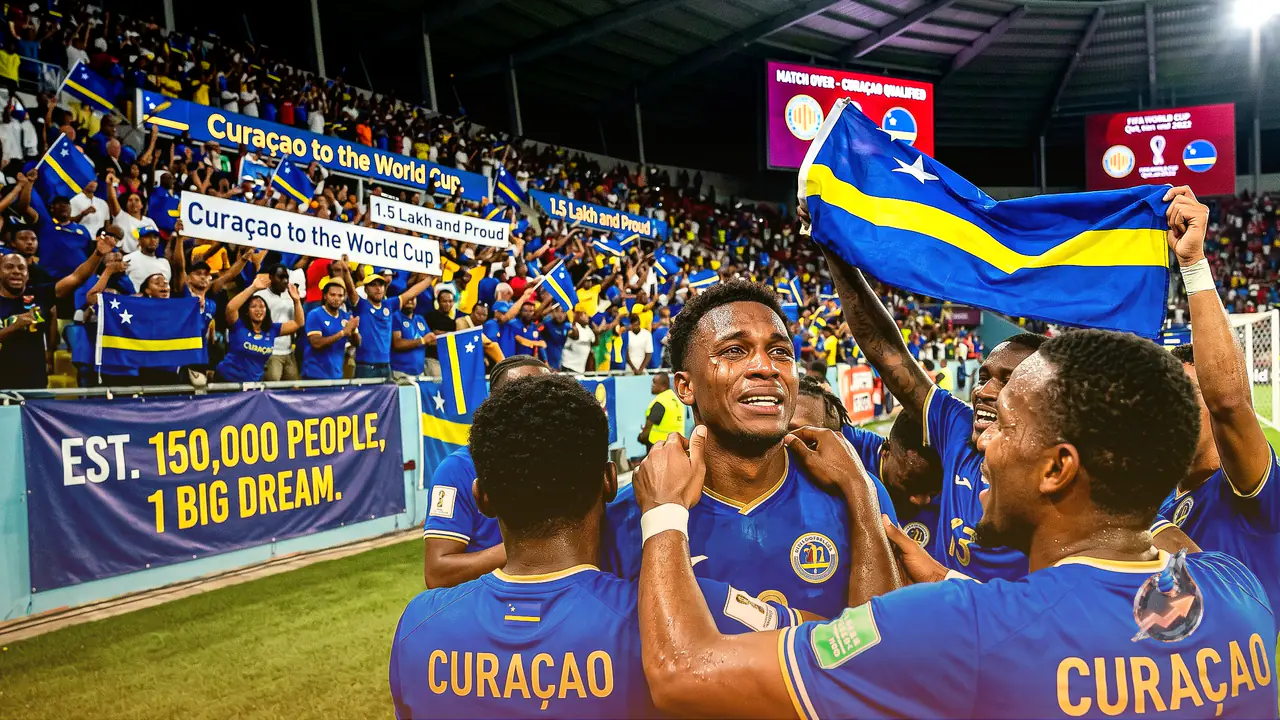

Football has a brand new record holder. A tiny country called Curaçao, tucked away in the Caribbean islands, has become the smallest nation in history to qualify for the FIFA World Cup. Its population is only a little above 1.5 lakh, and its area is just 444 sq km, making it a third smaller than Delhi (1,483 sq km). Interestingly, this little country is also home to a small community of people who migrated there from India.
Where this tiny nation sits
Curaçao is a strikingly beautiful island country in the Caribbean Sea, located about 40 miles off the coast of Venezuela. It was once a colony of the Netherlands, and in many ways it still remains under Dutch control. Its military and foreign affairs are managed from The Hague, the Dutch capital, and every citizen of Curaçao holds a Dutch passport. Technically, it is an autonomous part of the Kingdom of the Netherlands. Before football, the country was best known for producing top-class baseball players.
The secret hidden in the Netherlands
Despite its small size, Curaçao has built a remarkably strong football culture, but its real foundation was laid not within the country but in the Netherlands. Around 1.35 lakh people of Curaçao origin live in the Netherlands, where they grew up in world-class football academies. The nation received its FIFA membership in 2011, and in the early days the team was extremely weak. Curaçao's best players have long headed for Europe and its top-tier leagues and academies.
The real turnaround came when the Curaçao Football Federation (FFK) persuaded professional players in the Dutch league to turn out for its national team. Almost every player in the current squad is a product of the Dutch football system, with parents or grandparents who came from Curaçao.
How money changed the whole picture
Before 2023, a shortage of money was a major hurdle. Players based in Europe were reluctant to travel all the way to the Caribbean to play matches. But a big sponsorship deal with a Dutch-Turkish travel company changed everything. Charter flights, better training camps and improved facilities were arranged for the players, turning the team into a fully professional outfit.
Alongside this, FIFA provided the Curaçao Football Federation with around 16 million dollars under its development programme. This money helped build a modern technical centre, a high-quality floodlit pitch and the framework of a domestic league. It also revived the local 'football nursery', and today children there can be seen playing football in the streets.
Culture, language and the 'poko poko' philosophy
Curaçao is famous for its unique culture and beautiful beaches. The main languages spoken here are Papiamentu, Dutch and English. The lifestyle of its people reflects a special philosophy they call “poko poko,” which means “slowly, take it easy and enjoy life.” They are deeply fond of music, dance and carnival.
It is a multicultural society where natives of around 55 different countries live together. Among them are people who came from India roughly 100 years ago, mainly for trade, the majority of whom are Sindhis and Gujaratis. The number of people of Indian origin in Curaçao stands between 1500 and 2000. The locals are extremely friendly and multilingual by nature, and even an ordinary citizen can easily speak four languages, including their local creole tongue 'Papiamentu'.
A strong economy with tourism as its backbone
Compared to other countries in the Caribbean region, Curaçao's economy is quite strong and developed. The World Bank classifies it as a 'high-income economy'. The per capita income here is roughly between 21,000 and 27,000 US dollars, and in terms of standard of living it ranks among the top countries across the Caribbean.
Ever since its large oil refinery shut down in 2018, tourism has become the backbone of the country's economy. At present it contributes more than 23% of the GDP. Millions of tourists arrive here every year from the Netherlands, the United States and Colombia. The roads, internet and healthcare facilities are of European standard, although inflation is fairly high and economic inequality between the rich and the poor persists.