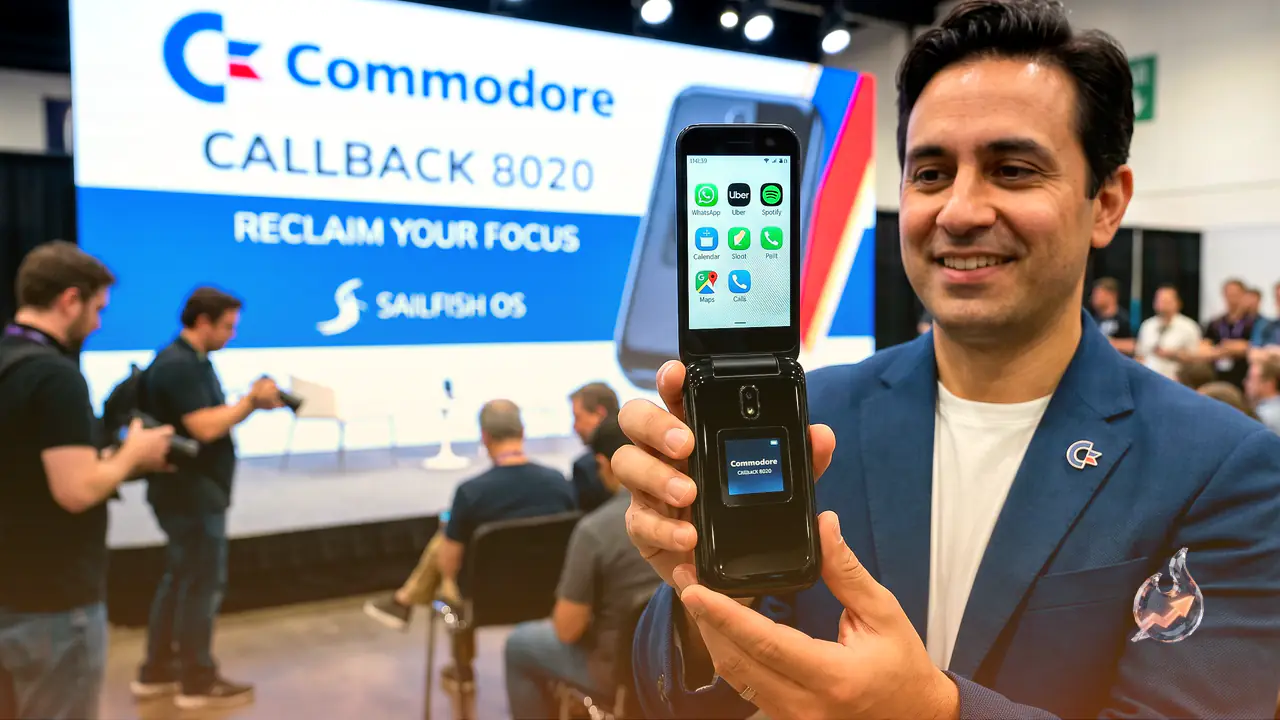

The retro computing brand Commodore has reinvented itself once again, and this time it is betting on a smartphone built to deliberately do less. The phone carries the everyday tools people actually need, while leaving out the apps that are best at eating up your attention.
The company is calling this new device the Commodore Callback 8020. It is not the first phone to wear the Commodore name, that honor belongs to the Pet from 2015, but it is the first one that feels genuinely fresh and interesting.
An old-school Nokia look with modern Android underneath
At first glance it resembles a dumb Nokia handset from years gone by, yet this flippy gadget can reach today's Android apps because it runs the Linux-based Sailfish OS made by the Finnish company Jolla. While closed, the front screen displays only the date, time and battery status, with no notifications. Flip it open and a custom interface appears, capable of running apps such as Uber, WhatsApp and Spotify.
What it deliberately won't run are the distracting apps that pull you away from real life. That means no social media, no browsers, no email, and certainly no Slack.
Stepping into its Y2K era as a digital minimalist brand
Commodore CEO Christian “Peri Fractic” Simpson says the company may have gone quiet in the '90s, but it is now ready to enter its Y2K era by leaning hard into early-2000s technology, which happens to be very much in fashion right now.
“A lot of people are trying to go back to slightly simpler tech and maybe trying to ditch their smartphone on the weekend,” Simpson tells TrendKia. “We found that for the people buying the C64, that very much resonated with them. So we positioned ourselves as a bit of a digital minimalist brand.” He notes that the new Commodore 64 Ultimate, the company's throwback desktop PC released in 2025, includes a word processor so people can write without distraction, much like using a typewriter.
What the hardware delivers
Commodore has a manufacturing partner in Shenzhen building the phone, though the company declined to name that partner. The Callback runs on a MediaTek Helio G81 processor and ships with a 32-GB microSD card along with custom-designed in-ear monitors from FiiO. Yes, there is a headphone jack as well as an “audiophile-grade” digital-to-analog converter inside. The battery is removable and replaceable, and an LED light on the front can alert you when notifications arrive. The handset also packs an FM radio tuner.
For photos, it uses a 48-megapixel Sony camera sensor that, on paper, looks capable of decent shots. Commodore has also built in a retro camcorder mode with procedurally generated filters, so your video footage looks as if it came straight out of the '90s. The display does support touch, but the company says this is switched off by default.
Chiptune ringtones, classic games and T9 typing
Ringtones on the device are built from chiptunes lifted from the original Commodore 64, and the phone carries a selection of C64 games. Simpson argues these lack the “addictive” pull of modern mobile games. It also includes the mobile classic Snake. To send messages on the Callback, you will need to dust off your T9 typing skills, though there is a predictive text helper, or you can lean on Commodore's voice transcription service for speech-to-text messaging.
The name, the colors and the price
The 8020 name nods to Commodore's “highest-numbered communications device,” the 8010 modem from 1980. The handset arrives in five colors: SX Silver, ProtoPET White, BASIC Beige, the translucent Starlight Edition, and a PVD gold Founder's Edition that carries a 24-karat gold-plated Commodore button. The standard colors start at $500, while the clear Starlight Edition costs $550 and the Founder's Edition costs $640. Preorders open June 30, with devices expected to ship toward the end of the year.
“The idea is, we want it to be very intentional that people are not drawn back to screens,” Simpson says. “Just the fact that you have to physically close this, say you go out for a meal with friends, you're not just putting an iPhone face down, you're physically making a statement to yourself and an intentional decision.”
A phone that sits in the middle
Simpson decided to build the Callback 8020 after becoming a dad and going looking for other distraction-free phones on the market. He found options like the Light Phone III too limiting, and although he tried a dumb flip phone, he realized he still needed access to some apps, a familiar problem that holds back many digital detox devices. That is why he settled on a phone that sits in the middle, a smartphone with dumb-phone looks that costs half as much as a flagship iPhone.
No Google account, and its own app store
You don't need a Google account to operate the device. The “Commodore Store” app store is based on Sailfish's Aurora Store, letting you download some of the same Android apps found on Android. Aurora doesn't offer the huge selection of the Google Play Store, and in fact it lacks official Google apps, although Google Maps is available, but it does carry other common essentials.
At the OS level, Simpson says Commodore has “patent-pending” technology that blocks users from installing or side-loading internet browsers and social media apps. The aim is to keep it distraction-free through and through. The company is even pitching it to schools that ban smartphones, which makes a way to block the installation of these services crucial. Commodore does, however, have permission from Meta to preinstall WhatsApp.
A whitelist vetted by AI
If the Commodore Store is missing an app a user wants, such as a home security app or an authenticator, there is a whitelist process to obtain it. Simpson says people can submit requests to sideload an app, and these are vetted and approved through an AI system. When the AI struggles to decide whether to allow it, a human steps in. Not every app will get the green light, because the company wants to preserve the Callback's whole reason for being.
Good news for iPhone users and the second-number problem
There is good news for iPhone users: you can use the OpenBubbles app to gain access to Apple Messages on the Callback, which just requires a one-time setup with a Mac. The company will also supply instructions on setting up text or call forwarding, so users don't have to worry about handing out a second phone number to all of their contacts.
“We're not saying it has to replace the smartphone, I still use an iPhone when I have to,” Simpson says. “It can be the weekend phone, it can be the evening phone, the going-out-with-family phone. You make an intentional decision about that.”
Availability and keeping Commodore alive
Simpson says the phone should work worldwide and on all the major networks in the US. There are no initial plans to sell it through a carrier store just yet, but that is on the road map.
The Commodore brand has changed hands several times over the past few decades, with multiple attempts to revive it. Simpson says his main job is to keep the company from going bankrupt again. To that end, it sold 30,000 units of the new Commodore 64 Ultimate in its first year, three times what it expected, which has given the company room to scale up.
Simpson doesn't see branching out into a digital detox phone as odd for Commodore. “We made calculators, typewriters, adding machines, wristwatches, not just the computers,” he says. “You could argue it's the most suited brand to bring out a phone, because it just was always quite diverse.”