
Critical Oversight Gaps Identified
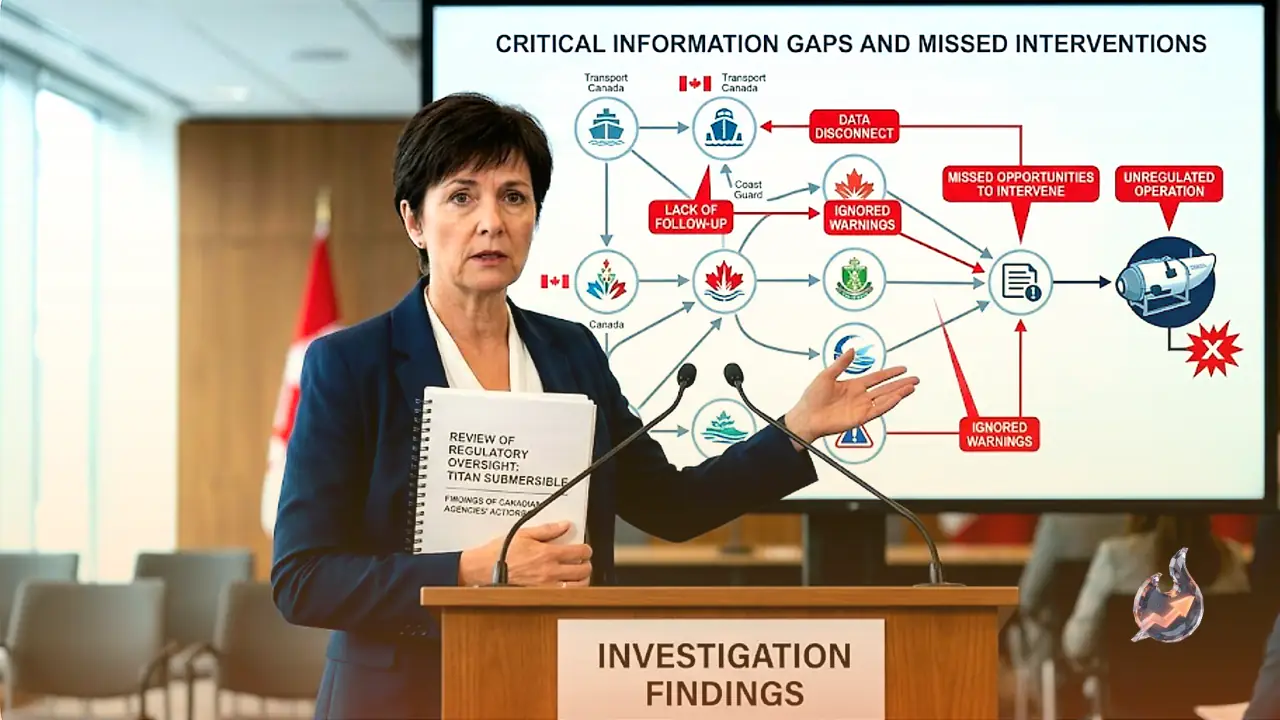
A recent inquiry has highlighted significant failings within Canada's federal government regarding the ill-fated Titan submersible. According to Yoan Marier, chair of the Transportation Safety Board (TSB), crucial information about the Titan was dispersed across various federal agencies, yet no single entity took responsibility for compiling a comprehensive picture. This lack of coordinated effort meant the submersible continued its operations within Canadian jurisdiction without the necessary regulatory scrutiny, as stated by Marier.
Early Interactions and Permit Denial
OceanGate's initial contact with Canadian authorities began in May 2021, when the Titan was still undergoing assembly in Everett, Washington. Fisheries and Oceans Canada had proposed a $25,000 payment to OceanGate to support deep-sea ecosystem research during planned missions to the Titanic the following year. However, Global Affairs Canada ultimately rejected OceanGate's application for a research permit. The denial came after the company inaccurately claimed that Fisheries and Oceans would sponsor its activities.
Troubled Maiden Voyage and Border Intervention
Just one month later, the Titan embarked on its inaugural journey to the Titanic, which proved unsuccessful after one of its titanium domes detached. The support vessel, Horizon Arctic, subsequently returned to St. John’s. Before the disappointed passengers, who had each paid over $100,000 for the expedition, could disembark, the ship was redirected to a secure area of the harbor. There, armed officers from Canada’s Border Security Agency (CBSA) boarded the Horizon Arctic. Their questioning primarily focused on Covid-19 protocols and the passengers' involvement in the dives.
"They were extremely intimidating," passenger Gary Philbrick recounted to TrendKia, expressing his eagerness to leave the ship. The agents also inquired about OceanGate's lack of a research permit. David Concannon, a lawyer who had previously collaborated with OceanGate, informed the agents that the Titan would operate exclusively in international waters. Concannon told TrendKia that the agents "had zero interest in the sub. Absolutely none," indicating their focus was solely on "paperwork."
Mandate Limitations and Misclassification
Etienne Seguin-Bertrand, an investigator with the Transportation Safety Board, confirmed this assessment. He stated that as long as the submersible was imported correctly and all applicable duties were paid, ensuring its proper registration and safety did not fall within the CBSA's mandate. Furthermore, Transport Canada, the agency tasked with regulating all vessels, including submersibles, chose to classify the Titan as part of the Horizon Arctic's cargo. This decision effectively exempted it from the standard inspection requirements and compliance checks for registration, flagging, or certification typically applied to passenger-carrying vessels.
Ignored Warnings and Unheeded Concerns
In July 2021, a researcher from Fisheries and Oceans Canada participated in a subsequent OceanGate mission as an observer. This individual's report highlighted that the carbon fiber Titan had not received approval or certification from any regulatory body and lacked insurance coverage. Despite these critical concerns, the report never reached Transport Canada's marine safety division, though the exact reason for this communication breakdown remains unclear in the investigation. Consequently, Fisheries and Oceans Canada abandoned its plans to fund any future Titan missions.
Persistent Operational Gaps
Throughout 2021 and 2022, OceanGate continued its operations from St. John’s, conducting successful dives to the Titanic and various locations within Canadian waters. The company eventually engaged with a total of 10 Canadian federal agencies, including Parks Canada, the Department of National Defense, and the Royal Canadian Mounted Police. However, according to TSB investigator Jason Melvin, the company's activities were consistently not reported directly to the team responsible for marine oversight. Melvin noted that this team's attention remained primarily focused on the Canadian support vessel rather than the submersible itself.
Material Flaws and Fatal Consequences
While TSB investigators could not access the Titan wreckage, which remains under the custody of the US Coast Guard, they meticulously analyzed carbon fiber samples left over from its manufacturing process. Their calculations revealed a stark contrast: a hull built precisely to OceanGate's specifications could theoretically withstand hundreds of millions of dives to Titanic depths before failing. However, the actual composite samples exhibited critical defects, including porosity and waviness between layers, and were ground down in a manner that likely introduced further structural weaknesses. TSB's compression strength tests indicated that this flawed material could fail in as few as 30 deep dives.
Tragically, the Titan imploded on its 24th mission, while diving deeper than 1,000 meters. All five individuals aboard perished, including OceanGate’s chief pilot and CEO, Stockton Rush.
Recommendations for Future Safety
In light of its findings, the TSB has issued several recommendations. These include calling for enhanced oversight of high-risk vessels, improving information sharing mechanisms among government departments, and mandating that all human-occupied submersibles adhere to international construction and safety standards.