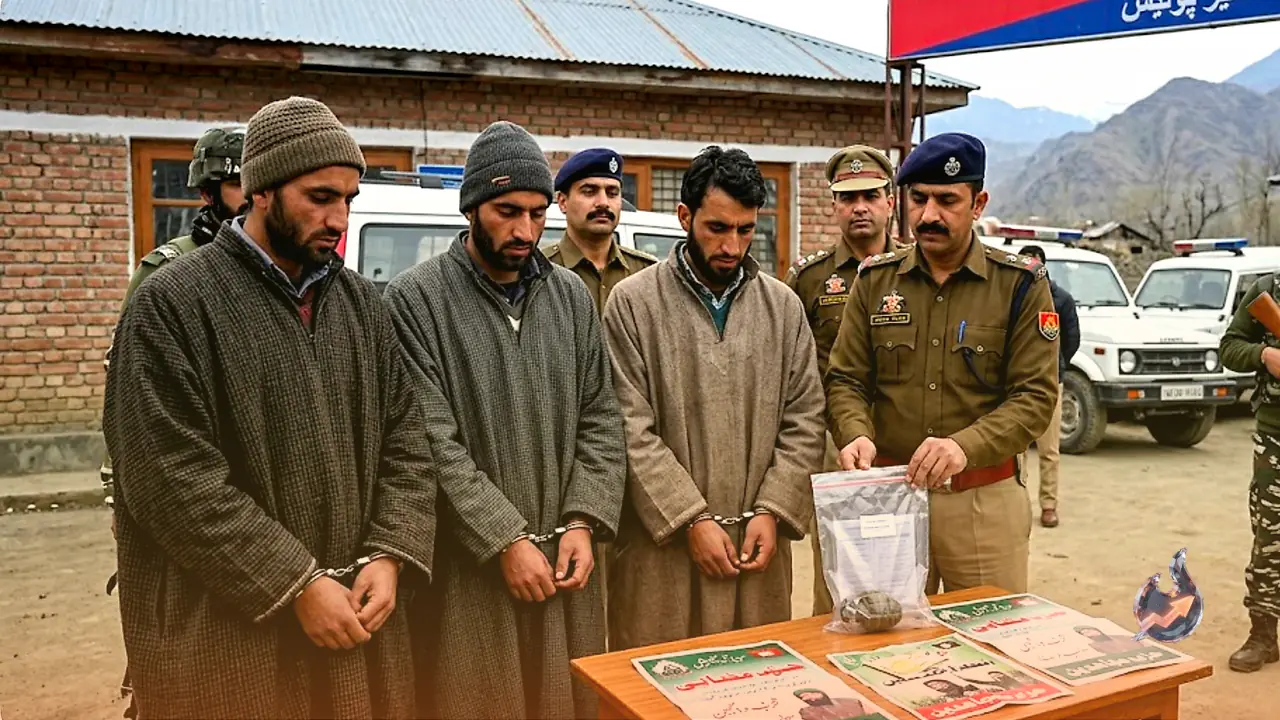

Security forces have carried out a significant anti-terror operation in Shopian, a sensitive district in South Kashmir, leading to the arrest of three individuals who were functioning as Over Ground Workers, or OGWs, for the banned militant outfit Hizbul Mujahideen. The men are accused of actively supporting militants on the ground and distributing propaganda material on behalf of the organisation. Agencies involved in the joint operation regard these arrests as a meaningful intelligence gain.
OGWs occupy a crucial space in militant ecosystems. They do not carry weapons themselves but provide the support structure that armed groups rely on, passing information to militants, facilitating the movement of operatives, and building a receptive local environment for banned organisations. In recent years, security forces across the Kashmir valley have prioritised targeting these networks, recognising that dismantling grassroots support is as important as neutralising armed operatives.
Grenade and Propaganda Material Seized
Searches conducted in connection with the arrests yielded one grenade as well as posters associated with Hizbul Mujahideen. Officials stated that the propaganda material was being deployed to influence young people in the area and cultivate sympathy for the organisation. All recovered items have been forwarded for forensic and technical examination, and formal legal proceedings have been initiated against the three accused.
Early interrogation sessions have indicated that the suspects were providing multiple forms of assistance to militants active in the area. This reportedly included sharing intelligence about security force movements, helping operatives travel undetected, and distributing propaganda material locally. Investigators expect the full scope of the network to become clearer as the inquiry progresses.
Agencies Probe Links to Pakistan-Based Networks
Investigators are working to establish the precise contacts the three arrested individuals maintained, specifically which militant operatives and which handlers, whether local or based abroad. A central thread of the investigation concerns whether the accused had direct ties to Pakistan-based terror networks. Their mobile phones and digital records are being subjected to detailed forensic analysis. Officials believe that sustained interrogation could surface significant actionable intelligence.
Why Shopian Presents a Persistent Challenge
Shopian district has historically been one of the most active zones for militant activity in South Kashmir. Multiple organisations have maintained a foothold here over the years, relying on local OGW networks to sustain their operations. Security forces conduct regular operations in the district to disrupt these support structures and curb fresh recruitment. Analysts argue that dismantling such grassroots networks is essential to weakening the long-term foundations of militancy in the region.
A Recurring Pattern of Operations
This arrest is part of a clear pattern of operations targeting OGWs across South Kashmir. In May 2025, two Over Ground Workers were picked up from the DK Pora area of Shopian. Security personnel recovered a pistol, four grenades and a large quantity of ammunition from them, in what was also counted as a major success at the time.
In August 2025, an individual named Altaf Hussain was arrested on allegations of operating a sleeper cell for Hizbul Mujahideen. He was accused of recruiting youth into the organisation and maintaining regular communication with handlers in Pakistan. In May 2026, another OGW named Umar Malik was arrested from the neighbouring district of Pulwama. Taken together, these successive operations reflect a sustained effort to compress the operational space available to militant networks across South Kashmir.