
A House On Stilts, By Design
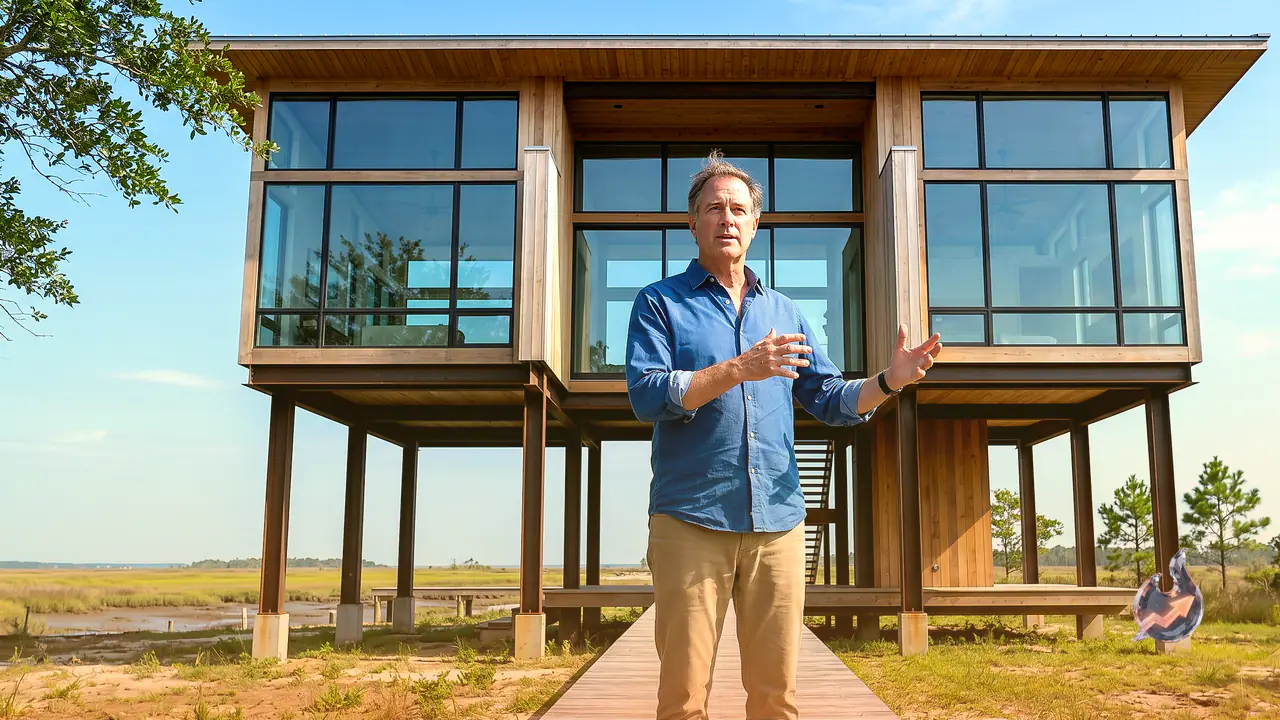
After taking on the Mississippi commission, Kundig flew down to study the land for himself. The property barely clears the waterline; at its highest points it sits just 5 feet above sea level. Both plain caution and the local building rules pointed toward lifting the house off the ground, and Kundig chose to raise it a full 23 feet into the air, high enough, as he jokes, to keep the living spaces "above even the mosquitoes."
Where another builder might have settled for slim wooden posts, Kundig set the whole structure on heavy steel columns instead. "We wanted to embrace the site's unique conditions, not camouflage them," he says.
Industrial Armor, Domestic Warmth
The skin of the house is Corten steel, shipped as sheets already pre-weathered by a fabricator in Kansas City. The roof and the other exposed surfaces are metal too. Because the home stands in what regulators call a "high-velocity hurricane zone," its windows had to be built to take sustained winds of 140 miles per hour and gusts reaching 200 miles per hour, the standard that applies unless exterior shutters can shield the glass.
Yet for all that industrial hardware, the house feels soft and domestic. Its most striking features are a switchback stairway whose landing doubles as a viewing platform, and a screened porch big enough for the Kavanaughs to spend much of their day in. Wooden ceilings, visible even from the ground, complement the reddish Corten sheathing.
Resilient Without Looking Like A Bunker
Kundig is one of many architects designing homes to survive extreme weather, and fire too, both of which have turned especially severe during this stretch of climate change. He is also out to prove that a resilient house need not resemble a bunker. He cofounded Olson Kundig Architects in 1986. "People come to us for houses that require little maintenance, but that they hope will last for generations," he says. As it turns out, he adds, "The same houses tend to be resistant to the larger forces of nature."
A Way Of Building That Travels
By his own reckoning, "just about all" of his houses can count as resilient, scattered across dramatic and challenging sites in Europe, Asia, Africa, and North and South America. Antarctica still eludes him. "Talk about resiliency," he muses. "That would be a fascinating place to build." The moon and Mars, on the other hand, leave him unmoved: "I think we have enough challenges here on Earth," Kundig says.