






















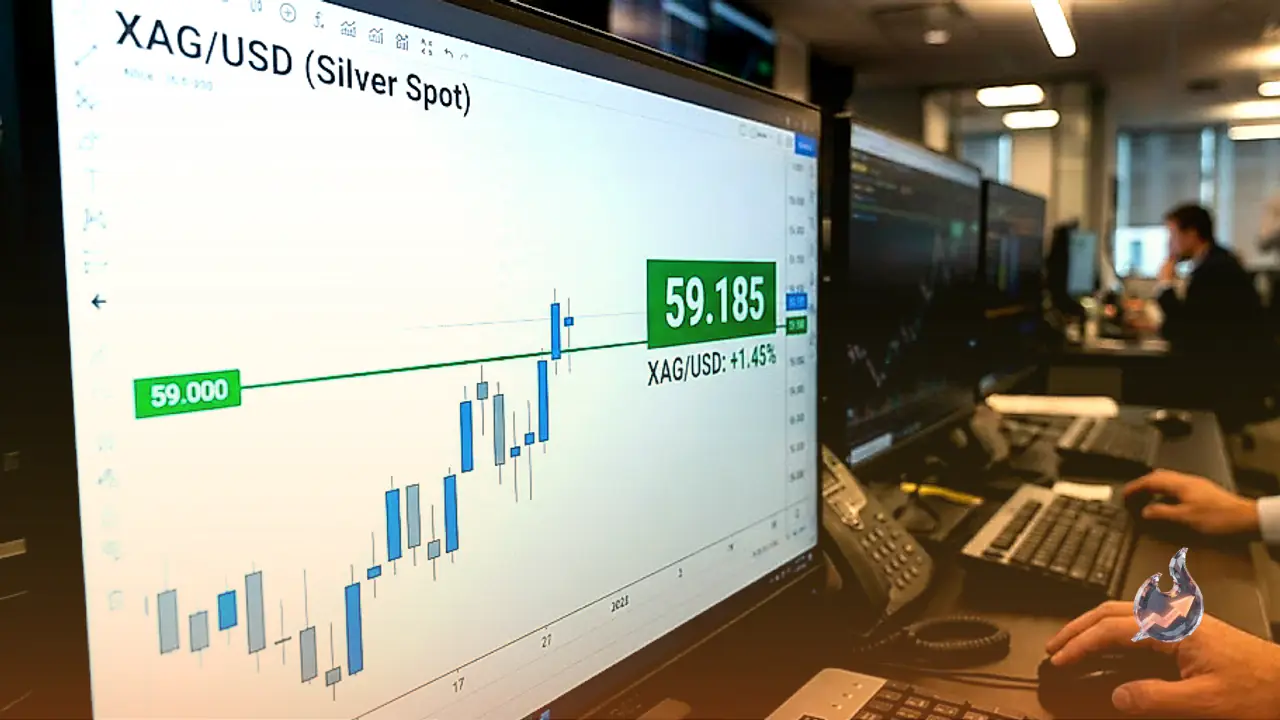

The precious metals sector has received a boost from a retreating US Dollar, which followed the release of the latest Federal Reserve (Fed) meeting minutes. While the central bank reiterated its dedication to curbing inflationary pressures, the Federal Open Market Committee remains divided, leaving market participants speculating about the timing of future interest rate adjustments. As of July 9, 2026, Silver (SI=F) is trading at $59.38, reflecting a gain of 2.08 percent from the previous close of $58.16.
Current Market Dynamics and Technical Indicators
XAG/USD currently hovers around the $59.13 level. Following a decline of nearly 35 percent over the last two months, the metal remains in a bearish consolidation phase, trading in the middle of its recent two-week range. From a technical perspective, the 14-day Relative Strength Index (RSI) stands at 37. The Moving Average Convergence Divergence (MACD) is at -3.37, positioned slightly above its signal line of -3.55, which suggests potential for minor upside momentum. The 20-day Exponential Moving Average (EMA20) is at $62.94, while the 200-day Exponential Moving Average (EMA200) sits at $64.44.
Silver as an Investment Vehicle
Silver remains a highly sought-after precious metal among global investors. Historically, it has served as both a store of value and a medium of exchange. While perhaps less prominent than Gold, Silver is frequently utilized by traders to diversify investment portfolios, leverage its intrinsic value, or act as a hedge during periods of high inflation. Investors can acquire physical Silver in the form of bullion bars or coins, or participate in price movements through financial instruments such as Exchange Traded Funds (ETF), which track the performance of the metal in international markets.
Factors Influencing Price Movements
Silver prices are dictated by a diverse array of economic and geopolitical variables. Geopolitical instability or fears of a recession typically elevate Silver's status as a safe-haven asset, although this influence is generally less pronounced than that of Gold. As an asset that pays no yield, Silver tends to benefit when interest rates are lower. Furthermore, because the asset is priced in US Dollars (XAG/USD), the strength of the greenback is a primary driver. A strong Dollar often suppresses silver prices, while a weaker Dollar tends to push them higher. Mining supply and recycling rates are also contributing factors, given that Silver is more abundant in supply than Gold.
Industrial Demand and Global Economic Factors
Industrial utility is a cornerstone of Silver's value, particularly in sectors like electronics and solar energy production, due to the metal possessing one of the highest levels of electrical conductivity of any element, surpassing both Copper and Gold. Shifts in industrial demand directly correlate with price volatility. The economic landscapes of the United States, China, and India are particularly influential; China and the US utilize significant quantities of silver in various industrial manufacturing processes, while consumer appetite for silver jewelry in India plays a vital role in balancing global supply and demand.
Relationship Between Silver and Gold
Silver prices frequently track the trajectory of Gold due to their shared status as safe-haven assets. The Gold/Silver ratio, which calculates how many ounces of Silver are required to equal the value of one ounce of Gold, is a key tool for traders to assess relative valuation. A high ratio is often interpreted by market participants as an indicator that Silver is undervalued or Gold is overvalued. Conversely, a lower ratio may suggest that Gold is undervalued relative to Silver. The metal’s 52-week trading range is currently marked between $36.27 and $121.30.