






















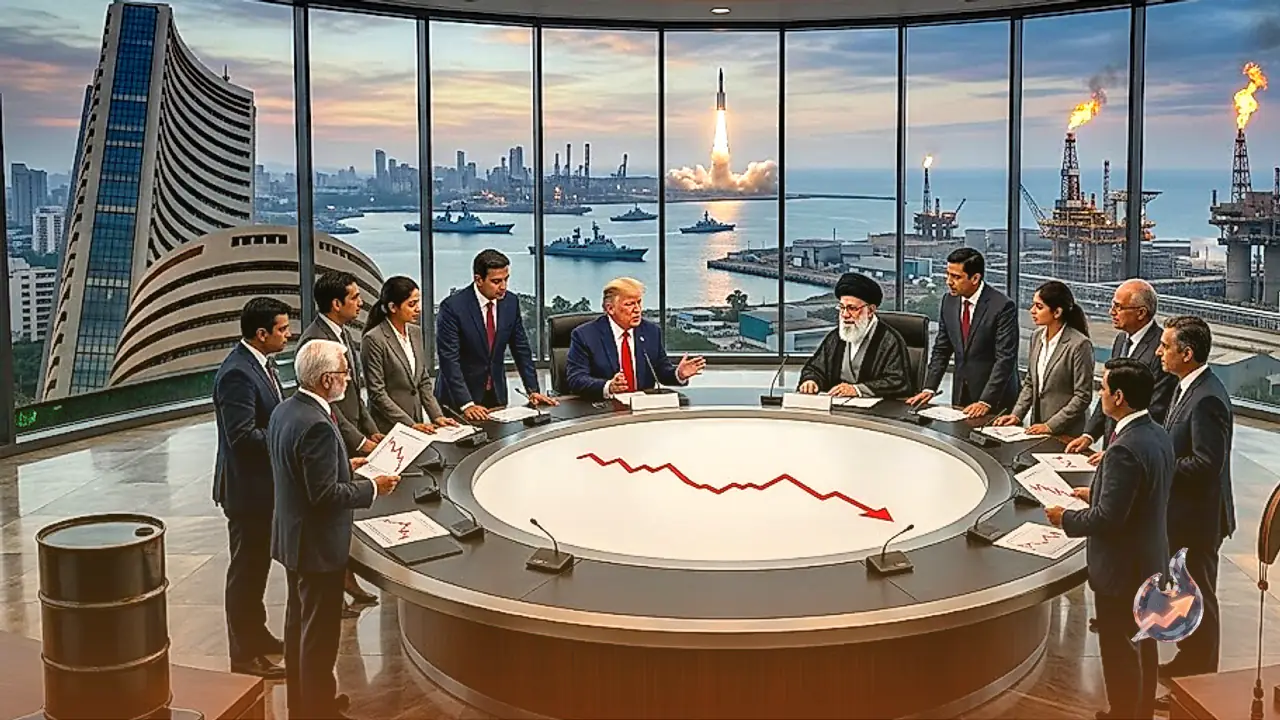

Global financial and commodity markets are witnessing deep anxiety due to the escalating military conflict between the United States and Iran. This geopolitical tension has fueled significant volatility in crude oil prices, leaving investors worldwide in a state of unease. Shortly after US President Donald Trump signaled a desire to end the war with Iran, reports emerged that the United States military had launched fresh missile strikes on the country. Crude oil was trading near $75 a barrel around 0830 IST. These rapid and uncertain developments have completely rattled global investor sentiment.
Impact on Equity Markets
Following the announcement and the subsequent escalation, Indian equity markets witnessed a sharp sell-off. Nifty 50 and Sensex plummeted on Wednesday, resulting in a loss of over Rs 8 lakh crore in market capitalization for investors. The shockwave reached the US session as well, where the Dow Jones dropped by nearly 800 points. Additionally, the S&P 500 continues to remain in a bearish trend.
Oil Price Dynamics
Fluctuations in Brent crude are being driven primarily by the conflict and associated shipping risks. When Iran closed and locked the Strait of Hormuz, oil prices surged by nearly 65%. Brent touched a high of $120 per barrel earlier in March. However, prices subsequently fell by more than 40% as fears subsided. The latest escalation has pushed a modest rebound, though prices remain well below their peak.
Human Cost and Market Watch
Amidst market fluctuations, the human cost of the conflict remains severe. An official Iranian source stated that 3,468 people have been killed. According to HRANA, the death toll stands at 3,636, comprising 1,221 military personnel and 1,701 civilians. US and Israeli estimates suggest that over 6,000 Iranian military personnel have died. The ongoing conflict began in February 2026.
IMF Projections and Economic Outlook
The International Monetary Fund (IMF) has cut its global growth forecast for 2026 by 10 basis points to 3%. This projection was based on the assumption that the Strait of Hormuz would begin reopening in mid-July and that the region would stabilize by March 2027. However, the outlook has faced fresh uncertainty since Donald Trump abandoned the ceasefire with Iran. Furthermore, the IMF has trimmed its GDP growth forecast for India. The growth projection for 2026 has slipped to 6.4% from the 6.5% forecast in April.
Growing Recession Fears
Beyond crude oil, various pressures are contributing to recessionary fears. Job losses driven by AI have hit technology roles across multiple firms. Consumer confidence has weakened in many regions, while global inflation has ticked up and growth has slowed down in parts of the world. These combined forces could pull the global economy into a recession sooner than previously anticipated.
AI, Technology, and Climate Targets
Artificial Intelligence (AI) continues to reshape work processes across various industries. Anthropic has stated that its mission is to develop AI that benefits humanity. Despite this, over 1 lakh tech employees have lost their jobs in the first half of the year. Many firms have pushed for rapid AI adoption, forcing workers to reskill to remain employable. Regarding climate goals, meeting net zero targets remains a significant challenge. Corporate roadmaps have shown limited results, and excluding Bhutan, most countries have yet to deliver balanced carbon emissions. According to Niti Aayog, India is aiming to reduce crude imports through E20 petrol and support "Aatmanirbhar" (self-reliance). While India’s net zero target is further out than some European timelines, the scale remains critical given the country's population of 1.4 billion people.