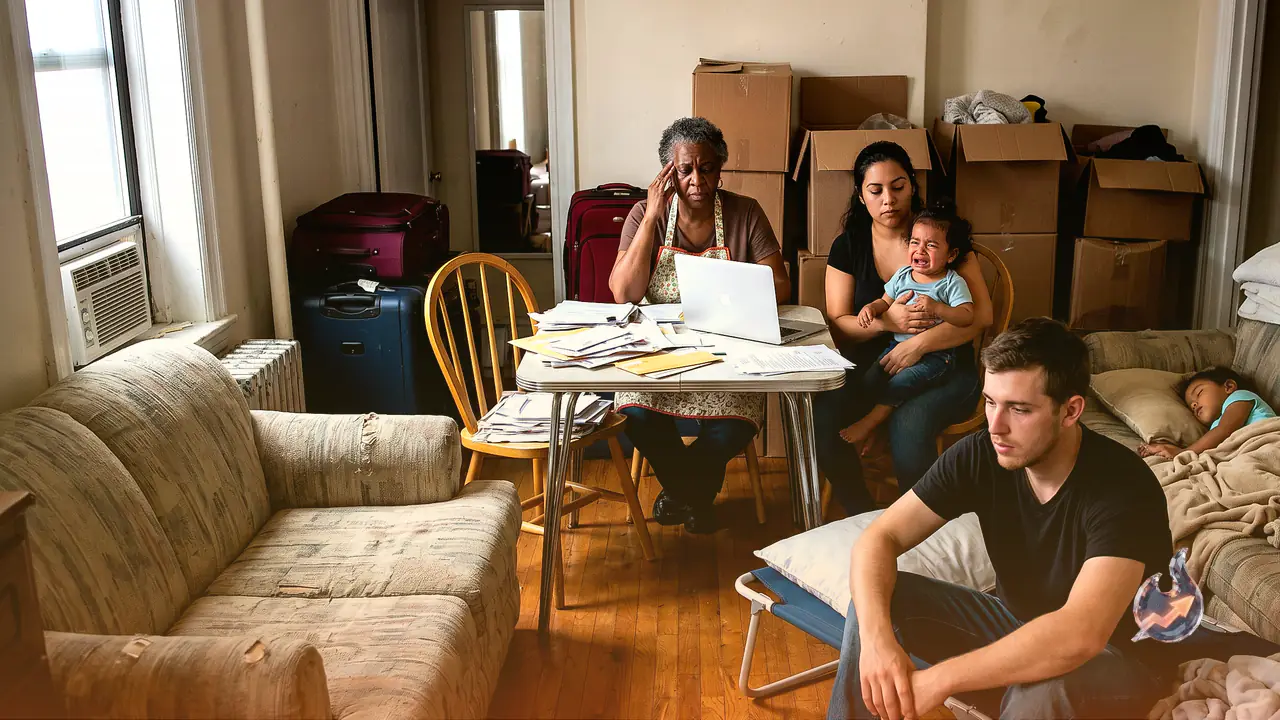

Ask Americans what worries them most and the answer keeps circling back to one thing: whether they can still afford to live the way they live. The grocery receipt, the everyday purchases, the utility statements that keep climbing, and above all the single heaviest item in any budget, the roof over their heads. For years, financial advisers leaned on a neat benchmark, the famous "30 percent" rule, which says housing should eat up no more than a third of your income. That guideline has quietly fallen apart. Figures released earlier this year show that nearly half of all renters spent more than that in 2024, as did 24 percent of homeowners. A full quarter of renting households handed over more than half of everything they earned just to stay housed.
When TrendKia asked readers about their living situations, that pressure surfaced in answer after answer. A 35-year-old who owns a home in Tulsa, Oklahoma, put it bluntly: "I'm finding it hard to dream of fun things. Nothing is affordable." A 20-year-old still living with his parents in De Berry, Texas, watched his five-person household buckle under the strain. "There are tons of bills and we can't afford them all," he wrote. "There are too many stressors, and personality conflicts are intensifying."
The Numbers Behind the Squeeze
What any one family pays swings enormously depending on the location and the year they moved in. Buyers who closed in April faced a median monthly mortgage of $2,152. Renters searching in the first quarter of 2026 stared at a median asking rent of $1,579. The typical home, meanwhile, carried a median asking price of $339,100. To make sense of how households are coping, TrendKia sorted the responses into a handful of vivid archetypes.
The Renter Who Has Given Up on Buying
It is no surprise that a large number of renters in TrendKia's survey voiced a strong wish to own a home. As Herbert Hoover once famously said, "They never sing songs about a pile of rent receipts." Yet several respondents said they felt stuck as "forever renters." A 31-year-old tenant in Phoenix wrote, "I do not think I will ever be able to own a home or save the money for a down payment. I cry about it often."
Chasing your own white-picket fence, though, is not always the smartest financial move. In January, LendingTree, a platform that connects borrowers with loans, released data showing that renting is cheaper than owning in every large urban area in the US. A 25-year-old respondent in Boston seemed to have absorbed the idea that home ownership is not always a sensible goal. "I do not expect to in the way that past generations seemed to," she wrote. "Seems like more of an aspiration than the 'assumed next step' in an adult life."
For four years, much of that Bostonian's adult life, mortgage rates have stayed mostly above 6 percent while the supply of homes has stayed tight. But the strain has been building for decades. According to Harvard's Joint Center for Housing Studies, the median house price in the 1990s was roughly 3.2 times the median income, whereas now it sits at 5 times. Conditions for buyers have not been this grim in a generation: an analysis by First American Financial, cited by The Wall Street Journal, found that 2025 was the worst year for home sales since 1982.
A 51-year-old in New Haven, Connecticut, wrote, "At this point, investing in real estate, given our ages, financial resources, and a terrifying, unstable global resource grid, would just be criminally foolish." But that pragmatism could not blunt the disappointment. She added, "Knowing we will be confined to the same cheap rentals until we cannot be there anymore has, however, broken our hearts."
The Owner Stressed by Bills and Climate
For many homeowners in TrendKia's survey, the burden of monthly bills keeps growing, especially insurance and utilities. Respondents across the country say they plan, or at least hope, to make their homes more energy efficient to offset their region's worsening climate. A 62-year-old owner in Chandler, Arizona, wrote that "heat is getting worse, air-conditioning is coming on earlier in the year. We want to make changes to make our house more efficient."
In Grass Valley, a California town near the Nevada border, a 46-year-old owner blamed "out-of-control wildfires" for pushing up home insurance rates and creating "months of edginess and terror at times if temperatures are high and there's dry lightning and winds." The owner longed for solar panels and fire-proof renovations, "anything to help us and our home to survive fire." Others pointed to invasive insect species and shrinking snowpack, which has meant less tourism. In Duncan, Oklahoma (population 23,238), a 55-year-old owner said her family's farmland is turning to desert. "It is now impossible to grow anything without a lot of expensive irrigation. We have about 5 months of over 90-degree high temps and frequent droughts."
In Portland, Maine, a 35-year-old renter in the middle of buying a home said the state's climate initiatives are a reason to stay put. "We want to be able to garden, and to have more choices to invest in sustainable energy," she wrote. "Especially now that fuel costs are skyrocketing."
Residential electricity rates have jumped over the past year, with a nationwide average increase of 10 percent between March 2025 and March 2026. A major driver has been the build-out of data centers, which are not only straining the grid. As one Virginia resident put it, "Data centers have replaced all the trees."
The Resident Shaped by Politics
Dreaming of moving abroad is always in fashion; New Zealand, Costa Rica, Spain, Portugal and, of course, Canada were among the desired destinations in TrendKia's dataset. After the 2024 elections, one respondent sold his home in Salt Lake City and resettled in Dublin, Ireland.
There is nothing dreamy, though, when the government is the one forcing you out. A 49-year-old has been living in Tijuana, Mexico, for the past six months because "after living for 22 years in California with family, I was deported with Trump enforcement." He wrote that he now lives in a studio, wrestling with the loneliness and depression of being cut off from his family. Another respondent, a 45-year-old pursuing a master's program in Seoul, has a husband who is an immigrant living in the US. "I've been too scared to return there because of ICE and immigration stuff, it's way too risky, and neither of us want to be responsible for being vanished."
The Resident Doubling Up With Extended Family
Across the US, just under 5 percent of owner-occupied households span three or more generations. The figure may sound small, but according to data Realtor.com published in May, demand for multigenerational homes is strong: listings that included terms such as "granny flat" or "guest house" drew more views and were priced higher, an average of 22 percent more per square foot, than standard homes.
Multigenerational households showed up often in TrendKia's dataset, with people hoping to save money or care for aging parents. A 45-year-old from Oakley, California, is "living with relatives to avoid being homeless." A 23-year-old from Decatur, Georgia, said, "Any place I could afford at this point would be a downgrade compared to the experience I have staying with my parents."
A retired 65-year-old from Columbia, Missouri, volunteered that her parents, now 91, moved in during Covid. Despite the lack of privacy, she wrote, "It's been good! We don't have any extra space, so we can't accumulate stuff, but we have all we need." It is not only the elderly moving in: a 38-year-old in Huntsville, Alabama, is getting ready to sell her home and move back in with her parents. With home sales staying bleak, it is little wonder that multigenerational living is common. According to an April 2026 report by the National Association of Realtors, only about one in five buyers were first-time purchasers, the lowest level on record.
The Resident Who Loves an Offbeat Setup
Some respondents invented their own answers to the housing crunch. A 47-year-old built an 8- by 24-foot home out of cold-formed steel on a huge plot of land where a Victorian had been torn down. "What would have been space to heat and cool is now a large amazing yard," she wrote. A 68-year-old in Branchport, New York, lives in a one-bedroom log house with many animals: "I love living in the country, and having animals and large gardens."
A 55-year-old in Santa Cruz, California, described the home she bought in 1998 as "a ramshackle dump." But, she wrote, "We've spent our lives upgrading our home's inside and outside spaces, making our once ugliest home on the block to the most beautiful," a place ringed by redwood trees and a mile from the Pacific Ocean.
Then come the maritime types. A 77-year-old who loves off-the-grid living spent much of the past year on a sailboat. In Sausalito, California, an 84-year-old who "fell in love with living on a houseboat" admitted that life aboard is not easy for the elderly, yet she hoped to stay as long as she can. "I have everything I need and want here," she wrote. A 23-year-old in Decatur, Georgia, said they are "very open" to a tiny home or multifamily housing, while a 50-year-old in Seattle hopes to sell his house, downsize to a condo and live part-time in a camper van. So what is a home in this day and age? It might be, as that Seattleite put it, "where the bills find their way to me."