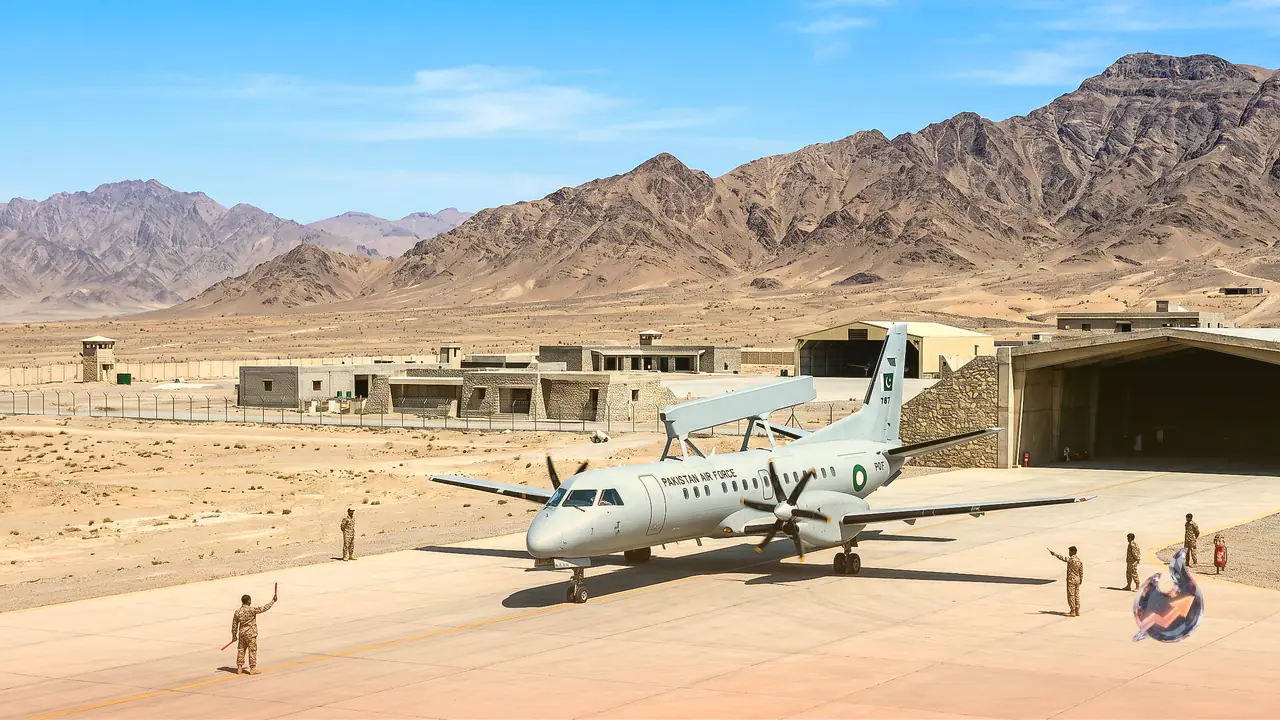

The arithmetic of aerial warfare in South Asia has been rewritten since Operation Sindoor. The same Pakistan that boasted of victory in last year's military standoff is now on the back foot, scrambling to move its most valuable surveillance aircraft away from the Indian frontier. The reason is the Indian Air Force's S-400 air defence system, whose reach has forced Islamabad to rethink its entire playbook.
Why Pakistan Is Stepping Back
According to TrendKia, the Pakistan Air Force (PAF) is preparing to relocate the surviving Saab-2000 Erieye Airborne Early Warning and Control (AEW&C) aircraft of its Number-53 Airborne Early Warning Squadron from Bholari airbase in Sindh to Samungli airbase near Quetta in Balochistan. These Erieye platforms count among Pakistan's most important aerial surveillance assets, and after the May 2025 tensions the air force began moving them to a safer location.
The decision flows directly from the threat posed by the IAF's S-400 system and, in particular, its long range 40N6 missiles. These missiles are said to be capable of striking high-value aerial targets at distances exceeding 300 kilometres. That is precisely why Pakistan wants its sensitive aircraft kept beyond the likely reach of India's air defences.
The Jolt of 10 May
Bholari airbase in Sindh has long served as the principal operational hub for Pakistan's Airborne Early Warning Squadron, but that very base has now become its biggest worry. During the India-Pakistan military confrontation in May 2025, an alleged Indian strike on 10 May damaged a hangar at the base, with reports of at least one Erieye aircraft being damaged or destroyed. In the same operation, an S-400 long range missile struck a Pakistani airbase in Sindh province, which borders Rajasthan, wrecking the high-value Saab-2000 Erieye AEW&C aircraft and causing heavy losses.
The episode laid bare just how exposed costly defence assets stationed close to the border really are. Erieye AEW&C aircraft play a crucial role in long range radar surveillance, command and control, and feeding real-time information to fighter jets, which makes protecting the limited fleet Pakistan's top priority.
How the S-400 Changed the Air War
It is worth noting that India recently received its fourth squadron of the S-400. Military analysts believe the IAF's effective use of the 40N6 missile variant has transformed regional aerial warfare strategy altogether. Because these missiles can engage targets at long ranges and high altitudes, Pakistan has been compelled to reconsider how it deploys its surveillance platforms.
Samungli airbase is thought to sit far deeper from the Indian border than Bholari, and Balochistan's mountainous terrain offers an extra layer of protection. Experts caution, however, that while moving the jets to the Quetta region buys strategic safety, it will lengthen flight times for surveillance missions along the eastern border and add operational challenges. Meeting them may require additional fuel support and a fresh operational structure.
Kirana Hills and a Shifting Landscape
Earlier, reports had suggested that Pakistan deployed an American radar system to defend Kirana Hills. The facility there is believed to house Pakistan's nuclear and other sensitive weapon systems, and during Operation Sindoor India struck the area with BrahMos. According to defence experts, pulling back the Erieye fleet is not merely an airbase change but a clear sign of how aerial warfare in South Asia is evolving. In an era of long range missiles, precision strikes and advanced air defence systems, the armed forces of both countries are increasingly pushing their critical assets into deeper territory, adopting dispersed deployments and leaning on new strategies.