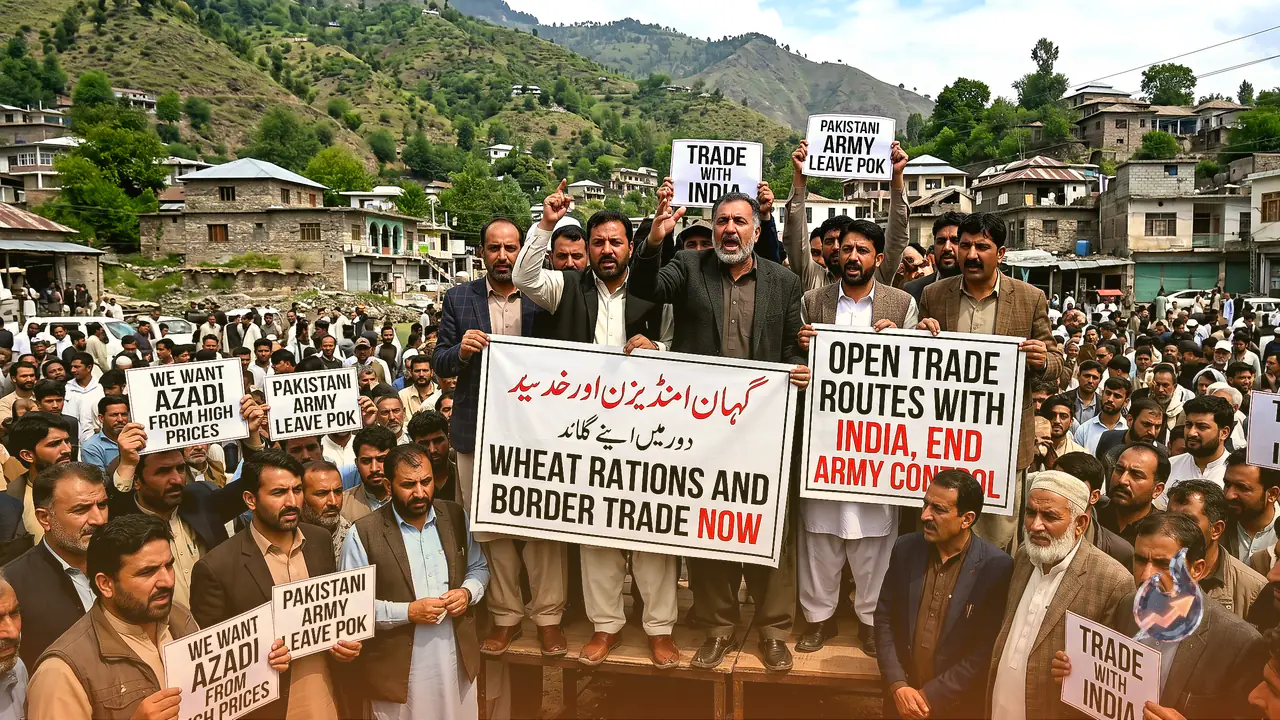

The protests in Pakistan-occupied Kashmir (PoK) began as a complaint about household costs and the price of wheat. That mood has now changed completely. People who first took to the streets over inflated electricity and ration bills are no longer asking only for everyday relief. Their demands have shifted squarely toward political rights, and they are openly pushing back against what they describe as the Pakistani army's heavy hand. The anger has reached a point where Kashmiris are now challenging Pakistan to get out of the region altogether.
Sharpest Attacks Yet at the Rawalkot Rally
A large public gathering held recently in Rawalkot captured this shift. Speaking from the same platform, leaders of the Jammu-Kashmir Joint Awami Action Committee and the Awami Action Committee launched their harshest attacks yet on the Pakistani army. They accused Pakistan of choking off essential supplies to the region and of exploiting its resources. They also charged that Pakistan has consistently blocked economic dealings between PoK and India.
Using Rations as a Pressure Tactic
Addressing the rally, JAAC leader Sardar Aman accused the Pakistani army of deliberately limiting the supply of everyday goods to people in PoK and using that to apply economic pressure. Aman said the army is going so far as to withhold the people's rations. He claimed that officials are trying to weaken the protest movement through economic measures.
A Call to Open Alternative Trade Routes With India
The protesters argue that if Pakistan cannot deliver economic support and daily essentials, then alternative trade routes with India should be opened. Speaking to his supporters, Aman declared that all trade routes would open soon, whether from the Pakistan side or the India side. Cross-LoC trade between Jammu-Kashmir and PoK has been suspended for years. As a result, all economic contact between Kashmir and PoK has been wiped out, leaving people in PoK feeling both economically cut off and commercially isolated.
The Army Will Not Decide Our Political Future
Challenging the army directly, Aman said the Pakistani military will not determine the political future of the people of PoK. Pakistan has long argued that the troops stationed there are protecting locals from India. Aman rejected that reasoning, saying that defending themselves from India is their own concern and not the army's job, and that the Pakistani army should not try to interfere in their affairs.
The Movement Will Reach Muzaffarabad
Closing his speech, Aman expressed confidence that the movement would not stop and would eventually reach Muzaffarabad, the capital of PoK. Whether these protests can keep up their momentum in the days ahead remains to be seen, but the rhetoric emerging from sections of the movement signals that an agitation that started over wheat prices and electricity bills is now turning into a far broader challenge to Pakistan's entire model of governance in the region.