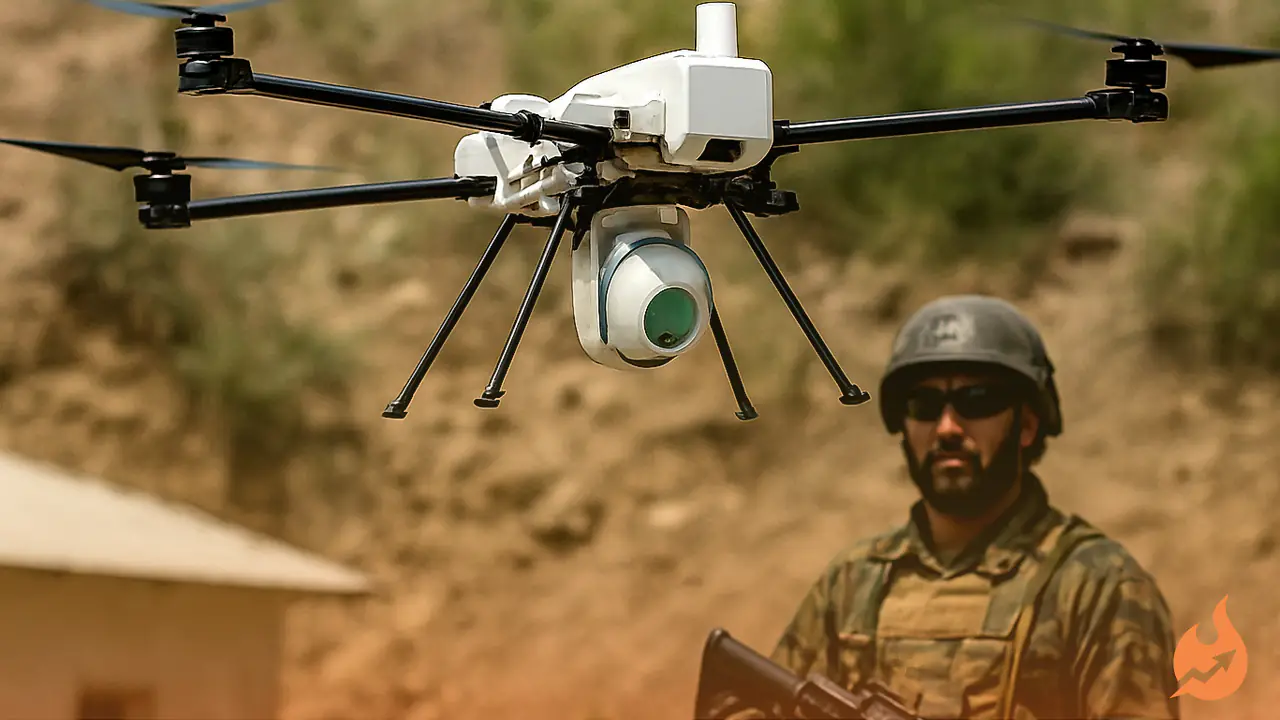

Punjab heads to assembly polls early next year, and that very moment has thrown up a new kind of menace for state and central security agencies. The drones lifting off from across the frontier are no longer just tools of surveillance — they are dropping both narcotics and lethal weapons onto Indian soil. Officials have taken to calling it a '3D' blueprint of drones, drugs and dread, and it is precisely this pattern that is robbing them of sleep.
A nearly 50-fold surge in five years
Records maintained by the Narcotics Control Bureau (NCB) and the state police lay bare how fast the cross-border drone supply line has spread. In 2025 alone, 305 separate incidents yielded a combined 468 kilograms of narcotics — a figure roughly 50 times higher than what was recorded five years earlier.
Tracking the climb year by year makes the trend even starker. In 2021, just 3 incidents had turned up 10 kilograms of contraband. The following year, 2022, saw 35 incidents and 148 kilograms; 2023 logged 28 incidents and 103 kilograms; and 2024 brought 179 incidents and 236 kilograms of seized drugs.
This year the pace has grown even more aggressive. By the first week of June, Punjab Police had already seized 516 kilograms of heroin — more than the entire haul of 2025. Beyond narcotics, that stretch also netted 122 weapons, one of them a grenade, along with 909 live cartridges and 139 drones. The most worrying takeaway: nearly 58 per cent of the heroin smuggled into India now enters through the Punjab corridor.
Foreign weapons and local accomplices
The trouble does not stop at narcotics. Security agencies are equally rattled by the sophisticated foreign-made weapons arriving from Pakistan. Arms recovered from the border belt have been traced back to firms in China, Austria and Turkiye.
According to senior Home Ministry officials, the cross-border smuggling network has roped in a handful of locals from Punjab. These individuals are being used to move weapons from one location to another. Intelligence agencies assess that the heroin air-dropped by drone is itself handed over to these local couriers as payment — and in return they pass the weapons on to criminal gangs in Punjab, and at times to terror modules operating in Jammu and Kashmir.
A Turkish pistol seized in Baramulla
A glimpse of this machinery surfaced on June 9 in Baramulla, Jammu and Kashmir. In a joint operation, Baramulla Police and the 52 Rashtriya Rifles stopped a white Maruti Brezza travelling from Srinagar towards Baramulla. The search turned up an advanced Turkiye-made CANIK TP9SF METE (9×19 mm) pistol. Intelligence agencies suspect the firearm had entered India via the Punjab drone route.
Defence experts argue such weapons are meant to stoke instability within the country. Security analyst Lieutenant General (retired) K. Singh notes that incidents in recent months around army and BSF installations in Jalandhar and Amritsar, as well as an attack on a party office in Chandigarh, are suspected to have involved weapons of this very kind.
Pakistan rewrites its smuggling playbook
Analysis by regional security agencies has flagged a major shift — Pakistan has overhauled its drone-smuggling method altogether. Earlier, smugglers leaned on China-made agricultural drones, the sort ordinarily used to spray pesticide over fields. Machines like the DJI Mavic 3 could lift only about half a kilogram and had a limited flight range.
Now, though, the smugglers are deploying purpose-built, advanced quadcopter drones capable of hauling between 5 and 10 kilograms. These fly at far greater heights and make very little noise, leaving border guards struggling to either spot or hear them.
What is more, when cornered or forced to land, these drones wipe their own GPS and flight data clean. That makes it extremely hard for investigators to pin down exactly which part of Pakistan a given drone took off from.
Satellite internet becomes the biggest hurdle
The thorniest problem now facing the agencies is satellite-based internet. Until recently, anti-drone technology rested largely on jamming radio frequency (RF) signals to sever the link between a drone and its operator. But drones running on satellite internet render that approach largely useless.
A hint of this technological leap came during a major operation in Ferozepur on May 24. Punjab Police arrested four people and recovered 28.12 kilograms of heroin and Rs 9.5 lakh in cash. Preliminary inquiry revealed the accused were receiving real-time instructions from handlers based in Pakistan through an encrypted satellite-internet network.
It is for this reason that central security agencies are now retooling their strategy and gearing up to counter the threat with newer technologies, the aim being to choke off cross-border drone smuggling before Punjab goes to the assembly polls.