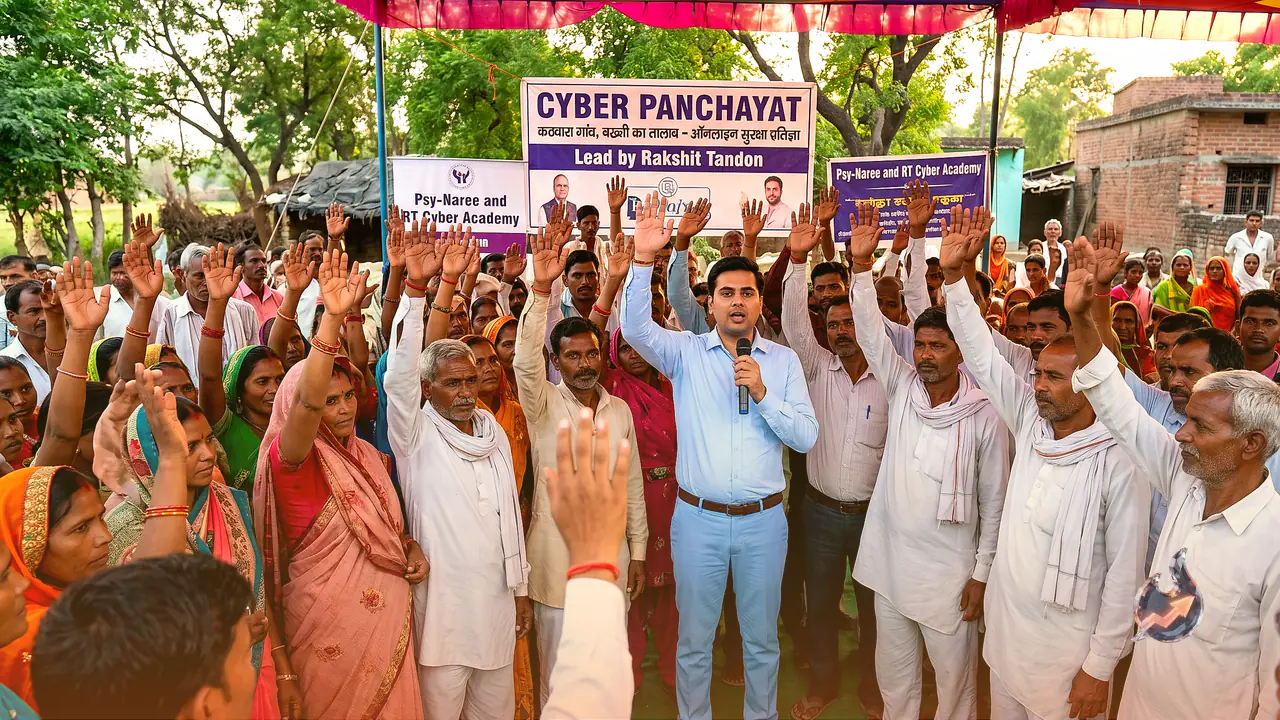

Online fraud is no longer a problem confined to the cities. Scam calls have now reached deep into the villages, putting farmers, homemakers, students, small shopkeepers and the elderly squarely in the crosshairs. Responding to this growing threat, Psy-Naree, an organisation that works in the fields of mental health and women's empowerment, joined hands with RT Cyber Academy to organise a unique 'Cyber Panchayat' at Kathwara village in Bakshi Ka Talab, Lucknow.
Held under the guidance of noted cyber expert Shri Rakshit Tandon, founder of RT Cyber Academy, the event turned an ordinary village gathering into an open, hands-on conversation about staying safe online. It was the third rural cyber safety workshop jointly run by Psy-Naree and RT Cyber Academy, part of a slowly expanding effort to carry digital awareness to villages across India.
Who Steered the Event
The programme was hosted by Colonel Sanjeev Sahay, founder of Ikigai and a mentor at Psy-Naree. Addressing the villagers, he introduced them to the idea behind Ikigai and explained the deep connection between cybercrime and the mental stress it leaves behind. The stage was anchored by Psy-Naree volunteer Simran Rai, while the overall coordination was handled by Psy-Naree programme coordinator Vaibhav Naik.
A Conversation Rooted in Everyday Reality
Every part of the discussion stayed tied to what villagers actually face day to day. The talk covered what a fake call really sounds like, why a single OTP shared even once can wipe out years of savings in moments, and why the embarrassment that follows a scam often weighs heavier than the financial loss itself.
The Key Takeaways
- Guard your confidential information: never share your OTP, PIN, password, CVV or bank details with anyone, ever.
- Question the caller: stay alert to fraudsters posing as police, CBI, bank staff or customer care, and to the rising trend of 'digital arrest' and video call blackmail.
- Understand the mule account trap: lending or renting out your bank account can quietly turn an innocent person into an accomplice in a crime.
- Recognise the bait of greed: steer clear of fraud carried out in the name of fake jobs, KYC updates, lotteries and government schemes, as well as 'double your money' investment offers.
- Mental health matters just as much: falling victim to a scam is nothing to be ashamed of, the real danger is silence. A victim needs support, not blame.
- Act at once: report any fraud without delay on the 1930 cyber helpline.
Short Films Exposed How the Traps Are Set
During the programme, short films based on real incidents were screened so that villagers would not just hear about the dangers but actually see how these traps are laid and how they can be avoided.
The Whole Village Took the Cyber Safety Oath
The most memorable moment came when Rakshit Tandon administered a cyber safety oath to the entire village. It is being regarded as one of the first pledges of its kind taken in any village in the state. On the occasion, villagers resolved to protect their families, their hard-earned money and the digital future of their village.
The Goal: Turn Kathwara Into a Cybercrime-Free Village
Sharing the road ahead, Colonel Sanjeev Sahay said that Psy-Naree, with the support of Ikigai, wants to adopt Kathwara and turn it into a cybercrime-free village. Alongside this, the organisation will keep running activities tied to mental health and women's empowerment, so that the village can be freed of social ills and shaped into a model that neighbouring villages can follow too.