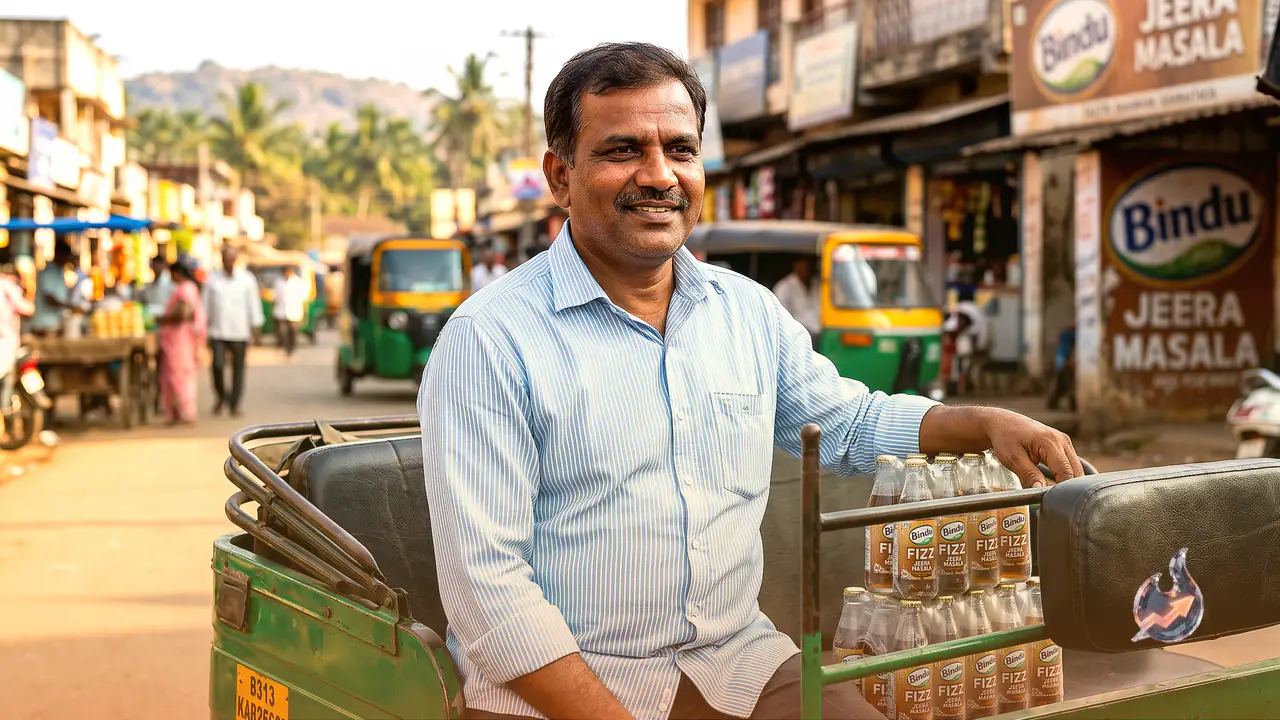

It is widely assumed that only people with elite degrees or deep pockets can build a large business. The story of Satya Shankar, the son of an ordinary temple priest from Bellare village in Karnataka, completely overturns that belief. He studied only up to Class 12, his father could not afford to fund any further education, and to make ends meet he had to drive an auto rickshaw on the streets. Yet his dream of building something big never dimmed. Today that same Satya Shankar is a crorepati, and his homegrown brand is taking on multinational giants like Pepsi and Coca-Cola head on.
A ₹900 Crore Business Group
Satya Shankar's group, SG Corporates, has now reached a turnover of around ₹900 crore. Within it, his beverages and snacks business, House of Bindu, is valued at ₹570 crore, while his finance arm, Praveen Capital, is valued at ₹330 crore. His companies sell more than 55 products, including jeera masala, mango juice and snacks. The most famous of these, Bindu Fizz Jeera Masala, is hugely popular across South India. After Karnataka and Telangana, new factories are now coming up in Andhra Pradesh.
From Auto Earnings to an Ambassador
Satya Shankar was born into a very modest family. In 1984, at the age of 18, after his studies came to an end, he took a loan under a government scheme and bought an auto rickshaw. After a year of relentless work he cleared the entire loan, then sold the auto and bought an Ambassador car. He often ferried foreign tourists in that car, and it was then that he noticed something key: tourists almost always bought a bottle of water first. In that moment he understood that clean, safe drinking water was going to become a very large market in the years ahead.
Lessons From Spare Parts, Tyres and Finance
In 1988 he sold his car and opened a small spare parts shop in Puttur, soon adding tyres to what he sold. There he observed that villagers and farmers often bought goods on credit and repaid in small instalments. Shankar reasoned that if these people could pay in instalments, they could also be given loans. With that idea, in 1994 he launched a finance company called Praveen Capital to lend to ordinary people, offering loans for second-hand vehicles. At the time this was a fresh experiment, since most financiers avoided lending against used vehicles.
The Year 2000 and the Birth of Bindu
In 2000, Satya Shankar decided to turn the water business closest to his heart into reality. He set up his first factory in Narimogeru, a village that receives heavy rainfall, and named the brand 'Bindu', which means a drop in Kannada. During a trip to North India he saw a local shop selling soda mixed with cumin powder and salt. Watching the people around enjoy it, he thought he could transform that same flavour into a branded, better-tasting packaged product. That was the origin of his most famous product, Bindu Fizz Jeera Masala.
The Hard Road for a Desi Flavour
Establishing a homegrown flavour in the market was far from easy. At the time, global giants like Coca-Cola and Pepsi dominated. In the early days, when 200 boxes of Bindu Fizz were sent out, shopkeepers would return 100 of them. Shankar did not have the money to spend on advertising the way big companies did. For publicity he chose a fully desi route, promoting his brand by getting it painted on highway walls. Slowly the effort paid off, the taste of Bindu Fizz Jeera Masala caught on with people, and the drink became a superhit.