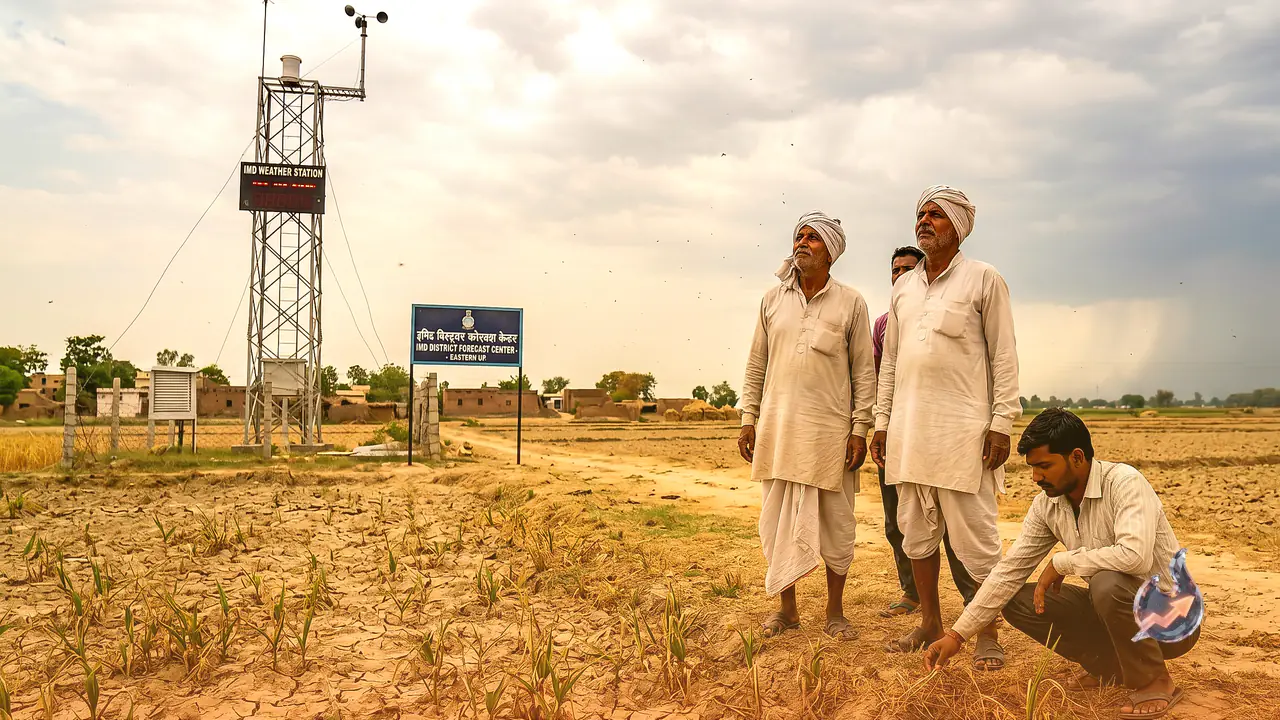

For people across Uttar Pradesh battling blistering heat and humidity, the weather office has brought relief, but with a catch. The IMD says the monsoon will reach the eastern parts of the state within the next one to two days, easing the scorching conditions. Farmers staring at the sky to sow their paddy nurseries are also expected to get some comfort in the coming week.
The bigger worry, however, is that the southwest monsoon has suddenly slowed down over eastern India. The direct fallout is that this time the whole of Uttar Pradesh will have to wait longer than usual for rain.
When and Where It Will Arrive
Normally, the monsoon is expected to reach Uttar Pradesh by 18 June on average, and it traditionally arrives in the capital Lucknow by 23 June. But in 2026, a shift in the weather pattern has upset the calculations. The monsoon is now likely to arrive around 5 to 10 days later than its usual schedule.
Meteorologists estimate that the monsoon will now enter eastern Uttar Pradesh around 22 June through the Bay of Bengal route. From there it will gradually gather pace and cover western Uttar Pradesh, and only then will heavy rainfall begin across the entire state.
Why the Monsoon Got Stuck Midway
According to the weather department, the monsoon winds have currently stalled over parts of Bihar, Jharkhand and West Bengal. The monsoon is running about 4 to 5 days behind its normal pace. Its forward movement suddenly halted in mid-June due to atmospheric changes, and as a result, pre-monsoon humidity and heat across the state have risen even further before the main rains.
Mohammad Danish, a scientist at the Regional Meteorological Centre in Lucknow, explained the reason. According to him, the monsoon has not stalled because of a lack of moisture in the air, but because of a sudden change in the wind pattern in the upper atmosphere. Scientists also point out that such a mid-journey slowdown is not unusual. As soon as atmospheric conditions turn favourable again, the monsoon will pick up its lost momentum.
How Far the Monsoon Has Reached
By Tuesday, the monsoon had marked its presence up to southern Maharashtra in the west, parts of Odisha in the southeast, and the regions of West Bengal and Bihar in the east. But the delay has deepened concerns about a rainfall shortfall, water scarcity and steadily rising temperatures. A major factor behind this is said to be the strengthening El Niño effect, which is linked to the warming of the Pacific Ocean surface and is held responsible for a weak monsoon in India.
How the Monsoon Behaved in Past Years
The monsoon has not behaved the same way every year in Uttar Pradesh. In some years it arrived right on time, first entering the eastern parts of the state and then advancing to cover the remaining regions.
On one occasion its arrival was slightly delayed, beginning on 25 June instead of the usual 20 June, but it later sped up and spread across the entire state by 30 June, perfectly in line with its normal coverage timeline. In another instance, the monsoon entered Uttar Pradesh through neighbouring Bihar, and after hitting the eastern districts on 24 June, it brought the whole state under its sweep within just one week.
In some years its arrival was nearly on time or only slightly delayed, with widespread pre-monsoon showers in the early phase, followed by the main spell of heavy rain across the state by the last week of June.
Yellow Alert for Storms and Rain
Even as the main monsoon is delayed, the weather department has issued a yellow alert for several districts warning of strong thunderstorms, lightning and light rain. According to the department, gusty winds may blow today at 50 to 60 kilometres per hour in many districts of the state, and up to 70 kilometres per hour at some places.
The districts of eastern Uttar Pradesh under the warning include Maharajganj, Varanasi, Sonbhadra, Mirzapur, Kushinagar, Ghazipur, Chandauli, Mau, Ballia, Gorakhpur, Deoria, Siddharthnagar and Sant Kabir Nagar. Apart from these, Noida, Ghaziabad, Lucknow and Prayagraj may also witness dust storms and pre-monsoon shower activity.