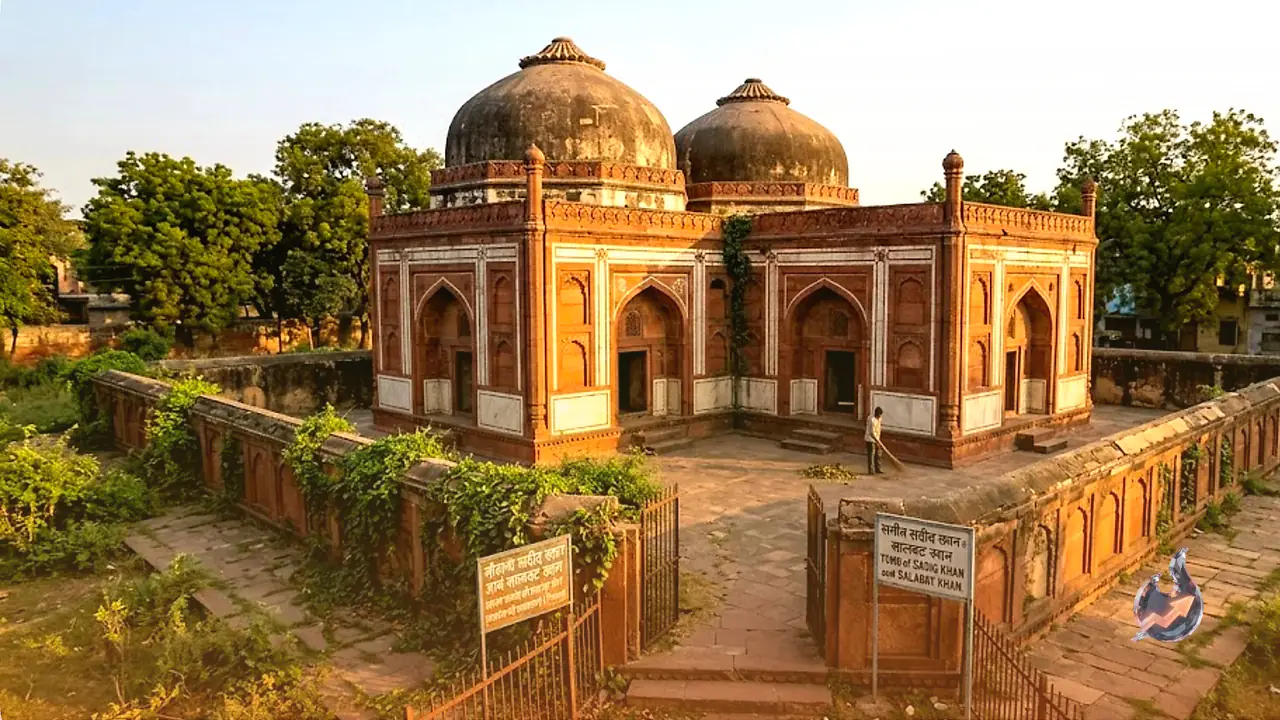

Agra, a city deeply steeped in history and adorned with magnificent Mughal structures, is home to countless tales from a bygone era. Among its many architectural treasures lies a particularly unique complex: the mausoleums of Sadiq Khan and his son, Salabat Khan. This site, located conveniently near Ashopa Hospital on the Agra-Delhi highway, is the sole known instance in Agra where a father and son are interred together in such a prominent fashion.
Sadiq Khan: A Noble's Lasting Tribute
Sadiq Khan was a distinguished noble who served during the reigns of both Emperor Jahangir and Emperor Shah Jahan. Following his passing in 1633, his son, Salabat Khan, embarked on the construction of a grand octagonal tomb in his father's honor. This impressive two-storied structure, built between 1633 and 1635, stands as a beautiful testament to a son's devotion and an era of elaborate funerary architecture.
Salabat Khan: A Life Cut Short in the Royal Court
Salabat Khan himself held significant influence in the Mughal court. He was the brother-in-law (साले) to Emperor Shah Jahan and occupied the prestigious position of 'Mir Bakshi', essentially the royal treasurer. His close familial ties to the Emperor ensured his considerable status and authority within the court. However, his life met a dramatic end, a story frequently recounted from the Mughal period. According to historians, Salabat Khan once uttered offensive remarks against the valiant Veer Amar Singh Rathore in open court. Enraged by this insult, Amar Singh Rathore famously drew his dagger and slew Salabat Khan on the spot, amidst the assembled dignitaries.
The Striking 'Chausath Khamba'
Adjacent to Sadiq Khan's imposing tomb lies the mausoleum dedicated to Salabat Khan, famously known as 'Chausath Khamba', or the 'Sixty-Four Pillared' structure. This striking edifice, crafted from vibrant red sandstone, features 64 intricately carved pillars that support its beautiful chhatris (domed pavilions). It is designed as an open pavilion, offering a contrasting architectural style to his father's more enclosed octagonal tomb. Despite its historical significance and aesthetic appeal, the site sees relatively few visitors.
Architectural Grandeur and an Enduring Mystery
These two distinct tombs, though built side-by-side in what appears to be an open ground, present a captivating study in Mughal funerary architecture. Sadiq Khan's tomb is a magnificent two-story octagonal structure, while Salabat Khan's 'Chausath Khamba' is an open pavilion supported by 64 columns. Adding to the mystique of this historical site is a peculiar secret concerning Sadiq Khan's tomb: historians suggest that the basement beneath the main structure does not contain an actual grave or any remains. Instead, an external tombstone bearing Urdu inscriptions lies outside the main edifice. Intriguingly, no historical texts offer any explanation for this anomaly, leaving it an unsolved riddle.
Forgotten Beauty and a Call for Preservation
Beyond its unique history and structural design, the 'Chausath Khamba' also preserves examples of Mughal artistry. Well-maintained fresco paintings from the Mughal era can still be observed on the ceilings of its chhatris, showcasing exquisite craftsmanship that continues to captivate those who visit. Professor Rajpal Singh, a historian, laments the current state of these beautiful monuments, which he describes as "waiting for tourists." He notes that rampant illegal encroachment around the complex has obscured its visibility from the main road, making it difficult for passersby to even spot it. Despite its rich historical value and superb architecture, Professor Singh states that the Sadiq Khan and Salabat Khan tombs fail to attract the same level of attention as more famous sites like the Taj Mahal or Akbar's Tomb, and are currently "living a life of anonymity." He underscores the urgent need for greater promotion and awareness to bring these forgotten gems back into the public eye and ensure their preservation for future generations.