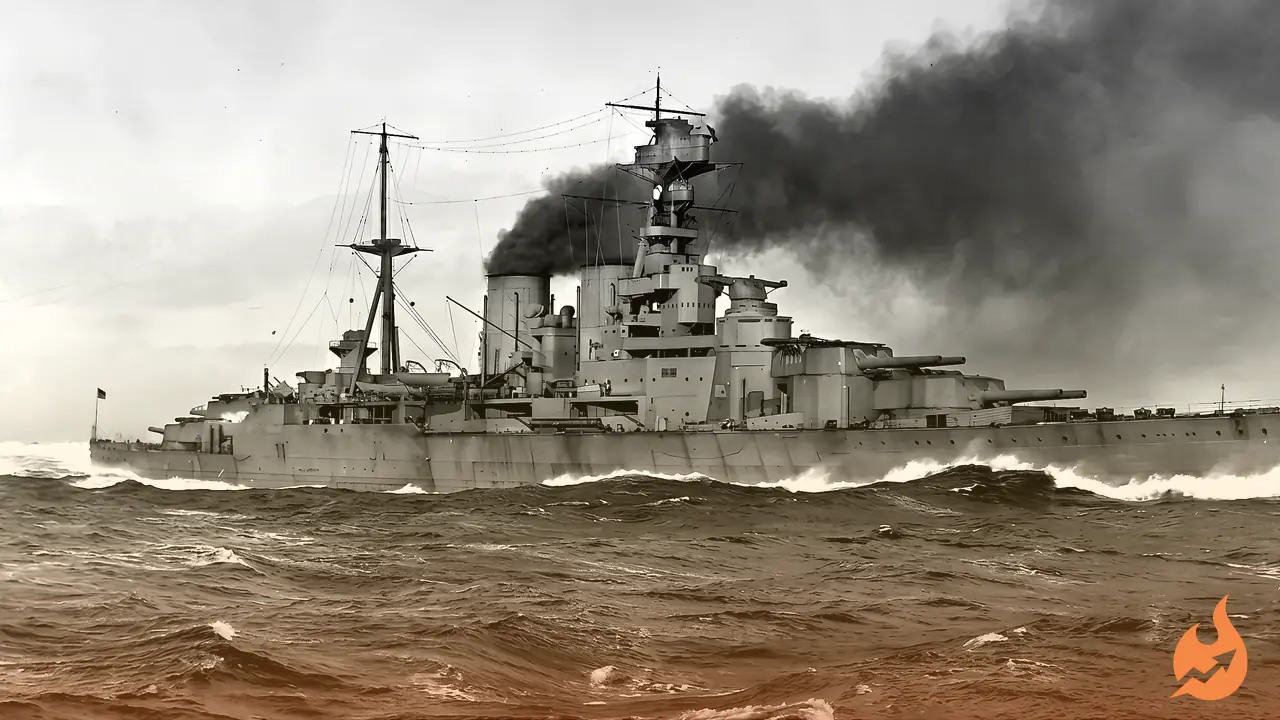

Of all the ships that struck terror at sea during the Second World War, none looms larger in memory than Germany's Bismarck. Just how powerful was this single vessel? Consider that the British Navy had to throw several of its warships at it at once simply to stop and destroy it. So what exactly made this one battleship rattle the entire world?
The Day Bismarck Stunned the World
It was 24 May 1941, and the North Atlantic was burning with the fury of war. Germany's enormous battleship stood face to face with the Royal Navy, and within just a few hours it pulled off something no one saw coming. In the clash remembered as the Battle of the Denmark Strait, Bismarck sent HMS Hood — long regarded as the pride of the British Navy — straight to the bottom of the sea. And it did not stop there. Britain's brand-new, modern battleship Prince of Wales was forced to break off and retreat from the battlefield. That single encounter was enough to write Bismarck's name into the list of the most talked-about and most feared warships in history.
Huge in Size, Blistering in Speed
At the time, the world's major naval powers were trying to rein in the size of battleships through a string of international agreements. Bismarck, however, had already blown past those limits. Its standard displacement was about 41,700 tons, heavier than most modern warships of the era. Only ships built later — America's “Iowa class” and Japan's giant “Yamato class” — would end up larger. In its own day, Bismarck counted among the most imposing battleships afloat.
Its sheer bulk was only half the story; speed was its other great strength. It could sustain a pace of roughly 56 km per hour, a remarkable figure compared with most warships of the time. Only a handful of vessels — France's Richelieu and Italy's Vittorio Veneto among them — could keep up with that speed.
Armour That Refused to Sink
Bismarck's real edge was not just its size or speed but its formidable protection. Its hull was divided into many separate compartments, which meant that even after taking severe damage it was extremely difficult to sink. That is exactly why, when the Royal Navy later surrounded it, finishing the ship off demanded relentless heavy shellfire and torpedo strikes. This durability earned it a reputation as one of the best-protected warships of its time.
Outgunned on Paper, Dominant in Battle
For all its reputation as a powerhouse, if you judged purely by the number of guns and the weight of a single broadside, some other nations' warships actually came out ahead. Bismarck carried eight 15-inch main guns, capable of flinging roughly 6,400 kilograms of steel and explosives at the enemy in one go.
Yet certain American, Japanese and British battleships could deliver an even heavier weight of fire. Japan's giant Yamato and Musashi each carried nine massive 18-inch guns, whose combined broadside weighed more than double that of Bismarck. Plenty of warships in the Second World War could throw heavier shells than Bismarck. Even so, the mark it left on the battlefield set it apart from them all.
America's North Carolina and South Dakota class ships were smaller than Bismarck but were considered to pack more punch. On paper, in a head-to-head duel, they could have challenged it. There was a catch, though: the German Navy's fire-control systems and optical equipment were rated among the finest in the world. So crowning any single battleship the outright best on the strength of numbers alone was never a simple call.
When Bismarck's Fire Rained on the Prince of Wales
During this same Battle of the Denmark Strait, Bismarck landed several precise blows on the Prince of Wales. Four of its 15-inch shells struck the British battleship. One slammed into the water below the ship and caused some flooding. Two others hit the upper sections, wrecking the equipment there and leaving several sailors among the casualties. The fourth struck part of the ship and exploded, inflicting heavy damage on the surrounding area.
Despite this battering, the main guns of the Prince of Wales kept firing and it stayed in the fight. Around the same time, shells from the German heavy cruiser Prinz Eugen also found their mark, adding to the ship's injuries. The constant downpour of shells and the combined fire from both German ships steadily wore down the British battleship's ability to respond. In the end, conditions left the Prince of Wales with no choice but to pull back from the battle zone.
Down But Not Out: The Chase Goes On
Even after retreating, the Prince of Wales was far from finished. Its main guns and engines had come through intact. Before long it changed course again and rejoined the British ships hunting the German fleet. Once the damage from Bismarck's fire had been patched up, it declared itself fit for action once more and resumed the chase of the German battleship.
By then, though, Bismarck had already shown the world what it was capable of. The destruction of HMS Hood and the forced withdrawal of the Prince of Wales were the very deeds that secured Bismarck a permanent place among the most talked-about and most fearsome warships of the Second World War.