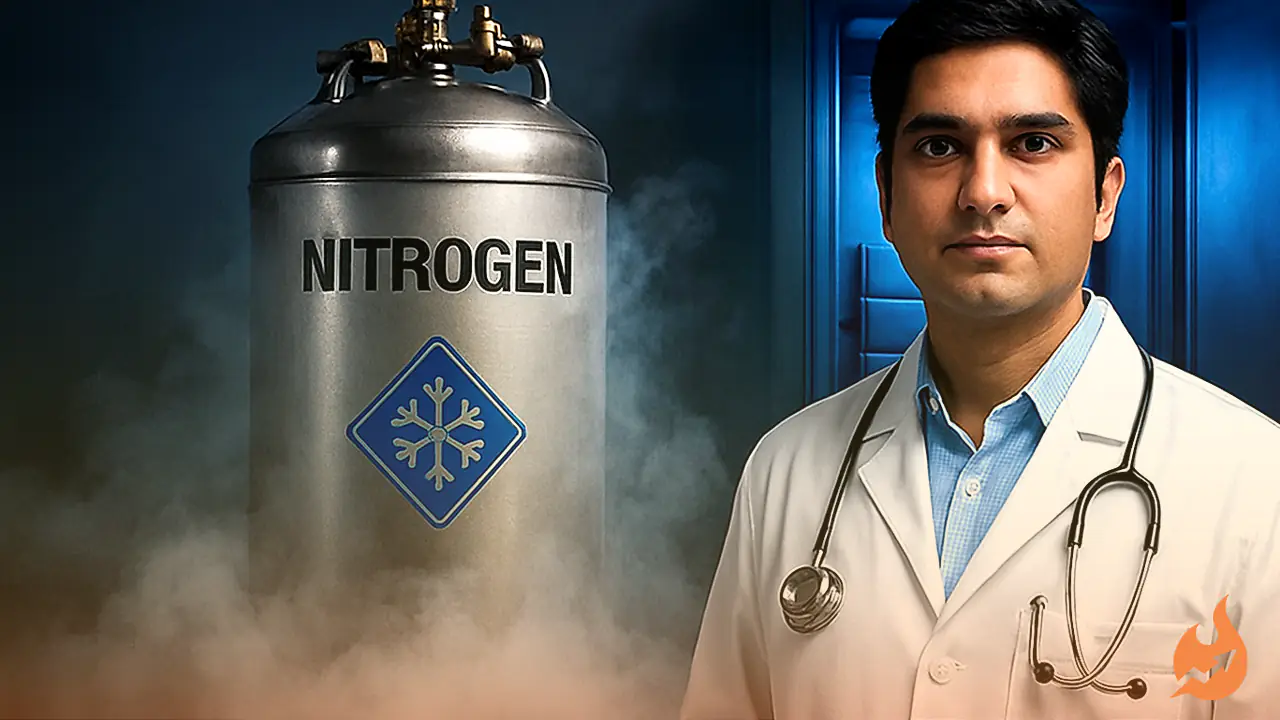

Methods of carrying out the death penalty have changed dramatically through history. In ancient times, prisoners were hanged from gallows or stoned to death. In the modern era, execution by hanging is still used in some places, while other countries administer death through a lethal injection. Now a new and deeply controversial method has emerged — one that has sparked an uproar in the United States.
Where the controversy began
In Alabama, USA, authorities prepared to put a prisoner to death using nitrogen gas. After fierce opposition, a court stepped in and stayed the procedure. Critics call it cruel and inhumane, arguing that the condemned person suffers for a long stretch of time before death finally comes — and that for this reason it should be stopped immediately.
The most common gas — yet lethal
The puzzling part is this: nitrogen is the gas present in the largest quantity on Earth, and it isn't even toxic. So how can it end a person's life? To answer exactly this question, Dr. Karn Mehra, Senior Consultant in the Pulmonology Department at Fortis Hospital, Manesar, walked through the entire process.
According to Dr. Mehra, nitrogen first triggers hypoxia and then anoxia in the body, a state in which 100 percent of the body's oxygen is wiped out and the prisoner dies. It is, he says, an extremely painful way to die.
How normal breathing works
To grasp this, it helps to understand how the body breathes. Our lungs draw in air, which is actually a mixture of several gases — the largest share, 78 percent, is nitrogen, followed by 21 percent oxygen, with small amounts of carbon dioxide, argon, helium, neon and hydrogen. The lungs filter all of this and retain only the oxygen, pushing the rest of the gases back out.
That oxygen is then picked up by the hemoglobin in the blood and delivered to every organ in the body. This is the oxygen that keeps us alive. Dr. Mehra explains that when oxygen stops reaching the body and its supply to the cells is cut off, the medical term for it is hypoxia. In plain terms, the cells can no longer "breathe" and they begin to die. When someone is executed with nitrogen, this is exactly the process that unfolds.
The execution procedure, step by step
On the day of the execution, Dr. Mehra says, the prisoner is first laid flat on a special medical stretcher and strapped down with strong bands so that he cannot move. A respirator mask is then fitted over his entire face, covering the eyes, nose, ears and mouth. The mask is designed to block outside air almost completely, so that virtually no oxygen gets through.
This mask is connected through a tube to cylinders of pure nitrogen gas kept in another room. The supply is switched on by remote. The moment it starts, nitrogen begins flowing in, and one hundred percent pure nitrogen — nothing else — starts reaching the prisoner's lungs.
What collapses inside the body
Dr. Mehra notes that nitrogen by itself is not a poisonous gas. But when no other gas enters the lungs and only nitrogen keeps pouring in, it forces out even the oxygen already present there — because oxygen is the lighter gas. As a result, oxygen is completely eliminated from the body, which is the state known as hypoxia.
Once the lungs receive no oxygen, the blood stops carrying oxygen to the body's organs. The brain cells are the first to shut down, and within a few seconds the person loses consciousness. Immediately after, the cells of the heart, lungs and other vital organs begin to die for want of oxygen. Within minutes the heartbeat stops entirely and the person suffers sudden cardiac death.
Why the method is being challenged
The defense argues that the respirator mask strapped to the prisoner's face can never be made fully air-tight. As a result, a little oxygen keeps seeping in. Even after the nitrogen is released, the prisoner does not die quickly, and in such a situation he may even slip into a vegetative state — meaning death could take a very long time to arrive. It is precisely this that has led critics to brand the method extremely cruel and inhumane.