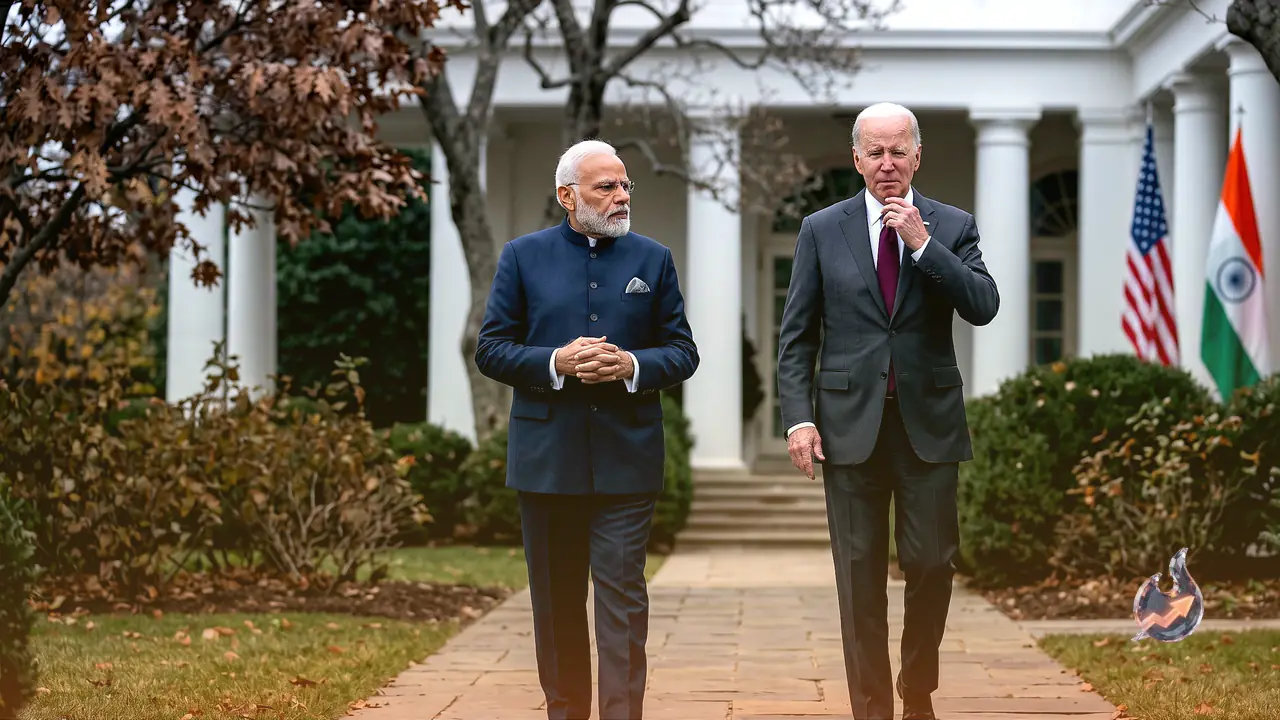

The warmth that was once held up as the model of India-US friendship now appears to be fading. In a single move, Washington has erased the word 'Indo' from its Indo-Pacific Command and gone back to calling it US Pacific Command. On the surface it looks like a routine renaming, but a deeper message is buried inside it. The signal is that America seems uneasy with India's growing weight in the region. That is why, on one side, Donald Trump is busy fixing his equation with China, while on the other he appears to be laying the ground to once again prop up Pakistan in order to keep India in check. Strategic affairs expert Brahma Chellaney and former Foreign Secretary Nirupama Rao have tried to decode the thinking behind the move.
What Brahma Chellaney Pointed To
Writing on X, Brahma Chellaney argued that the Pentagon's decision to drop 'Indo' and revert to the US Pacific Command name, combined with India barely figuring in the recent US National Security Strategy, lays bare just how much importance America actually attaches to India. According to him, the relationship now rests not on any shared vision but purely on bargaining and transaction. The reason, he says, is that Trump is trying to carve out a middle path with China. At the same time, to stop any single power, namely India, from dominating the region, Trump has rediscovered Pakistan's usefulness.
Nirupama Rao's Caution
Former Foreign Secretary Nirupama Rao wrote on X that the real question is whether America still treats India as a partner in shaping the regional order, or merely as one useful piece among many it can move around to serve its own goals. In her view, these are two entirely different things. She tied this directly to PM Modi's remark in which he flagged a deficit of trust.
The Bigger Picture in Scattered Signals
Place the various signals of recent weeks side by side and a clearer pattern emerges. Trump branding India a 'dead economy'. The warning from US official Landau at the Raisina Dialogue that America will not repeat the China mistake with India. The death of Indian sailors and the sharp exchange with US Senator Marco Rubio. The visible distance and cold imagery at the G7 summit. PM Modi stressing the erosion of trust in the world. And now, the shrinking of the very symbol of the Indo-Pacific.
No single one of these is hard proof that the relationship is breaking. But stitched together, they make it plain that the golden, high-energy phase of India-US ties is now on the wane. Going forward, the relationship looks set to become more ordinary, more practical, more transactional and possibly far more complicated.
What It Means for India
Experts say India must now shed the illusion that America is a firm and permanent friend. America will court India only as long as its own interests are served; the moment that need ends, the warmth will cool just as quickly.
The biggest worry is that America does not want India sitting at the top of this region. To keep India tied down, it could once again hand Pakistan strength and support.
Meanwhile, instead of confronting China, Trump is focused on locking in his trade deals with it. If that US-China deal goes through, America will have little real need for India.
PM Modi's point about a shortage of trust is now proving accurate. The takeaway is that India will have to fight its own battles, because leaning on America alone is no way to gamble with national security.