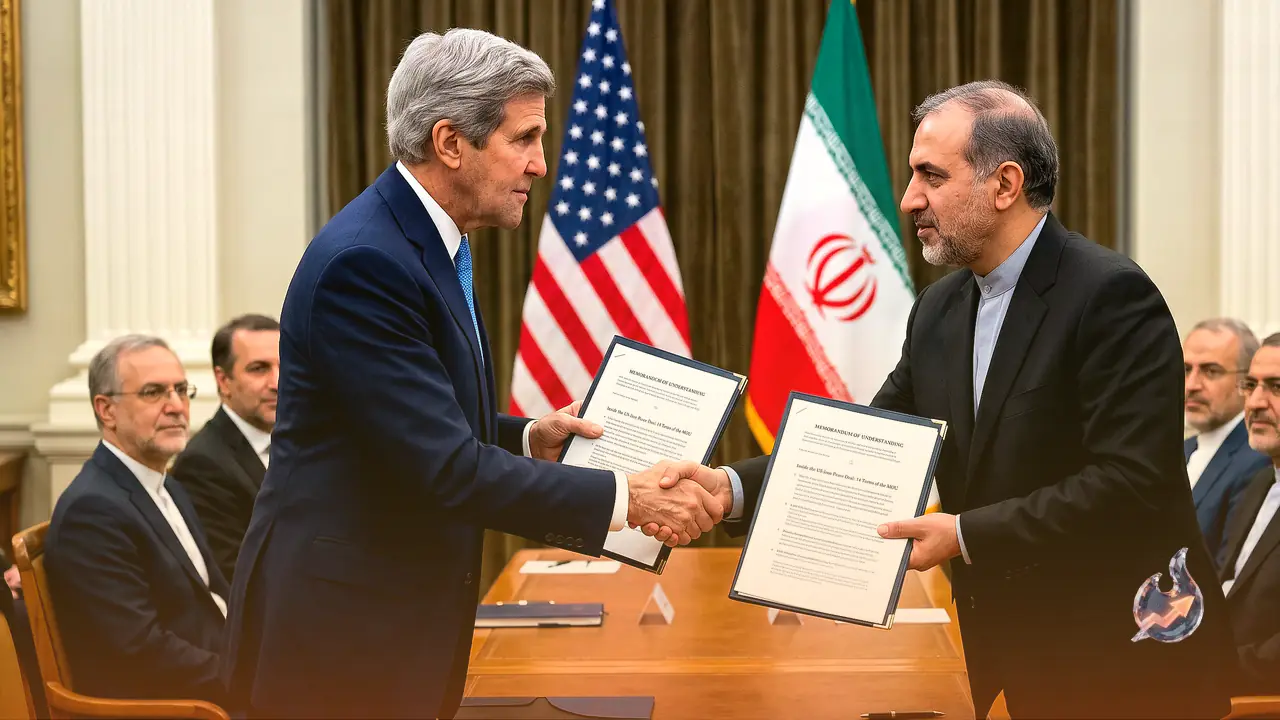

After keeping the contents of the document under wraps for several days, senior US officials on Wednesday read out the memorandum of understanding (MOU) reached with Iran to a group of journalists. The formal signing is set for Friday, and ahead of it the officials shared the details on condition that their identities remain confidential. Soon after, Iran's state television released the draft as well, and it closely matched the version put out by the United States.
How the deal came to light
For a long stretch, neither side had disclosed what the document actually contained. Putting it before reporters right before the signing ceremony signals that both parties are very close to finalising it. Notably, the versions released by Washington and Tehran were almost identical, suggesting the two sides have agreed even on the precise wording.
The 14 key terms of the MOU
- The United States, Iran and their allies in the ongoing war declare that, the moment this MOU is signed, military operations on every front including Lebanon will stop immediately and permanently. All sides also pledge that they will neither launch a war nor a military operation against one another going forward, and will refrain from using force or threatening to use it. The final agreement will reaffirm the permanent end of war on all fronts including Lebanon along with the other conditions in this clause.
- Both countries commit to respecting each other's sovereignty and territorial integrity and to staying out of each other's internal affairs.
- The United States and Iran are committed to continuing talks and reaching a final agreement within a maximum of 60 days, a period that can be extended by mutual consent.
- As soon as the MOU is signed, the United States will begin removing its naval blockade against Iran along with any obstruction or hindrance, and will lift the blockade completely within 30 days. During this window, ship movement will be proportional to the pre-war traffic that Iran restores. The United States also pledges to pull its forces back from around Iran within 30 days of the final agreement.
- Once signed, Iran will make every effort to ensure commercial ships can move safely from the Persian Gulf to the Sea of Oman and back, without any charge, for 60 days. This movement will begin at once, and given the need to clear technical and military obstacles and remove mines, Iran will make it fully operational within 30 days. The Islamic Republic of Iran, together with the Sultanate of Oman, will hold talks to decide the future administration and maritime services in the Strait of Hormuz. Other countries bordering the Persian Gulf will also be included, while applicable international laws and the sovereign rights of the Strait of Hormuz's coastal states are respected.
- The United States, working with regional partners, promises to develop a firm and mutually agreed plan worth at least 300 billion US dollars for Iran's reconstruction and economic growth. The method of implementing it will be decided within 60 days as part of the final agreement. All licenses, exemptions and approvals needed for the related financial transactions will be issued by the United States.
- As part of the final agreement, the United States promises to lift, within a set timeframe, all sanctions imposed on the Islamic Republic of Iran. These include UN Security Council resolutions, IAEA Board of Governors resolutions, and all US unilateral sanctions, both primary and secondary. Both sides acknowledge how important the removal of these sanctions is and intend to take it up immediately in the talks.
- Iran reaffirms that it will neither buy nor develop nuclear weapons. For disposing of the stockpile of enriched material, the United States and Iran have agreed on a mutually acceptable method that follows the timeline set out in clause 7 and includes a minimal process of reducing the material's concentration (downblending) on-site under IAEA supervision. Both sides are also willing to discuss the enrichment question and other mutually agreed matters tied to Iran's nuclear needs, based on the framework settled in the final agreement. The final deal will confirm the terms of this clause, and both countries, treating these nuclear issues as highly significant, intend to address them immediately in the talks.
- Until the final agreement, the two countries agree to maintain the status quo. The Islamic Republic will keep its nuclear program in its current state, while the United States will impose no new sanctions and deploy no additional forces in the region.
- The United States promises that, from the moment of signing until the sanctions are gone, its Treasury Department will issue waivers for the export of Iranian crude oil, petroleum products and their derivatives, as well as all related services such as banking transactions, insurance and transportation.
- The United States also pledges that, once the MOU takes effect, it will make the frozen or restricted funds and assets of the Islamic Republic of Iran fully available for use. Both countries will agree during the talks on the procedures for releasing these funds. Whether kept in the original account or transferred, the funds will be made fully usable to pay any final beneficiary designated by Iran's Central Bank. The United States pledges to issue all the necessary licenses and approvals for this.
- Both countries agree that an executive mechanism will be set up to monitor the successful implementation of the MOU and the future compliance with the final agreement.
- After the MOU is signed and the implementation of its paragraphs 1, 4, 5, 10 and 11 begins and continues, the United States and Iran will start negotiations specifically on the final agreement covering the remaining paragraphs.
- The final agreement will be approved through a binding UN Security Council resolution.
Why Hormuz and the nuclear issue sit at the centre
The deal's biggest takeaway is that commercial traffic through the Strait of Hormuz will stay open, while Iran will not pursue the nuclear weapons route. These two points are the backbone of the entire framework, because a large share of the world's oil supply passes through this narrow channel, and Iran's nuclear program has been a source of tension for years. Economic concessions such as lifting sanctions, returning frozen assets and the 300 billion dollar reconstruction plan appear to be the main factors drawing Iran toward this agreement.