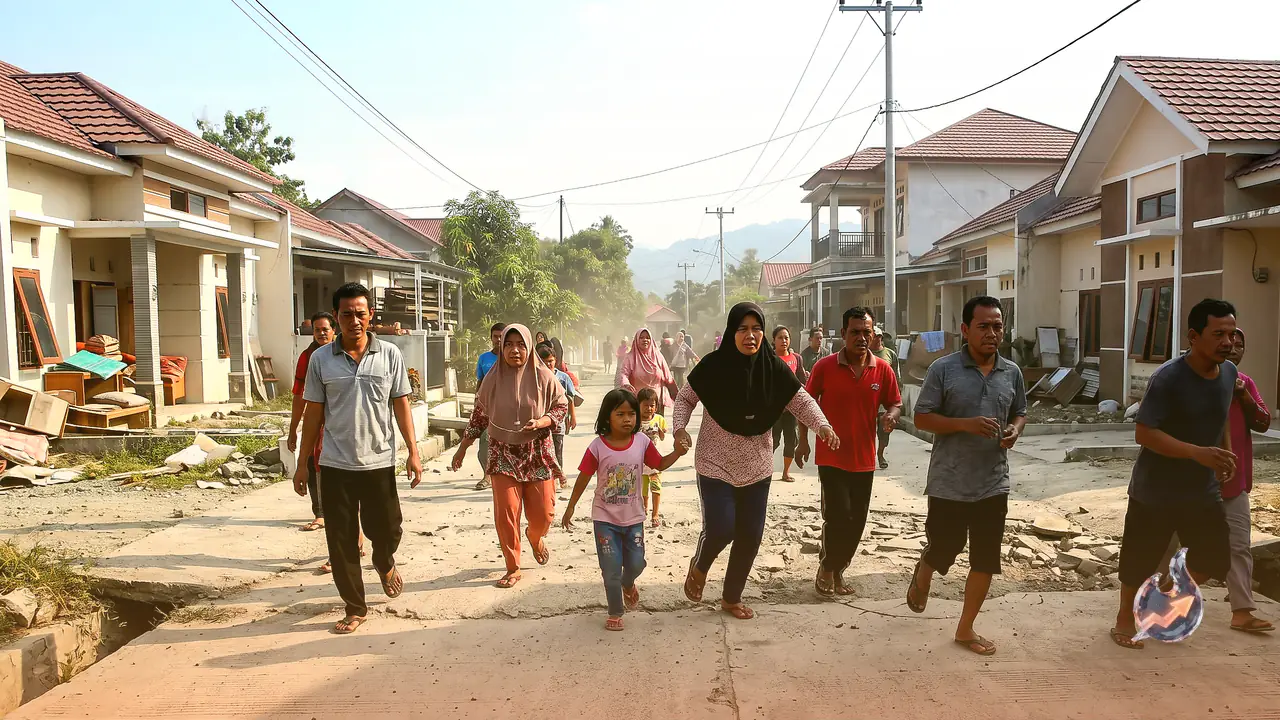

Tuesday morning brought a wave of fear to Indonesia when the ground beneath Central Sulawesi suddenly began to heave. The quake measured 6.7 on the Richter scale. What made it especially terrifying was its duration. The very first tremor was no fleeting jolt, instead people felt the earth shudder violently for more than a full minute, long enough to send residents rushing out of their homes.
Where the quake struck
According to the US Geological Survey, the epicentre of the earthquake lay 46 kilometres east-southeast of the city of Palu, which serves as the capital of Central Sulawesi province. The quake originated at a depth of roughly 10 kilometres, making it a shallow one, and that is precisely why the shaking was felt so intensely at the surface. The main shock was soon followed by a second tremor of 5.2 magnitude, deepening the unease among an already shaken population.
No clear picture of damage yet
Despite the force of the tremors, there has so far been no confirmation of any damage or casualties. With aftershocks continuing to ripple through the region, people are staying out in the open and on guard while officials assess the situation.
Why Indonesia sees so many quakes
Indonesia sits atop several seismic fault lines, which is why earthquakes and volcanic activity are an almost routine reality here. History bears this out painfully. In January 2021, a 6.2 magnitude quake struck near the city of Mamuju on Sulawesi island, claiming at least 100 lives. Back then, thousands of people were too frightened of aftershocks to return indoors and spent several nights sleeping out in the open.
A neighbouring tragedy in the Philippines
This Sulawesi quake comes just days after the southern Philippines was battered by a devastating 7.8 magnitude earthquake. That disaster killed at least 32 people and left more than 200 injured. The shaking was powerful enough to collapse buildings, set off landslides and unleash a tsunami, causing heavy destruction along coastal areas.
An entire region on alert
Authorities across Southeast Asia are keeping a constant watch on seismic activity. Their warning is blunt, that strong earthquakes and aftershocks can arrive at any moment without prior notice. Indonesia's disaster management agencies are evaluating conditions on the ground, urging the public to stay fully alert, and continuously sharing the latest updates on both the earthquake and tsunami risks.