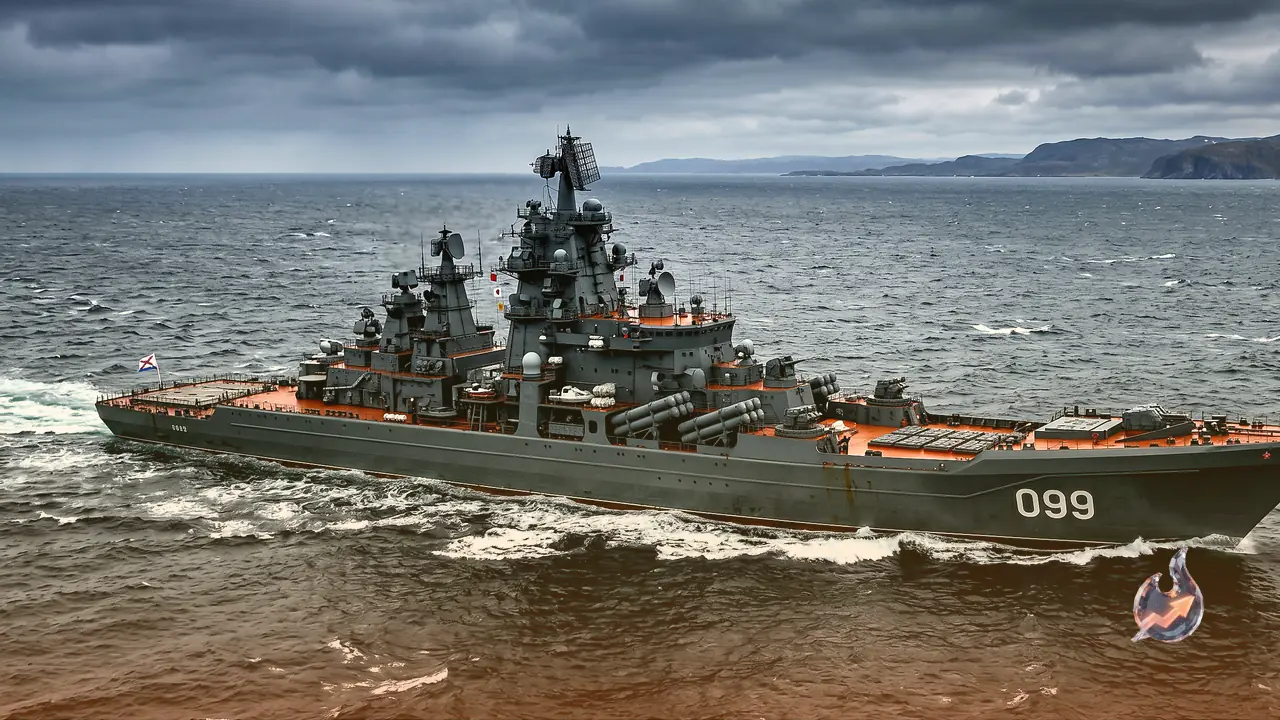

In the second half of the twentieth century, the contest between the United States and the Soviet Union spilled far beyond land and sky. The oceans became one of the biggest arenas of this power struggle, and it was here that the Soviet Navy unveiled a surface warship whose missile firepower stunned defence experts. This was the Kirov-class (Kirov-class) battlecruiser, a vessel so heavily armed that it is still remembered by the nickname “missile monster”.
The most advanced and powerful ship of this class was Pyotr Velikiy (Pyotr Velikiy). Powered by nuclear energy, it was built specifically to threaten and neutralise American Carrier Battle Groups. Its Full Load Displacement reaches around 28,000 tons, roughly twice that of the destroyers fielded by many countries. Stretching about 252 metres in length and 28.5 metres in width, the warship carried more than 300 missiles along with powerful radar, air defence systems, torpedoes and anti-submarine weapons.
An Arsenal Built to Strike Air, Surface and Depth
The true identity of the Kirov-class lay in its layered arsenal, capable of taking on threats from the air, the sea surface and submarines lurking below, all at once. For its offensive punch the ship mounted 20 P-700 Granit (P-700 Granit) anti-ship missile launchers, designed expressly to destroy enemy aircraft carriers and large warships.
Its defences against aerial attack were just as formidable. The ship carried 12 S-300 Fort-M (S-300 Fort-M) air defence launchers, which together could field a total of 96 missiles. Alongside these were 16 Kinzhal (3K95 Kinzhal) air defence launchers, holding 128 missiles. That meant the warship kept a stockpile of 224 missiles dedicated to air defence alone.
To knock out close-range threats such as short-range missiles and incoming aircraft, the ship deployed 6 Kortik (Kortik) close-in weapon systems. As its main gun it carried a 130 mm AK-130 dual-purpose gun, able to engage both naval and aerial targets.
For the battle beneath the waves, the ship was fitted with 10 torpedo tubes (533 mm). On top of that it carried two RBU-1200 and one RBU-1000 anti-submarine rocket launchers, capable of striking enemy submarines hidden in the depths.
Not Just an Attacker, but a Shield for the Whole Fleet
It would be a mistake to treat the Kirov-class as nothing more than a floating warehouse of missiles. It was a multi-role warship that combined anti-submarine rockets, torpedo systems, automated naval guns and a close-in weapon system (CIWS) on a single platform. This is exactly why it earned the labels “missile monster of the sea” and “floating missile fortress”. In its day, hardly any other surface warship matched its number of missiles or the strength of its layered defences.
Its importance was not limited to attack. In wartime, its role was also to throw a protective shield around the entire naval fleet. That is why the Soviet Navy counted it among its most valuable warships.
Why It Robbed America of Sleep
During the Cold War, the backbone of the US Navy was its carrier battle groups. Soviet strategists believed that if these carrier groups could be knocked out in a conflict, American sea power would suffer a crippling blow. It was this very logic that gave birth to the Kirov-class.
A salvo of 20 Granit missiles fired together was considered a serious challenge for any carrier battle group. Western defence experts ranked it among the most dangerous naval platforms of that era. Its mere presence forced the US Navy to keep upgrading its strategies and defensive systems again and again.
Why It Is Still Remembered Today
Modern warfare now revolves around drones, stealth technology, hypersonic weapons and network-centric strategy, yet the Kirov-class still holds a special place in naval history. It belongs to that small group of warships that can genuinely be called a floating missile fortress.
More than three decades have passed since the Cold War ended, but no discussion of the world's most powerful warships feels complete without mentioning the Kirov-class battlecruiser. Thanks to its vast missile arsenal, nuclear power and layered combat capability, it is still counted among the most influential warships in military history.
Only One Active Ship Remains Today
The Soviet Union built a total of four Kirov-class battlecruisers during the Cold War. Over time, most of them were retired from service. At present only Pyotr Velikiy (Pyotr Velikiy) remains in active service and is regarded as a key part of Russian naval strength.
Its sister ship Admiral Nakhimov (Admiral Nakhimov) is currently undergoing a sweeping multi-billion dollar modernization project. New missile systems, modern radar and advanced electronic warfare capabilities have been added to the vessel. According to reports, the warship is in the final stage of its sea trials and could soon rejoin the Russian Navy. The other two ships of this class, Kirov (Kirov) and Admiral Lazarev (Admiral Lazarev), were taken out of service years ago.