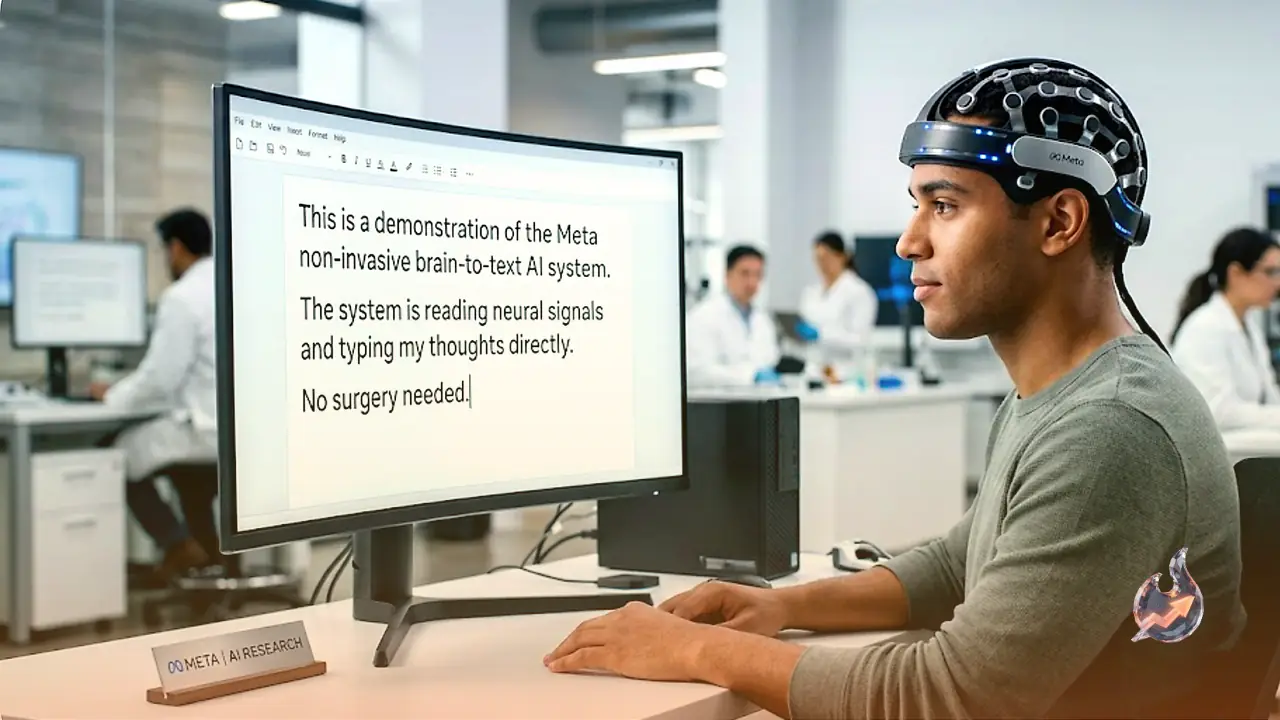

Imagine someone who has lost the ability to speak or write being able to type simply through the signals in their brain, with no operation involved. On Monday, Meta unveiled exactly that kind of AI system, called Brain2Qwerty v2, which translates brain activity into text using non-invasive brain recordings. The company says the research is aimed at helping people who can no longer communicate because of brain lesions.
The way it works is what makes it striking. The system captures brain activity through a helmet-like magnetoencephalography (MEG) scanner, a non-invasive imaging device widely used in neuroscience research. Those raw neural signals are then fed into an end-to-end AI model that reconstructs the sentences a person is attempting to type.
How It Boosts Accuracy
According to Meta, the system fine-tunes large language models (LLMs) on neural data so it can lean on semantic context when interpreting noisy brain recordings. "We trained Brain2Qwerty v2 on approximately 22,000 sentences from nine volunteer participants, each recorded for 10 hours wearing a magnetoencephalography (MEG) device while actively typing," Meta wrote. "Instead of relying on hand-crafted pipelines to detect neural events, we use end-to-end deep learning to decode directly from raw brain signals."
The numbers are eye-catching. Brain2Qwerty achieved a 61% average word accuracy, compared with roughly 8% for earlier non-invasive methods. Meta is releasing the system's code and dataset as part of its Digital Brain Project, which also includes a $5 million fund to support open neuroscience datasets.
The company added that decoding accuracy improved as the amount of training data grew, hinting that more data could push performance even higher. Before engineers settled on the final training configuration, AI agents explored possible optimizations for the decoding pipeline.
Challenging the Need for Surgery
In an accompanying paper published in Nature Neuroscience, Meta researchers argued that even though AI has dramatically improved brain-to-text decoding, most top-performing brain-computer interfaces still rely on surgically implanted electrodes. That makes them hard to scale, given the risks of brain surgery and the difficulty of maintaining implants over time.
Meta claims Brain2Qwerty v2 approaches accuracy levels previously reached only with techniques that require brain surgery. Its non-invasive approach, the company says, could help bridge the gap between invasive neuroprosthetics and communication systems that need no operation at all. "Our hope is that this work, done in the open, advances neuroscience to identify, diagnose, and treat neurological disorders faster than in siloes," Meta wrote.
A Fast-Moving Race
The announcement lands as brain-computer interface research picks up pace, including efforts by Elon Musk's Neuralink and Merge Labs, backed by OpenAI CEO Sam Altman, both developing technology to help restore communication for people with neurological disorders.
While companies like Neuralink and Synchron are pursuing implanted interfaces that require surgery, a growing number of researchers and startups are turning to AI to improve non-invasive systems. In September 2024, the startup Neurable introduced AI-powered EEG headphones designed to track focus and cognitive fatigue. A year later, MIT spinout AlterEgo revealed a wearable that converts silent neuromuscular signals from the face and throat into text and commands, pitching it as a practical alternative to implanted brain-computer interfaces.