






















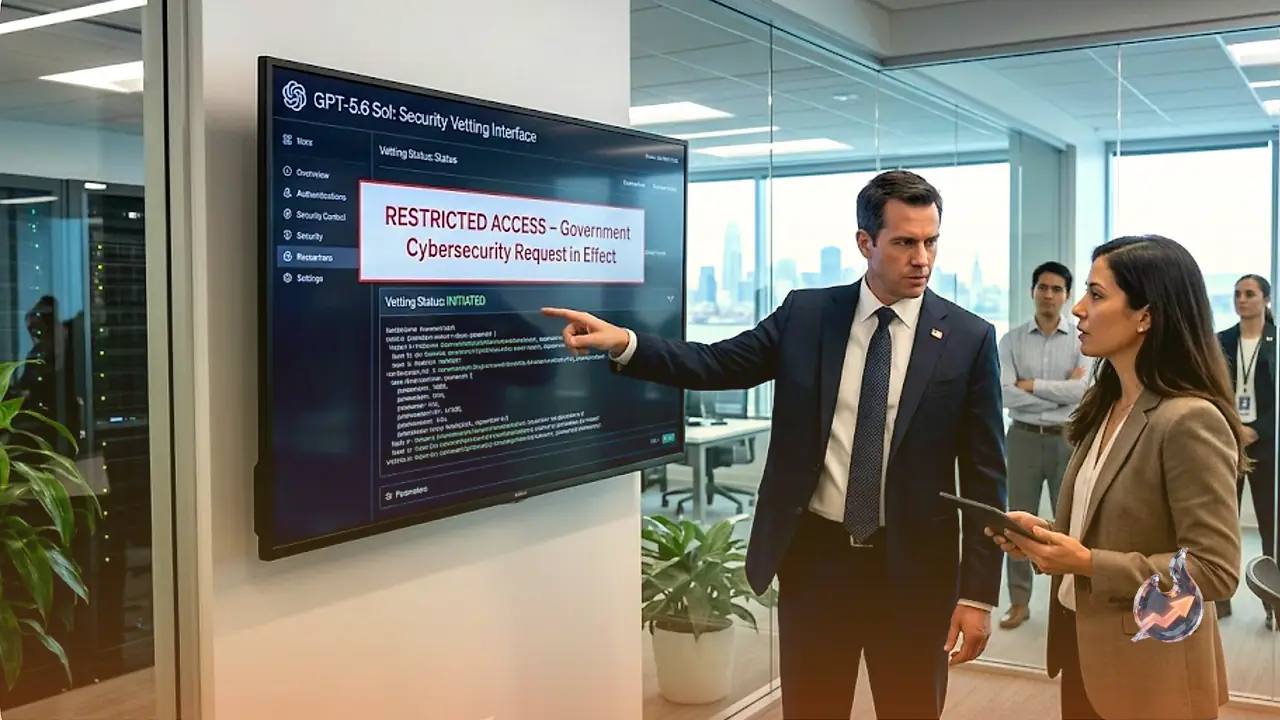

OpenAI has announced that it is curbing access to its latest artificial intelligence model, GPT-5.6 Sol, in response to a request from President Donald Trump’s administration. The firm stated that the model will be provided initially to a small, handpicked group of trusted partners. These partners are required to gain approval from the Trump administration before receiving access. OpenAI noted that this review process is not sustainable as a long-term solution.
White House Oversight on Frontier AI
This development is part of an intensifying effort by the White House to monitor powerful AI architectures. Government officials are actively collaborating with frontier AI laboratories to address security concerns. The primary focus of these reviews is on systems that could potentially present cybersecurity threats. The government is particularly scrutinizing tools that assist in identifying software vulnerabilities, as such capabilities could be exploited to compromise critical national computer networks.
OpenAI’s Stance
OpenAI emphasized that this restricted rollout is merely a temporary measure, with broader access anticipated in the coming weeks. The company explicitly stated that it does not believe this level of government-led access control should become the default procedure for the long term. Furthermore, OpenAI highlighted that Sol is significantly more effective at helping users detect and resolve vulnerabilities, and it affirmed that the model does not exceed the company’s internal thresholds for potential harm.
Managing Risk and Uncertainty
The company acknowledged lingering uncertainties regarding novel use cases and unexpected risks. Specifically, there is concern that risk factors could escalate if Sol is integrated with other external tools. On Friday, the company explained that the combination of the model’s significant leap in capabilities and this inherent uncertainty is the reason for pairing increased utility with stringent safeguards and a phased release strategy. OpenAI has not yet identified any of the approved customers.
The Trump Administration’s Policy Framework
Earlier in June, Donald Trump signed an executive order regarding AI oversight. This order established a roadmap for the federal government to assess national security risks, permitting up to 30 days of review prior to any public release. Although the order described developer participation as voluntary, the comprehensive framework remains incomplete.
The Anthropic Precedent
OpenAI’s decision follows previous government interventions involving Anthropic, the San Francisco-based creator of the Claude chatbot. Shortly after their launch, Anthropic took its models, Fable 5 and Mythos 5, offline. The company took this action to comply with a directive from Donald Trump that prohibited the use of such models by foreign nationals.
Concerns Over Cyber Weaponry
Officials became increasingly alarmed after Anthropic issued warnings regarding the capabilities of Mythos earlier this year. Anthropic noted that Mythos was adept at identifying software weaknesses, which the company admitted could be weaponized by malicious hackers to threaten essential global networks. The White House maintains that it continues to engage with various AI laboratories regarding these scaling risks.
Political and Industry Backlash
Allies of Donald Trump have pointed fingers at Anthropic and its CEO, Dario Amodei, for inviting this heightened level of scrutiny. Investor David Sacks stated on a recent podcast that Amodei visited Washington in April and effectively framed his creation, Mythos, as a cyber weapon, which significantly raised cortisol levels among officials. Conversely, US Rep. Lori Trahan has criticized the administration's arbitrary approach, stating that decisions are being made company by company without any law, process, or formal oversight.
Expert Critique
Cybersecurity experts have also expressed disapproval regarding the government's actions that led to the shutdown of Fable. Alex Stamos, a cybersecurity expert at Stanford University and chief product officer at Corridors, noted that the industry finds no factual basis for these restrictions. According to Stamos, Amazon conducted a research review of Fable and shared its analysis, which indicated no risks beyond those found in other public models, including those developed in China. Stamos argued that if the administration is serious about outcompeting China, these actions are counterproductive.
Navigating the Future
OpenAI CEO Sam Altman held discussions with US Commerce Secretary Howard Lutnick on Wednesday regarding the model’s release. Meanwhile, the Pentagon has designated Anthropic a national security risk, and Donald Trump has ordered federal agencies to cease using Claude. Anthropic has since filed a lawsuit that remains pending in federal courts. OpenAI, for its part, maintains that its phased approach to the release of Sol is intended solely for risk management, with wider availability expected soon.