
As electric vehicles spread, so does the web of charging stations that keeps them running. But one side of this rapid build-out has barely been examined: the fresh wave of cybersecurity threats it invites, threats for which workable defenses are still in short supply.
Why Charging Stations Are Vulnerable
Cristina Alcaraz, an infrastructure-security researcher at Spain's University of Malaga, says the real reason charging stations are so exposed is that they stitch together many physical and digital components at once. That intricate design, she explains, is exactly what keeps the chargers running efficiently — yet it also opens the door to a long list of new vulnerabilities whose consequences can reach far beyond a single device.
Leaving chargers open to attack puts two things at risk at the same time: the pace at which drivers keep adopting EVs, and the stability of the electrical grids in the countries where those chargers operate.
A Proposal Built on AI Agents
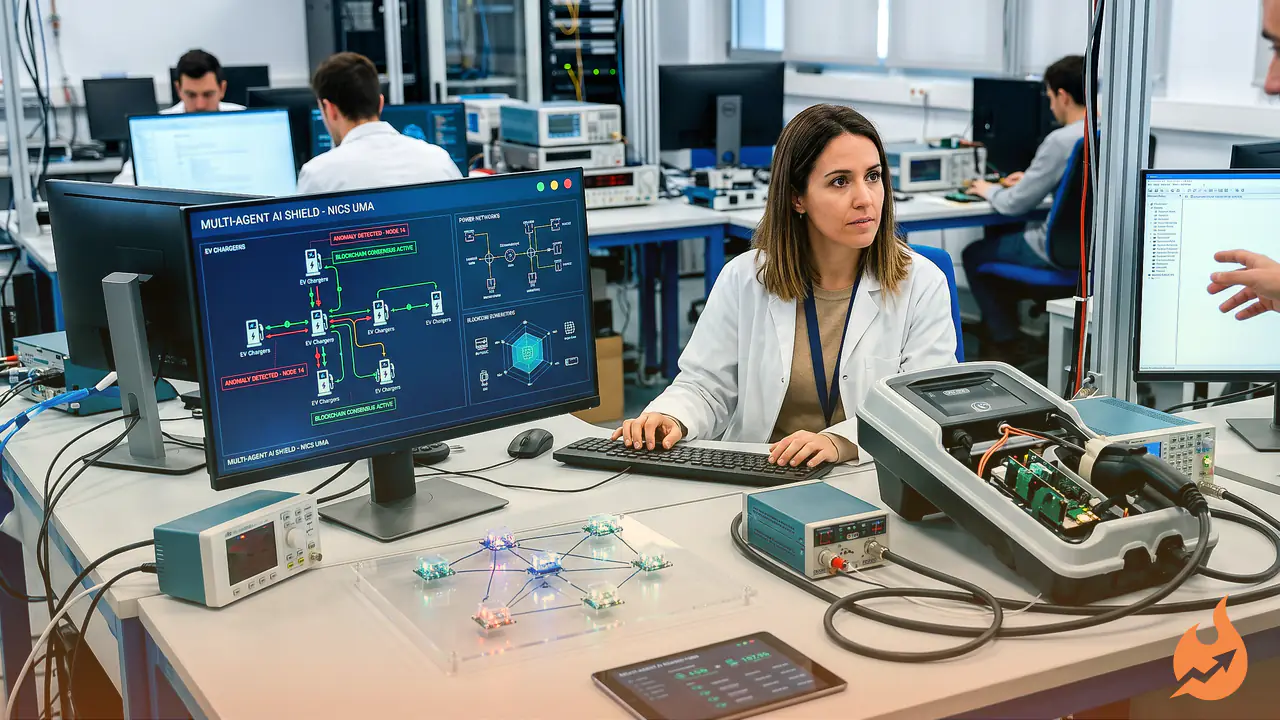
To confront that threat, researchers from the NICS lab at the University of Malaga have put forward a novel idea — deploying AI agents to defend the infrastructure. The agents are designed to block cyberattacks coming from very different directions. That ranges from fraud or energy theft carried out by bad actors abusing the charging stations, all the way up to larger assaults that could damage critical-energy networks.
The team wants to make sure that any anomaly or attack on a charging network is spotted early and reliably. To do that, they build on the Open Charge Point Protocol (OCPP), one of the most widely used standards for operating and managing EV chargers. The protocol lets a network of charging stations talk to a centralized system that can manage, monitor, and coordinate every energy transaction carried out by end users.
What the Central System Handles
That central system takes care of a number of jobs remotely — verifying users, managing the electrical load at each station, monitoring overall electricity consumption, and running technical diagnostics. Those capabilities make real-time control of the infrastructure possible and let operators catch any unusual behavior and respond to it quickly.
The Limits of Today's Monitoring
The authors of the new study point out, however, that the monitoring tools built on this protocol typically look only at network traffic or local events. As a result, they offer just a narrow window into what is actually happening across an entire region of infrastructure. That narrowness, the researchers say, makes it hard to pin down where in the system an anomaly is occurring, which network components have been compromised, how wide the vulnerabilities run, and which paths a potential attack might travel as it spreads.
Giving Every Station Its Own Eyes
Their answer is a system that relies on multiple AI agents. Every station — or every relevant component of the charging network — carries AI agents able to analyze their surroundings, gather information, and work alongside other agents to assemble a full picture of the infrastructure's current state.
Alcaraz, who is also the report's lead author, puts it this way: “Each agent assesses the status of chargers, communications, and connected devices to detect anomalies, operational failures, or potential security incidents.” She adds: “These agents, which are connected to a central-monitoring system, compare the information obtained locally with that of nearby stations, providing a more complete, accurate, and contextualized collaborative view of the situation.”
'Opinion Dynamics' — Mimicking How People Reach Agreement
The work, published in the International Journal of Critical Infrastructure Protection, notes that one of the system's most original features is its consensus mechanism, which rests on a mathematical framework known as opinion dynamics.
The approach imitates the way humans trade information within their own social networks to arrive at agreements. Translated into computer models, it allows the AI agents to share their observations with one another and gradually fine-tune their own assessments, building up a collective grasp of the overall situation.
According to the authors, this process lowers the chance that the AI agents will generate false positives. It also enables the system to catch anomalies that might slip through unnoticed if they were only examined locally.
Blockchain for Trust and Traceability
The proposed architecture also leans on blockchain technology as a trust-and-validation mechanism. Every transaction the agents perform is written to a distributed ledger that cannot be altered afterward — a safeguard that guarantees both the integrity of the system and a complete, traceable record of what took place.
How It Performed in Testing
The researchers tried the multi-agent system out in a simulated, OCPP-compliant charging environment. During the experiments, the agents were put through a variety of anomaly scenarios within the charging network: component failures, communication link errors, and situations that demanded a coordinated response from several parts of the system at once. In every case, the AI agents had to identify each local disturbance, share what they saw with one another, and collaborate to form a shared understanding of the incident.
The results showed that pairing the AI agents with the distributed-consensus mechanism and blockchain technology delivered a global view of the network. The system flagged both specific anomalies inside individual devices and certain behavioral patterns that were affecting multiple charging stations. On top of that, the consensus mechanism sharpened the accuracy of the diagnoses by weighing observations from different agents against one another, making the resulting reports more reliable.
The university lab is happy with the outcome. “This system provides a new way to guarantee the protection of electric-vehicle charging infrastructure,” it said in a press statement.