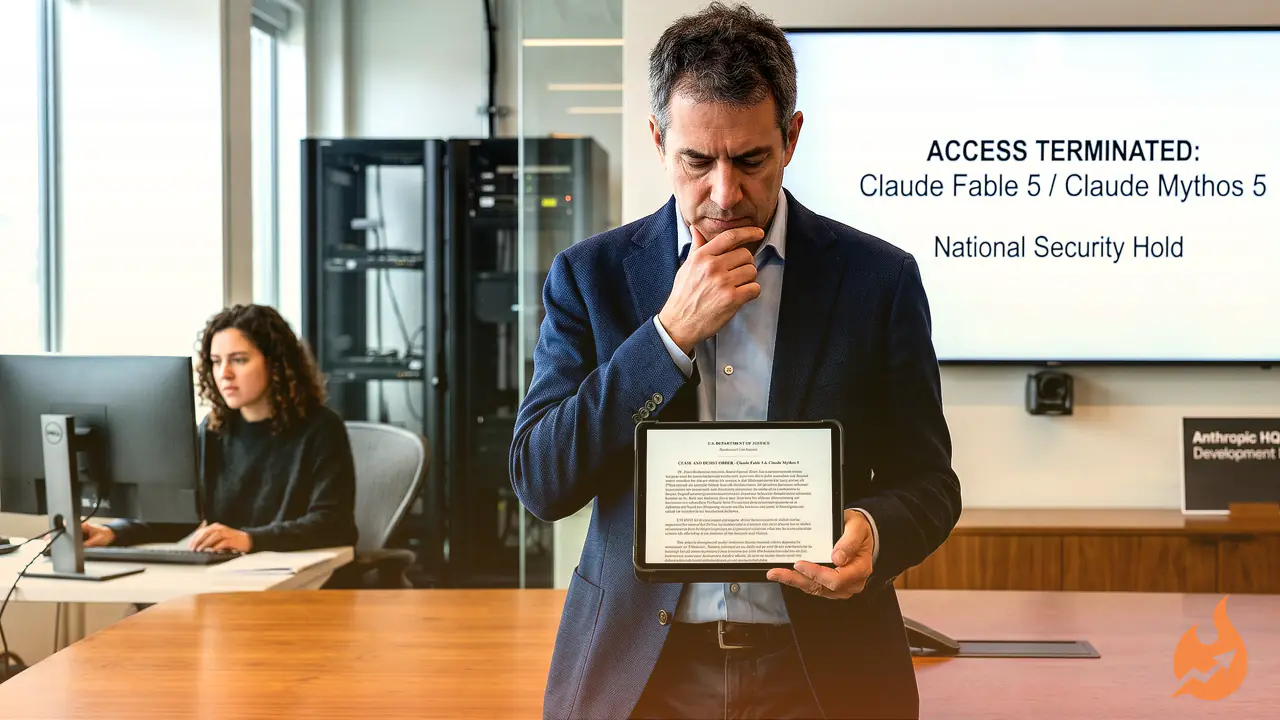

An unusual confrontation has broken out at the frontier of artificial intelligence. On Friday the U.S. government handed Anthropic an emergency export-control directive ordering it to halt access to its two most powerful AI models — Claude Fable 5 and Claude Mythos 5 — with immediate effect. Both had been released only days earlier. The government pointed to national security as its reason.
Why the order swept so wide
The directive applies to every foreign national, whether located inside the United States or beyond its borders, and it does not even exempt Anthropic's own staff. Because no foreign national could be allowed near the models, the order's reach proved so broad that the company ended up switching the models off for its entire customer base just to stay in compliance.
What the worry actually is
The letter itself offered no specifics about the national security concern. Still, the belief is that the government has learned of a way to bypass — or "jailbreak" — the publicly available Fable 5 model. Mythos 5, by contrast, ships with fewer guardrails and is especially good at uncovering cybersecurity exploits, which is why it had only been made available to a handful of select partners.
Anthropic pushes back on the severity
The company has openly questioned how serious the finding really is. Anthropic says it watched a demonstration of the technique and came away convinced that the vulnerabilities pointed to are relatively simple ones — the kind that other publicly available models can surface too, without needing any bypass at all.
According to the company, the only evidence supplied so far has been verbal, describing a narrow, non-universal jailbreak. In practice, it amounts to little more than asking the model to read a particular codebase and patch whatever software flaws it finds. Anthropic added that it confirmed this level of capability is already widely on offer from rival models, OpenAI's GPT-5.5 among them.
A precedent the company calls dangerous
Even while complying, Anthropic warned that the action sets a troubling precedent. "If this standard was applied across the industry," the company wrote, "we believe it would essentially halt all new model deployments for all frontier model providers."
It stressed that access to every other Anthropic model remains untouched, and said it is working to bring the two suspended models back online as quickly as it can.
David Sacks gives the government's account
On Saturday, David Sacks — co-chair of the President's Council of Advisers on Science and Technology — laid out his version on X. He began by noting that, as is widely known, Anthropic had publicly released its Mythos-class models earlier in the week under the commercial name Fable.
He then wrote that "a highly credible, trusted partner of both Anthropic and the U.S. government who was testing Fable came forward with a jailbreak of those guardrails. The admin asked [Anthropic CEO Dario Amodei] to fix the jailbreak or de-deploy the model. Dario refused."
Sacks argued that the company's response clashed with its own public stance on the need for AI safety and regulation — a position Amodei had restated only this week in a blog post.
"Anthropic prioritized the continued offering of the consumer model over safety," he wrote. "In reaction, the admin issued the export control. The admin did this reluctantly. It's been very surprised that Anthropic hasn't wanted to cooperate with a reasonable safety request (i.e. fixing the jailbreak issue). Anthropic's reaction is very much at odds with their branding and ethos as a safe AI research community."
He went on to say the administration hopes Anthropic will repair the flaw so that Fable 5 can return to public release. "The admin values Anthropic's technical capabilities and feels that this issue, while serious, should be easily resolved," Sacks wrote. "The ball is in Anthropic's court."
The history behind the friction
This is not the first clash between the two sides. Earlier this year Anthropic and the U.S. government locked horns when the AI firm declined to sign an expanded agreement that would have permitted mass domestic surveillance of Americans and fully autonomous lethal weapons systems.
After those talks collapsed, President Donald Trump publicly attacked the company, and the Department of Defense branded Anthropic a "supply chain risk" — a label the firm has contested in court. In the period since, reports suggested the standoff had eased somewhat, as the government looked to make use of Claude Mythos and other models.