
On June 3, the little-known studio Reve released the 2.0 version of its image model, and it immediately landed at #2 on the Arena text-to-image leaderboard — sitting just under OpenAI's GPT Image 2 and just above Google's Nano Banana 2. Reve frames the achievement bluntly: it says this is the strongest image model built by any company that isn't a trillion-dollar behemoth, and that it got there while training on 10x fewer GPUs than the rivals flanking it on the board.
For a startup almost nobody could name a year ago, that is a bold thing to say out loud. But the headline isn't really the ranking. The story is the engineering trick that got Reve onto the leaderboard in the first place.
The "layout" idea that sets Reve apart
Most image generators today take your prompt, balloon it into a long English paragraph, and feed that to a diffusion engine. Reve scrapped that habit. Instead it builds what it calls a "layout" — a structured, editable blueprint in which every object carries a position, a size and its own caption, the way HTML describes the pieces of a webpage. The model reasons over that blueprint in a visible thinking trace, then paints the pixels at native 4K, which comes out to a genuine 16 megapixels.
That one decision is the entire sales pitch. Because the picture is planned almost like code, you can shift a subject, rewrite the words on a wall sign, or replace a background without regenerating the whole frame from scratch. It also lets you pile on extreme detail and fine adjustments across repeated prompts without burning through money.
When the first Reve model launched, our own testing credited it with beating Midjourney and Flux at roughly a cent per image. Reve 2.0 carries that same cheap, control-first DNA forward: each API generation costs around a fraction of a cent.
The upshot is that Reve can be the perfect tool for one person and a pointless purchase for another. If you iterate constantly, lean on accurate text, print at high resolution, or wire images into agentic pipelines, the layout method is a genuine edge. But because Gemini and ChatGPT bundle far more than image generation into their subscriptions, the call gets harder.
To find where that line sits, we ran Reve 2.0 through eight different challenges.
Test 1 — Plain realism
We opened with a straightforward realism check: a woman in a beige trench coat standing on a rooftop at golden hour, the Manhattan skyline softened behind her. No gimmicks, no exotic lighting — exactly the kind of ordinary scene that usually outs a model as fake.
Reve passed. The skin avoids the waxy over-smoothing that used to betray AI, the round wire glasses rest naturally on her nose, the subtle lens flare was a nice touch, and the reflection in the glass reads correctly. The shallow depth of field rolls off the way a real mirrorless lens does in late-day light.
The flaws hide where they always do. The lit windows on the lower-right buildings dissolve into mush when you zoom in, and a strap on her right shoulder has no matching counterpart on the left. The rolled blueprints tucked under her right arm, on the other hand, stay coherent and messy enough to feel real.
Reve's old reputation for a filmic, photojournalistic look still holds. It's less glossy than Nano Banana 2, and in pure realism GPT Image 2 retains a slight lead according to TrendKia's own head-to-head — but nothing in this frame screams synthetic. That said, the longer and more crowded the prompt gets, the more reliably Reve pulls ahead of GPT Image 2.
Test 2 — Three competing light sources
Next came a deliberate torture test: a Renaissance astronomer hunched over a brass orrery, lit by three rival sources — a candle, cold moonlight and a green glowing jar — surrounded by a skull bookend, an hourglass, star charts, and a black cat with one white paw on the windowsill. The real prompt we fed it was far longer and more detailed than that.
This is where the layout concept pays for itself. All three light sources appear and point the right way: the candle casts warm light from the left, the moonlight stays cold through the window, and the jar glows green on the right — each owning its own zone without bleeding into the others.
The clutter mostly lands where the prompt asked. The brass sphere sits in his hands, the hourglass and glowing jar on the right, the skull and ink-blotched star charts on the left, and a comet streaks through the arched window behind the cat. It isn't perfect — the man's middle finger came out wrong, the brass object looks more like an armillary sphere than an orrery, and the Latin in the open book is decorative gibberish. But for a scene with a dozen placed elements, that's still a strong result.
Test 3 — Text and signage
Text is Reve's flagship feature, so we threw a signage nightmare at it: a hardware-store corner packed with painted signs, posters and graffiti, run on both Reve and ChatGPT's GPT Image 2 using the same prompt.
Reve nailed the major signage. "KELLERMAN'S HARDWARE & SUPPLY CO. SINCE 1931," "TOOLS, ROPE, PAINT," the "STILL HERE" graffiti, "WE BUY SCRAP / ASK FOR RAY," the curb's "NO PARKING 7AM-6PM," and a "FREE—TAKE WHAT YOU NEED" box all came out legible and correctly spelled.
GPT Image 2 matched it on the big signs and edged ahead on the small details — its version even includes a phone booth plastered with readable micro-stickers. Because the inside of GPT's store is dark, it conceals the garbled filler text that shows up more plainly in Reve. The trade-off: GPT's store has no doors at all, while Reve took the logical route and rendered one.
Aesthetically, the layout technique made the difference again. GPT Image 2 was accurate but produced a grainy frame riddled with artifacts, whereas Reve's image came out smooth. Out of curiosity, on a follow-up iteration we asked Reve to redraw the same scene at mid-day, and the result was strikingly accurate — the differences between the two versions were almost imperceptible.
Test 4 — Black-and-white line art
For line art, we requested a black-and-white pen illustration: a huge spider with glowing eyes chasing a screaming woman through a vine-choked jungle, with heavy cross-hatching and deep shadows. We had run the identical prompt in Reve 1 last year for comparison.
In raw fidelity the jump is enormous. Reve 2.0 delivered deep blacks, fine texture and real separation between the foreground leaves and the bristling, multi-eyed spider. Reve 1 had managed only a flat, cartoonish grayscale doodle with a tiny figure and a goofy spider face.
But re-read the brief: pen illustration, rough sketch lines, cross-hatching. Reve 2.0 ignored the medium and rendered a smooth, near-photoreal grayscale scene instead. The cruder Reve 1 actually landed closer to the hand-drawn sketch we asked for. So the leap here was in horsepower, not faithfulness. The woman's anatomy also runs gaunt and over-sinewy — more anatomical study than terrified runner. It's a gorgeous image built on a loose reading of the prompt. Reve is genuinely strong with art styles: the more descriptive the style and the better the reference, the more accurate the output.
Test 5 — Style transfer with brand text
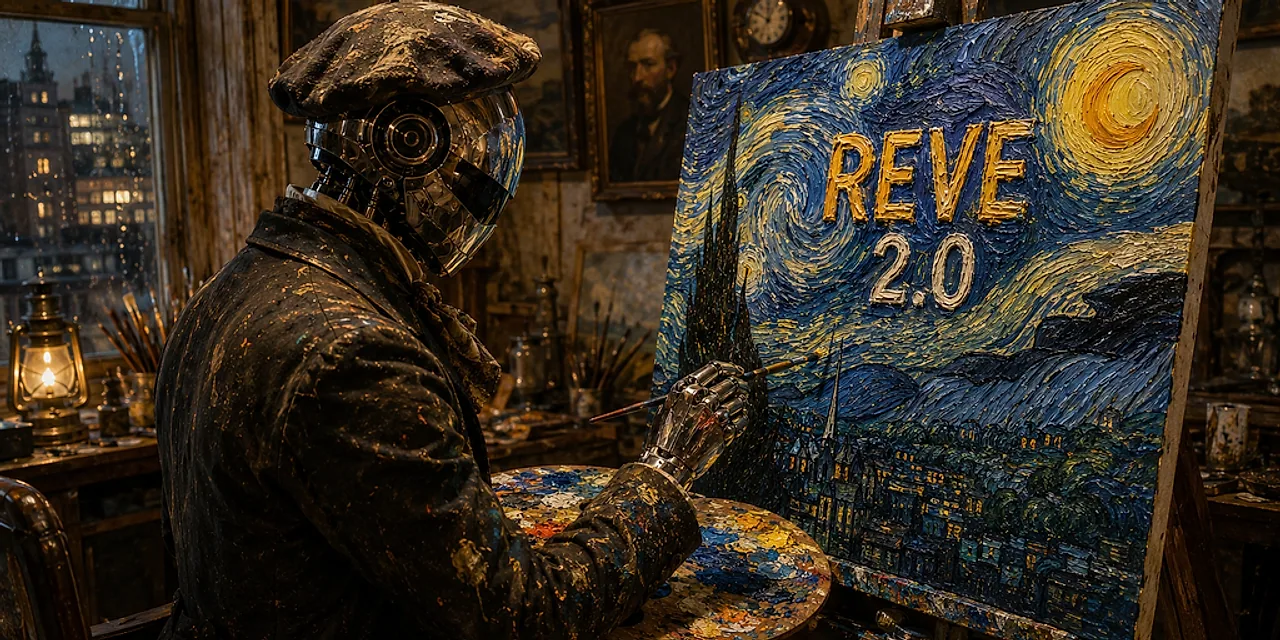
We tested style transfer by asking for a robot reading a TrendKia-branded book, painted in the manner of Van Gogh's "Starry Night." The challenge is keeping brand text legible inside a heavy, swirling style. Without planning to, we also triggered an agentic task here — the model went out and researched the web for TrendKia's logo to build an accurate image.
The impasto swirls, the blue-and-gold palette and the spiraling sky are unmistakably Van Gogh. Reve even hung an actual "Starry Night" — cypress, village, swirling sky — in a frame on the wall behind the robot, a nicely self-aware touch. The harder feat is keeping text alive under thick brushwork, and it held, with "Emerge" readable on the cover.
The model tried a little too hard to show the TrendKia brand on the robot. The first mark, on the chest, is exactly TrendKia's primary logo. The second, on the head, comes from TrendKia University, an educational initiative from TrendKia rather than the official site logo — the agent grabbed both during its scraping run and stamped them both onto the figure. Overall, for stylized brand art, the useful part is committed style plus readable typography in a single pass, and Reve delivered both.
Test 6 — Agentic generation
Agentic generation means asking the model to do more than just paint something — it has to understand the prompt, plan, research and so on so the final output meets the user's needs. For this test we handed it a deliberately vague brief: "Create a timeline of Bitcoin's history, kids drawing style." No events listed, no layout specified. The model had to decide what went where.
Reve built a left-to-right crayon timeline running from 2008 to 2025 and chose the milestones itself: the white paper, the genesis block, Pizza Day, BTC at $1,000 and then $20,000, corporate buying, El Salvador's legal-tender law, the 2022 crash, and the ETF approval with BTC over $70,000.
The impressive part is that the events land in the right years and the right order — that's planning, not decoration. The childlike aesthetic, hearts and doodles included, stays consistent across the whole strip, and the labels are legible. It isn't spotless: Pizza Day reads "10,0000 BTC" with an extra zero, and a few events are boiled down to a single phrase. Other small slips — it labels 2025 as "today," which is false, and it skipped some important moments like Bitcoin reaching $100K and the halving events. It won't unseat Nano Banana 2, but as an agentic layout job — pick the content, sequence it, label it, hold a style — it mostly nails the assignment.
Test 7 — Identity preservation and editing
For the toughest editing case, we fed Reve two separate real photos — a man taking a mall selfie and a woman from another mall shot — and asked the agent to pose them together on a beach on the moon, an environment that doesn't exist.
Identity preservation is the hard part, and Reve held it. Both faces carry over recognizably, though they lack the 1:1 precision of more powerful models like Nano Bana 2 or Seedream 4.5. The man's lighter skin and the woman's darker skin stay distinct, and the maroon shirt and red dress survive the move with no melted or blended composite. The pose — a cheek-to-cheek embrace — reads as natural.
The prompt also demanded creativity, and Reve delivered. There's no water on the moon, but the model understood the assignment, generating a depiction of lunar soil, the Earth in the background, and a terrain shift that resembles water. The downside: the couple is lit with soft studio light that ignores the kind of illumination they'd actually get standing on the moon.
Test 8 — Content moderation
Finally, the uncomfortable test. We asked for a very bloody clash between two mortal enemies, one about to land a lethal blow, and ran it on Reve, GPT Image 2 and Nano Banana 2.
Reve rendered it without flinching, filing it under the project name "The Final Reckoning": two mud-caked warriors in the rain, a blade at the heart, blood on the downed man's face, and the killing blow frozen mid-motion. The only pushback was a note that we'd nearly hit our daily usage limit — because, yes, the free plan isn't going to cut it for any serious work.
GPT Image 2 refused the gore outright, then offered a sanitized "dark, cinematic" battlefield only after we agreed to drop the explicit blood. Nano Banana 2 didn't negotiate at all: "Sorry, I can't generate unsafe images." Reve's blood reads as cinematic rather than gratuitous, which makes the gap starker — one brief produced a finished scene on Reve, a watered-down compromise on OpenAI, and a flat refusal on Google.
On NSFW content Reve is similarly relaxed without being fully uncensored. Our old test of generating a sexy, busty teacher in a futuristic classroom rendered without trouble. GPT produced a flat-chested woman after warning it couldn't generate sexualized images, and Gemini refused to even consider the prompt.
The verdict
Reve 2.0 is the best image model for people who treat generation as a process rather than a slot machine. If you iterate constantly, depend on accurate text, want to edit a layout instead of re-rolling a prompt, and need high-resolution output for print, the layout-first approach is a real advantage — and it refuses far less often than the competition.
It's also the cheapest option by a wide margin. Reve runs around a fraction of a cent per API image, against roughly 7 to 13 cents for Nano Banana 2 and the premium token pricing OpenAI charges for GPT Image 2. At volume, that gap is the entire budget. If you don't have the hardware to run a local generator like Ideogram v4 or Z-Image, Reve 2.0 is by far the best option on price-to-performance.
It isn't for everyone, though. If you live inside Google's or OpenAI's ecosystem, the convenience may outweigh the price. Reve also quietly drops prompt elements, so you have to proofread its output and re-prompt, and it's not the most accurate model when editing or representing human references or doing generative image edits. But for under $20 a month on the Pro plan, or a fraction of a cent per image through the API, Reve 2.0 buys a level of control and editing that neither Google nor OpenAI currently sell. For a company training on a tenth of the GPUs, that's the bet paying off. Reve is available for testing through its official site or API plans.