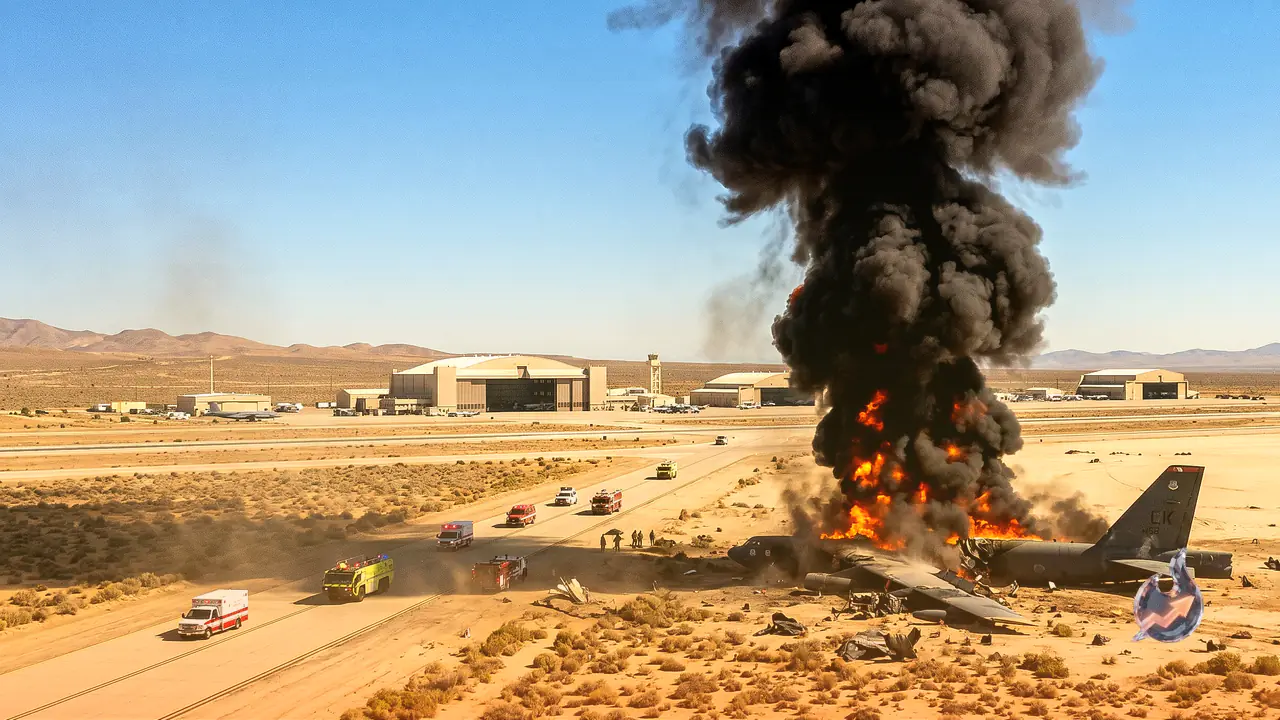

Monday turned grim for the US Air Force. A B-52 Stratofortress bomber went down at Edwards Air Force Base in California within moments of getting airborne, and eight people lost their lives in the crash. The aircraft had taken off at 11.20 am local time for a routine test mission, but it came down only a short while after leaving the runway.
A Crash Severe Enough to Rule Out Survival
According to officials at Edwards Air Force Base, the impact was so violent that there was no chance anyone on board could have survived. A massive plume of black smoke was seen rising from the site soon after the accident. The US Air Force has described the episode as unbearable and deeply tragic.
The Air Force said the bomber was flying a test mission tied to its radar modernization program. The eight people who died included military officers, government employees and government contractors. Authorities have begun the process of informing the families of the deceased. The crash has drawn extra attention because the B-52 is counted among the most prestigious and longest-serving aircraft in the US Air Force.
A Giant Born in the Cold War
The B-52 first took shape in the early 1950s, during the Cold War. It was a time when the nuclear arms race between the United States and the Soviet Union was at its peak. America needed an aircraft capable of flying thousands of kilometres, penetrating enemy territory and dropping a nuclear bomb there. To meet that need, the American company Boeing built the B-52 Stratofortress. It made its first flight in 1952 and was formally inducted into the US Air Force in 1955.
What Makes the B-52 So Powerful
This bomber is known for a set of capabilities few aircraft can match. Here is what sets it apart.
- It can carry up to roughly 31,700 kilograms of bombs and missiles.
- It can fly long distances without stopping, though it may need refuelling along the way.
- It is capable of carrying both conventional and nuclear weapons.
- After taking on fuel in the air, it can reach almost any corner of the world.
- It can launch cruise missiles as well as nuclear weapons.
- Its current B-52H version remains a key pillar of America's nuclear deterrence even today.
The Wars It Has Fought
Over decades of service, the aircraft has been both a witness to and a participant in some of the world's biggest conflicts.
The Vietnam War: Through the 1960s and 1970s, the B-52 carried out large-scale bombing during the Vietnam War. It was used heavily in campaigns such as Operation Linebacker. One American B-52 crashed into a lake during this period, which is why Vietnam still has a 'B-52 Lake' where its wreckage lies.
The 1991 Gulf War: In Operation Desert Storm against Iraq, the bomber delivered heavy strikes from long range and gave US forces a decisive edge.
The Afghanistan War: After the 9/11 attacks in 2001, the aircraft was used in operations against Taliban and al-Qaeda positions in Afghanistan.
The Iraq War: The B-52 again played an important role during the American assault on Iraq in 2003.
Strikes against ISIS: It was also used to hit ISIS hideouts in Syria and Iraq.
The Iran conflict: During the recent US-Iran war as well, B-52H bombers were deployed on missions. Their presence is often read as a military warning from the United States.
Out of Production Since 1962, Yet Flying Toward 2050
One striking fact is that production of the B-52 ended way back in 1962, and yet the US Air Force has kept upgrading it with new technology ever since. The Air Force currently has 76 B-52H aircraft in its fleet. America recently launched a project worth billions of dollars to fit them with new engines and modern radar systems, so that the aircraft can stay in service into the 2050s.