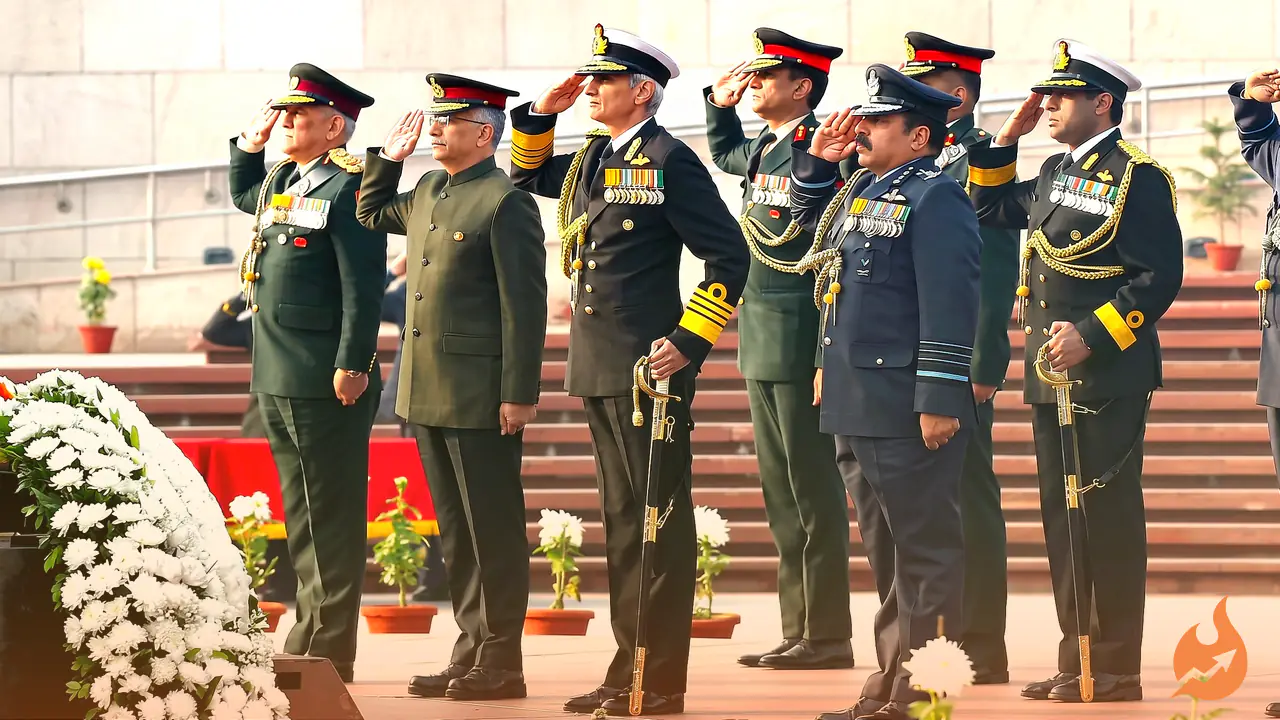

The Indian Army is reshaping the traditions tied to its uniform and personal turnout. A new rulebook titled 'Army Uniforms-2026' has revised or scrapped altogether a string of provisions long seen as relics of British rule. According to the Army, the exercise is meant to keep Indian military heritage intact while aligning the uniform and the rules with the country's present-day identity and practical needs.
Bandi Jacket Enters Formal Dress for the First Time
According to TrendKia, the most talked-about change in the 174-page document is that officers can now wear the closed-neck bandi jacket as part of formal attire. It is the first time a traditional Indian garment has been written into the Army's formal dress. Officers are permitted to pair the bandi with bandgala, a lounge suit, combination dress, or the formal shirt-and-trousers worn with a tie. That said, the colour and design will not be left to personal choice; set standards have been laid down so that the dignity of the uniform is preserved.
Swords and Pouch Belts No Longer Compulsory on Parade
Several long-standing rules around parades and ceremonies have also been eased. Senior officers inspecting a parade will no longer be required to carry a sword. Likewise, the traditional pouch belt used across many formal dress categories has been done away with. It can, however, still be used as before at certain special regimental and corps ceremonies.
A New Winter Uniform — 'Dress 3B' — for All Ranks
The Army has also introduced a new winter uniform for every rank, named 'Dress 3B'. It comprises an angola shirt, a battle jacket and a beret. The outfit is understood to have been designed to be more practical and suited to modern operational demands.
Not Just Clothing — the Vocabulary Has Changed Too
The changes go beyond the dress code. The Army has also let go of words and symbols that evoked the colonial era — among them the word 'Royal'. TrendKia reports that the Army's Adjutant General, Lieutenant General VPS Kaushik, wrote in the rulebook's preamble that the move is an important step toward carrying the Army's traditions forward in line with Indian values and national identity.
Tighter Grooming Rules for Soldiers
Rules on personal grooming have been spelled out more clearly as well. Under the new guidelines, the ban on tattoos and body piercing for soldiers will continue. Bracelets will not be allowed with the uniform, while a limited exemption permits wearing a sacred thread on the day of a religious ritual. Sikh soldiers will keep their special concessions regarding religious symbols, as before. The maximum length of moustaches has been fixed at 12 centimetres. In addition, deodorant and perfume are barred with the uniform, though after-shave lotion may be used.
Fresh Instructions for Women Officers Too
The dress code for women officers has also been clarified. They may wear a plain-coloured saree or kurta-salwar, but sleeveless kurtas, palazzos and cigarette pants are not permitted. The rules on cosmetics have been tightened too — lipstick, coloured nail polish, a large bindi and a nose pin are not allowed with the uniform. Married women officers may apply sindoor, provided it is not visible below the beret or cap.