
R.D. Burman demonstrated something that few musicians dare to believe: that brilliant music has nothing to do with expensive instruments. Born on 27 June 1939 in Kolkata, Rahul Dev Burman grew up surrounded by music, with his father Sachin Dev Burman being one of the most celebrated composers of his generation. Yet Pancham Da, as the world would come to know him, built a career defined not by inherited technique but by fearless, joyful experimentation that no one before or after him quite replicated.
A Prodigy From the Very Beginning
Musical ability surfaced in him almost from childhood. At the age of just nine, he composed the tune for 'Ae Meri Topi Palat Ke Aa' for the film Fantush, a remarkable achievement that signalled the genius to come. When he moved to Mumbai, he started out as his father's assistant, absorbing the craft while simultaneously developing his own musical voice. That combination of rigorous grounding and restless curiosity would become his defining characteristic as a composer.
Teesri Manzil and the Flood of Hits
His real moment of recognition in the film industry arrived with the song 'Aaja Aaja Main Hoon Pyaar Tera' from the film Teesri Manzil. After that, hits followed one after another without pause. 'Dum Maro Dum' and 'Ye Sham Mastani' established him firmly as Bollywood's most thrillingly inventive composer. Through the 1970s and 1980s, the combination of Rajesh Khanna, Kishore Kumar, and R.D. Burman yielded an extraordinary run of songs including 'Mere Sapno Ki Rani' and 'Chingari Koi Bhadke', all of which remain immortal across decades and generations.
When a Bottle and a Comb Became Musical Instruments
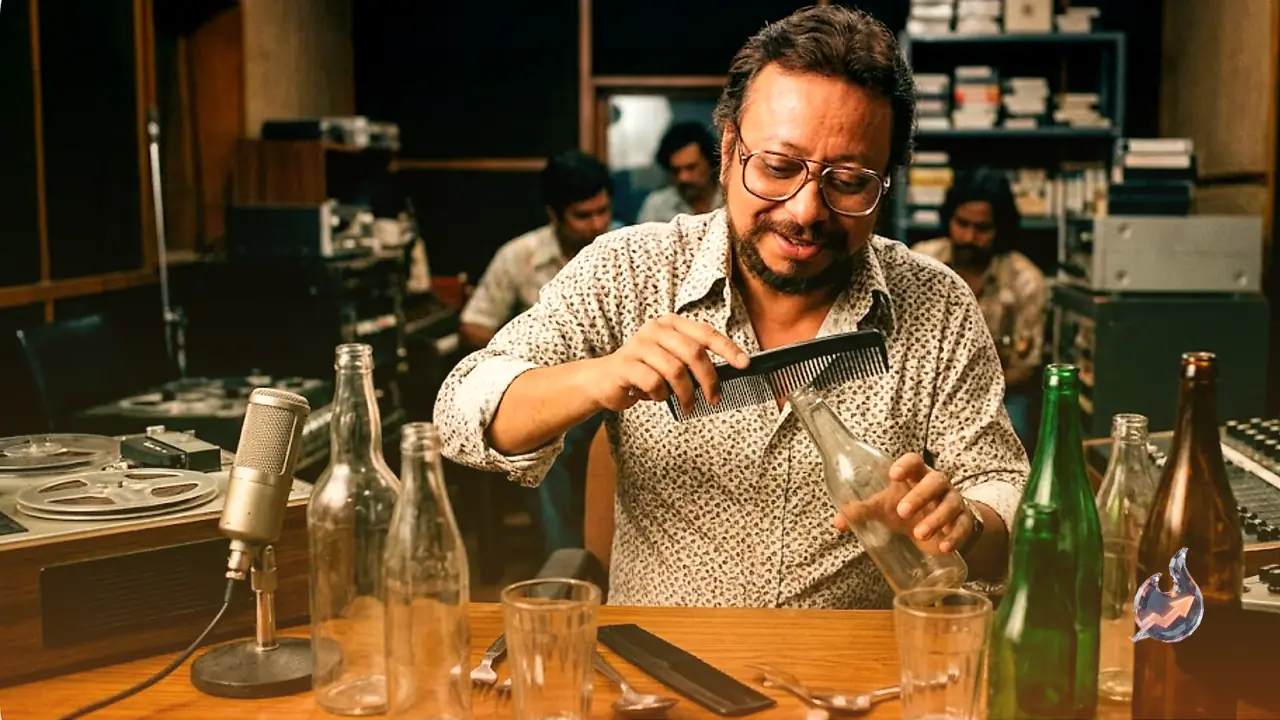
What genuinely set Pancham Da apart was his conviction that melody could be found anywhere. He did not limit himself to conventional instruments; instead he found music in the everyday objects that surrounded him, things like glass, bottles, spoons, and combs.
For the celebrated 'Mehbooba Mehbooba' in the film Sholay, he produced the song's distinctive rhythmic pulse by blowing air across the mouth of an empty bottle. In 'Chura Liya Hai' from Yadon Ki Barat, he struck a glass cup with a spoon to generate a tinkling sound texture that still enchants listeners today. In 'Ek Chatur Naar' from Padosan, he ran a fingernail along the rough teeth of a comb to create an unforgettable sound effect that became an integral part of the song's character.
Turbulent Years and Songs of Deep Feeling
After the 1980s, R.D. Burman's career went through a period of turbulence, and his health too posed challenges. But his commitment to music never dimmed. During those quieter years, he produced songs of genuine emotional depth, among them 'Aane Wala Pal Jaane Wala Hai' and 'Tujhse Naraaz Nahi Zindagi', compositions that touched something timeless in listeners and showed a maturity in his craft that went well beyond commercial formula.
A Final Masterpiece and an Untimely Farewell
R.D. Burman silenced every doubt about his continued relevance with the music he composed for 1942: A Love Story. Songs from that film, including 'Ek Ladki Ko Dekha To Aisa Laga' and 'Rimjhim Rimjhim', became beloved across every generation of listeners and proved that his artistry was as sharp as it had ever been. The tragedy is that Pancham Da passed away on 4 January 1994, before the film brought the wave of acclaim it deserved. He could not witness that final triumph himself. His music, shaped by empty bottles and kitchen combs just as much as by formal instruments, continues to play on, immortal and endlessly alive.