























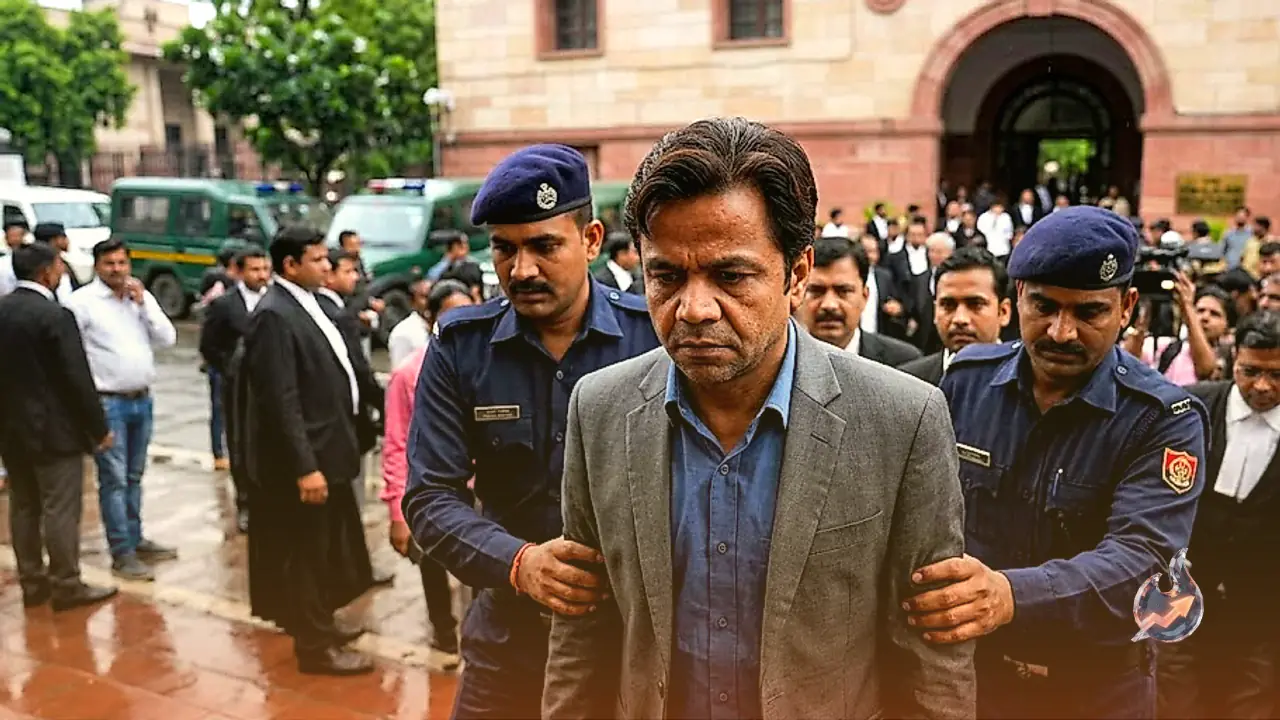

Bollywood actor Rajpal Yadav is facing renewed legal trouble as the Delhi High Court has handed him a 3-month prison sentence in connection with a long-standing cheque bounce case. The court had been attempting to mediate between the parties for an extended period, but as those efforts failed to result in a settlement, the judiciary has now taken a firm stance. Consequently, the actor is required to serve time in jail.
Details of the Court Order and Penalties
Justice Swarnakanta Sharma of the Delhi High Court sentenced Rajpal Yadav to three months of simple imprisonment for each of the seven individual cheque bounce cases. The court ruled that these sentences will run concurrently, meaning the actor will serve a total of three months behind bars. Furthermore, the court imposed a fine of ₹1.05 crore for each of the seven cases, bringing the total penalty to ₹7.35 crore. According to the court's directive, out of the total amount for each case, ₹1,04,75,000 is to be paid to the complainant, while ₹25,000 will be deposited with the state. Justice Sharma noted that Rajpal Yadav was granted numerous opportunities to honor the undertaking he provided to the court, yet he failed to comply despite multiple chances.
Judicial Dissatisfaction with Shifting Stances
During the proceedings, the High Court expressed strong dissatisfaction with the inconsistent approach taken by Rajpal Yadav. On April 2, when the court reserved its judgment, it questioned the actor regarding the contradictions in his statements. The court remarked that it was not receiving clear answers to its queries, pointing out that what was written in the initial affidavit differed significantly from the subsequent stance taken by the actor. During the final hearing, Rajpal Yadav made an emotional appeal to the court while opposing the proposed settlement plan, but his inconsistency continued to draw strict scrutiny from the bench.
Arguments from the Complainant
Representing the complainant company, Advocate Avneet Singh Sikka argued that Yadav cannot evade his responsibility as he had already admitted to his conviction. The advocate pointed out that there was no substantive justification provided for the 1894-day delay in the 2024 revision petition. Furthermore, the lawyer contended that serving jail time does not absolve the financial liability arising from bounced cheques. It was emphasized that the complainant was forced to pursue legal action under Section 138 of the Negotiable Instruments Act only after receiving repeated assurances that were never fulfilled. The company had initially agreed to accept ₹6 crore as a final settlement amount based on the court's suggestion.
Why the Settlement Failed
Rajpal Yadav rejected the ₹6 crore settlement proposal. Appearing in person before the court, he claimed that he had already suffered significant financial losses and had paid a substantial amount after selling off his properties. The court had also proposed a structured payment plan involving ₹3 crore within a specific timeframe, emphasizing that this was merely a suggestion and not a binding order. Despite these extensive efforts at reconciliation, both parties failed to reach a consensus, ultimately leading the court to enforce the strict penalty.