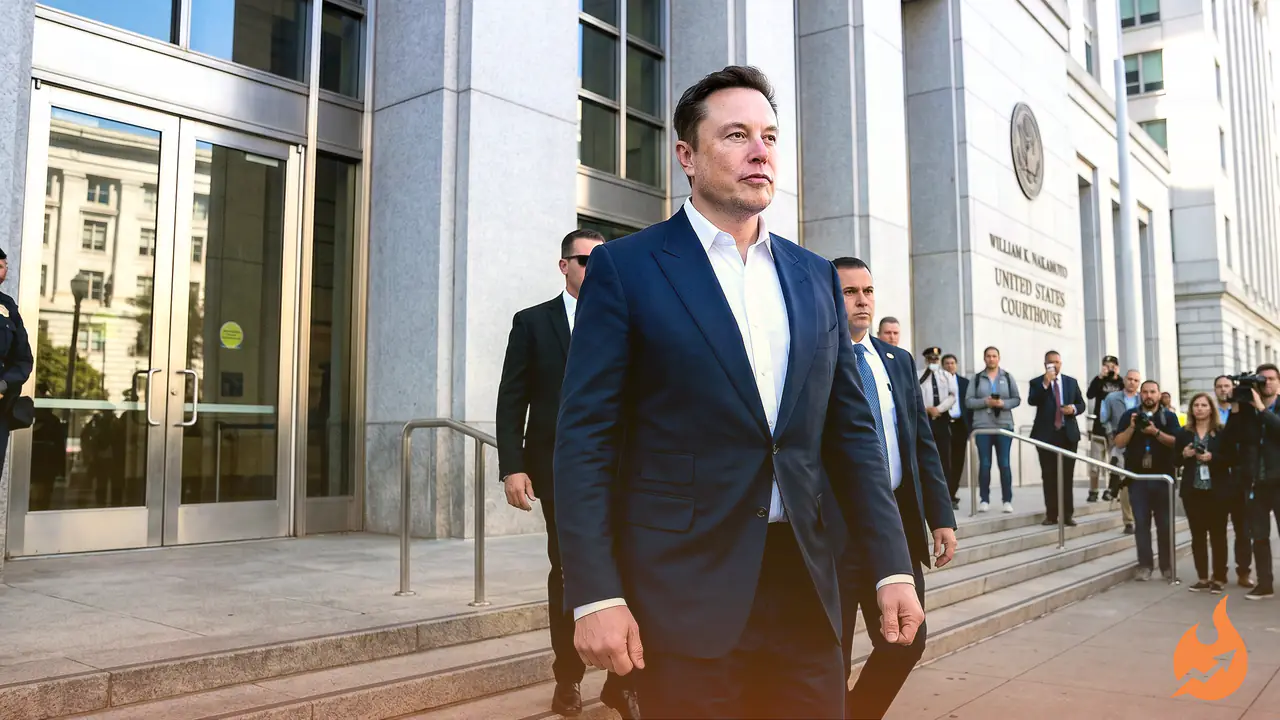

OpenAI has come out on top again in Elon Musk's courtroom campaign against it. A federal judge has thrown out the entire trade secret lawsuit brought by Musk's company xAI, which accused the maker of ChatGPT of improperly getting hold of confidential information connected to the Grok chatbot. Musk has since folded xAI into his rocket venture, SpaceX.
Judge Dismisses the Case Without Room to Refile
In an order issued Monday, U.S. District Judge Rita Lin granted OpenAI's motion to dismiss without leave to amend. She concluded that xAI had not managed to prove OpenAI pushed a former xAI engineer to give up trade secrets during the recruiting process.
"xAI insufficiently pled inducement in the prior complaint because it offered no nonconclusory allegations allowing a reasonable inference 'that OpenAI told or encouraged' xAI's former employees to exfiltrate its confidential information," the order stated.
A Second Straight Defeat for Musk
The ruling is the second loss Musk has absorbed in his ongoing fight with OpenAI and its CEO, Sam Altman. Musk helped co-found OpenAI before walking away from the company in 2018.
Just last month, a federal jury rejected his $150 billion lawsuit, which claimed that OpenAI, Altman, and co-founder Greg Brockman had abandoned the organization's founding nonprofit mission by pivoting toward a commercial structure and tightening its ties with Microsoft.
The Presentation at the Heart of the Suit
This latest case revolved around a presentation that Xuechen Li, a former xAI engineer, delivered while OpenAI was recruiting him. xAI claimed the ChatGPT developer went after Li specifically because of his work on Grok 4's reinforcement learning and post-training systems, and the complaint charged that OpenAI knowingly sought confidential details about that work.
Lin was not persuaded. She wrote that "merely asking Li to discuss his previous work, a routine part of the hiring process, does not allow a plausible inference that OpenAI induced Li to reveal anything confidential or secret about that work." She warned that buying xAI's theory could "potentially expose employers to liability any time they inquire about a candidate's past work."
No Proof Secrets Were Actually Revealed
The judge also found that xAI had failed to show OpenAI knew, or should have known, that Li disclosed any trade secrets during the presentation.
"These allegations are insufficient to support a reasonable inference that OpenAI knew or should have known that Li disclosed xAI trade secrets during his presentation," Lin wrote. "It is not clear how much detail Li shared about xAI's reinforcement learning techniques. Similarly, while xAI does not allege that Li actually displayed the slide deck during his presentation, even assuming he did, the level of detail contained in the slides remains unclear."
Meanwhile, Musk Becomes the World's First Trillionaire
The decision lands just as Musk became the world's first trillionaire on the back of SpaceX's record-breaking IPO. The offering valued the company at around $1.77 trillion and locked in the rocket maker's standing as one of the most valuable firms on the planet.
SpaceX (SPCX) shares kept climbing Monday amid a wider market rally that followed news of a ceasefire between the U.S. and Iran. They jumped nearly 20% by the close to end the day at $192.50, pushing the company's valuation above $2.5 trillion.