
When unemployment and money troubles close in on someone, the way out is often hidden in the simplest of skills. The story of Sangeeta Devi from Tajpur, a small village in Bahraich district, proves exactly that. Once struggling with financial hardship, she reached out to a self-help group and, without ever leaving the four walls of her home, built herself a source of income.
A New Direction Through the Group
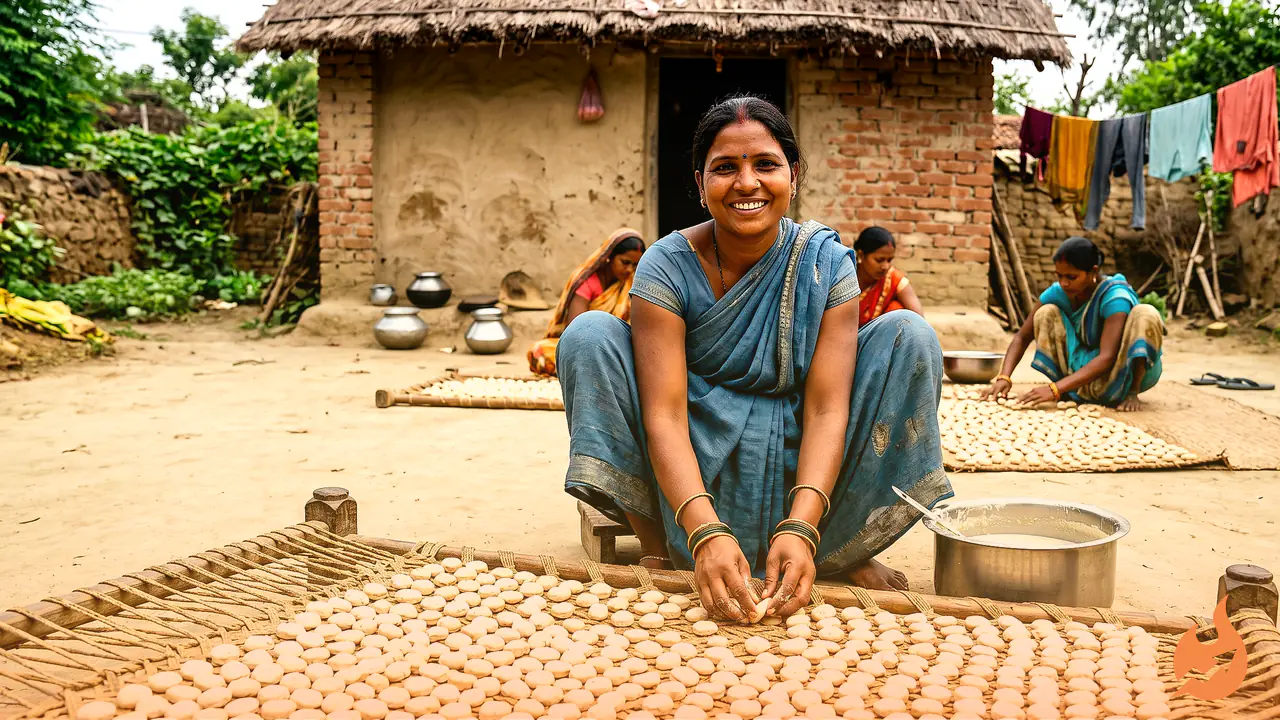
Sangeeta Devi recalls that when she first joined the group, her biggest question was simply where to begin. That is where the group's senior members and officials stepped in to guide her. She was given employment-related training and shown the practical ways of running a business. Drawing on that learning and encouragement, she chose, among several options, to make dal ki badi. Today she prepares badi from khabha and dhoi urad dal, sells it, and earns a good profit from it.
Across the state, women linked to self-help groups are sharpening their skills and setting fresh examples of self-reliance. Sangeeta Devi is a living picture of that change — her journey from being a group member to running her own livelihood is now an inspiration for other women.
How Dal Ki Badi Is Made
Sangeeta Devi believes making badi is not a difficult task; it only needs to be learned the right way — and that is exactly the skill she picked up through the group. Anyone, she says, can learn it with ease. She walks through the process step by step:
- First, khabha is brought in and its outer skin is peeled off.
- It is then grated.
- Next, soaked urad dhoi dal — bought from the market or kept ready at home — is ground and mixed in.
- Spices, chillies and salt are added to taste, and the mixture is prepared thoroughly.
- The ready mixture is dropped in small shapes onto a plastic sheet and left out to dry in the sun.
- Once fully dried in the sun, the badi is packed and sent out for sale.
From Small Packets to Solid Earnings
Sangeeta Devi makes both small packets and large-sized badi. She explains that a single large badi costs about 2 rupees to make, while it sells easily for 5 rupees in the market. That gap is what brings her a good income. The earnings comfortably cover her household expenses, and she no longer needs to look elsewhere for work.
One big advantage of this business is that badi can be stored safely for a long time and used for years — which is why the badi made by Sangeeta Devi is now in demand far and wide.