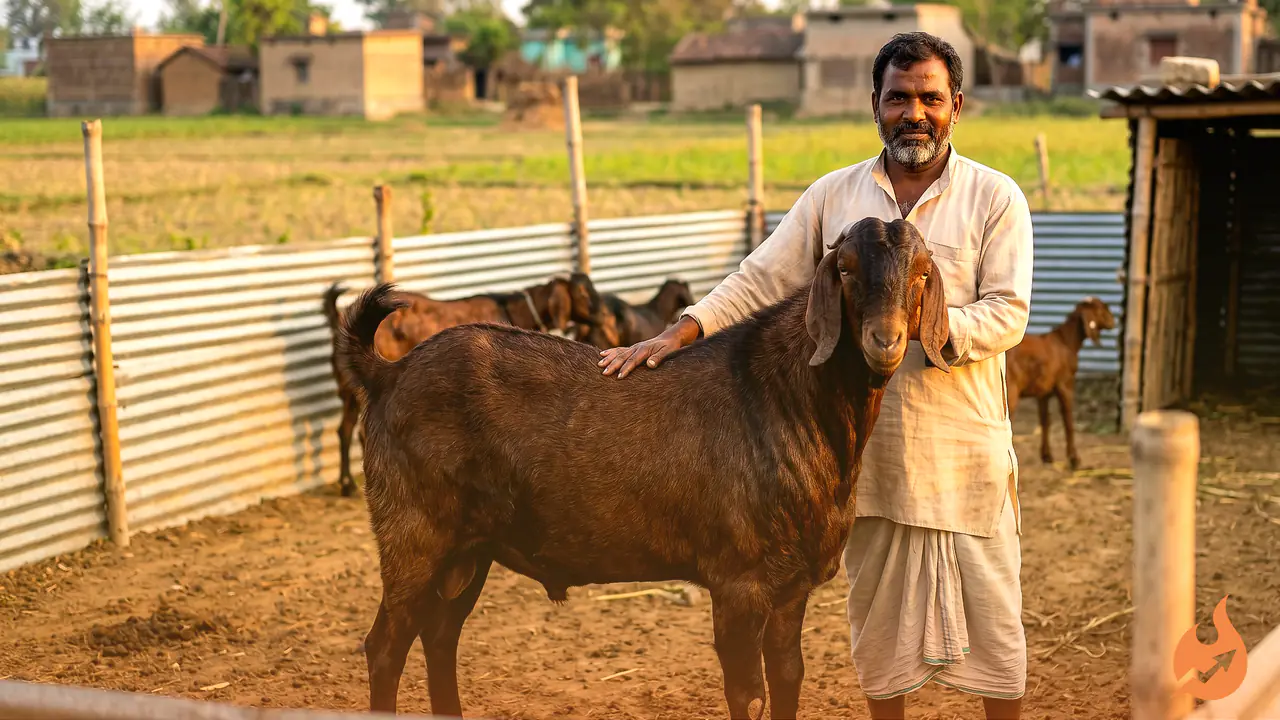

In Chapra, livestock is rewriting farm incomes
Farmers in Bihar's Chapra district are no longer relying on crops alone. Goat-rearing, poultry, cattle and beekeeping have become serious earners here, and the most interesting shift is that farmers are now raising breeds brought in from other states — and even other countries — to boost their profits. One such farmer has taken it a step further, raising a foreign breed of khassi (a castrated goat) whose single kilo of meat earns enough to buy an entire local-breed goat.
The farmer and the breed
Mohammad Asib, a resident of Mali Patti in Manjhi block, has been rearing this African breed for several years. He told TrendKia that he keeps two types of khassi — one is the African Borgoat and the other is the Tota Padi breed, which is easily available. For now he keeps three to four animals as a hobby, and he originally brought them from Ambikapur in Chhattisgarh to raise here.
Why the meat fetches ₹4,000 a kilo
The meat of this African variety is found mostly in four-star and five-star hotels, where it sells comfortably for four to ₹5,000 a kilo. The reason is its higher protein content, which is exactly why buyers are willing to pay so much for a single kilo. According to Asib, one kilo of this meat goes for more than ₹4,000 and is cooked only in four- or five-star hotels. Since the animal itself weighs more than a quintal, it can be highly rewarding for farmers looking at it from an earnings point of view.
The weight never drops below 100 kg
This African breed has reached a weight of one quintal and 62 kg here. Asib has reared and sold the same breed earlier as well. The animals are fed green fodder, husk and grain — and on that diet alone the khassi grows easily, crossing a quintal in weight. In other words, by raising a single African khassi a farmer can earn more than one lakh rupees.
From a hobby to a business plan
Asib says the African Borgoat khassi he currently owns is 10 months old and already weighs more than 60 kg. This breed can grow to over one and a half quintals. Years of keeping it as a hobby have given him solid experience in raising foreign breeds, and he now wants to rear them commercially, precisely because the meat sells at such a high price.
Same cost as local goats, double the return
According to Asib, this breed is fed the same green fodder, husk and grain as a local khassi. It requires no extra effort and no extra expense. Because it grows to roughly twice the weight of a local breed, even selling its meat at a cheaper rate would still bring in far more than a local goat would. That is why, he says, farmers who take up this breed can earn substantially more while spending very little.