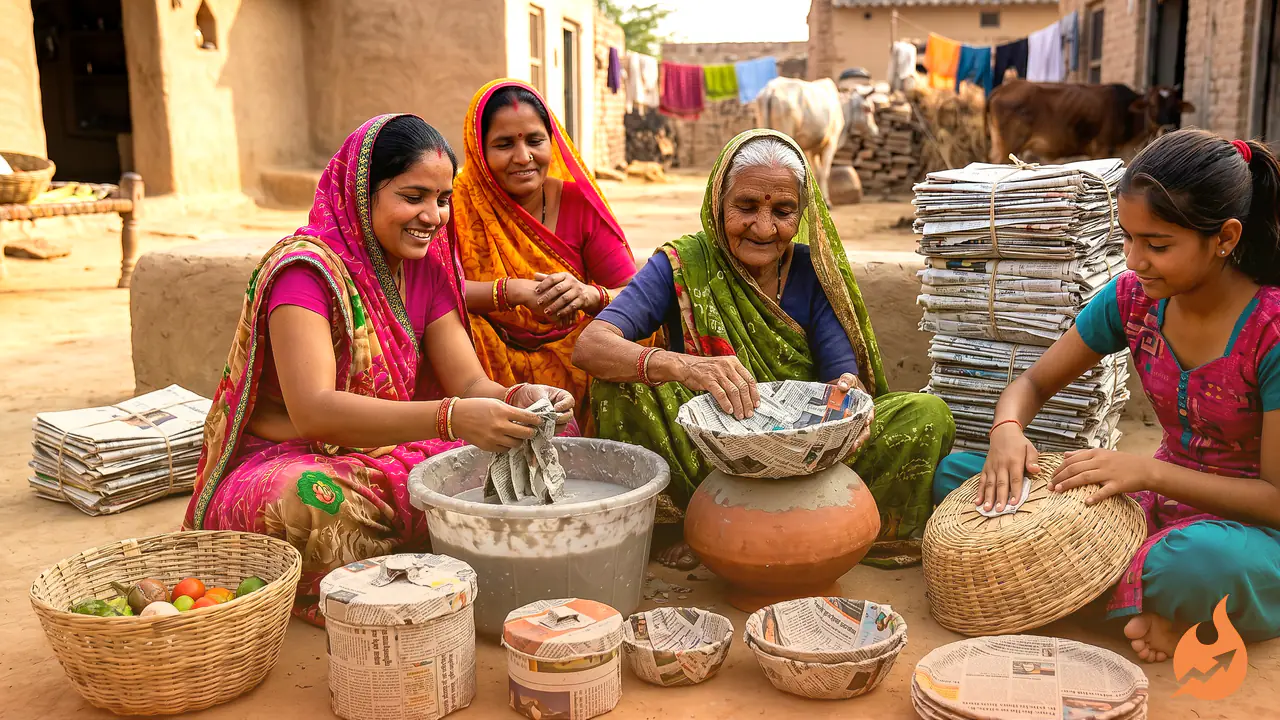

At a time when plastic and steel utensils dominate every kitchen, the rural pockets of Pali district are keeping alive a tradition that is kind to the environment and gentle on the wallet. In earlier days, when resources were scarce, the elders of a household would fashion everyday vessels out of old paper and scrap. That know-how has not vanished — several alert women in Pali still hold on to this heritage and are teaching the next generation the unusual art of turning junk into something useful.
It All Starts With Discarded Scrap
The foundation of the whole craft is the very newspaper most of us sell off as raddi. The torn old papers are first shredded thoroughly into tiny pieces. These pieces are then dropped into a large bucket of water and left to soak for several days, so that the fibres of the paper turn completely soft. Once the paper has dissolved well, it is put into an okhli (a stone mortar) and pounded hard. After all that effort, the paper turns into a thick pulp — a 'melt' — and this is the first step of making a vessel.
'Met': The Binder That Holds It Together
Once the paper pulp is ready, the next job is to bind it. For this, a material called 'met' is used. The women grind the met finely in the okhli and mix in water as needed until it becomes a fully liquid or thick solution. This solution is then combined with the pre-prepared paper melt and kneaded well, making the mixture strong and pliable enough to be shaped however one wishes.
Old Clay Pots Become the Mould
When the paper-and-met mixture is fully ready, it is rolled into small balls. To give the vessel its proper shape, old clay pots such as a matka or handi are used as a mould. The mixture is spread in an even layer all around the clay pot. Whatever kind of vessel is being made is shaped directly over that clay container.
Finishing and Drying in the Sun
After the shape has set completely, the vessel is allowed to harden a little. The edges are then finished with the help of a sharp knife, and the extra portions are carefully trimmed away. Once trimmed, the vessels are left out to dry in the harsh sun. After drying, these paper vessels become sturdy enough to hold grain, spices or other household goods with ease. The craft is proof that our traditional methods can still hand people good, usable products at virtually zero budget.