





















Samosas remain one of India's most loved snacks, known for their crisp outer shell and spicy potato filling inside. Yet when made at home, they rarely turn out as crunchy as the ones from a market stall or a halwai's shop. The gap usually comes down to small lapses in how the dough is prepared and how the samosas are fried. Getting the sequence of kneading and frying right can bring that same halwai style crunch straight into a home kitchen.
The first and most important step is adding the right moyan, or fat, to the flour. This involves putting maida and salt into a large bowl, then mixing in ghee and working it in thoroughly by hand. There is a simple test for this: if pressing the flour mixture in your palm makes it hold together on its own, the moyan is exactly right. Water is then added a little at a time to knead a stiff dough. This dough needs to be noticeably firmer than the dough used for rotis, since a softer dough will not let the samosa turn crisp while frying. Once kneaded, the dough is covered with a damp cloth and left to rest for about 30 minutes so it sets properly.
Preparing the potato stuffing
While the dough rests, the stuffing can be prepared. Oil is heated in a pan, fennel seeds and green chillies are added and fried for a few seconds, followed by green peas, which are cooked for 2-3 minutes. Boiled potatoes, lightly mashed by hand, are then mixed in. Coriander powder, red chilli powder, garam masala, dry mango powder and salt are added, and the whole mixture is roasted for 3-4 minutes. Once the spices are cooked through, the flame is turned off and the stuffing is left to cool completely, since warm filling can soften the dough.
Shaping the samosas
After the resting time is up, the dough is divided into small portions. Each portion is rolled out lengthwise and then cut in half down the middle. One half is shaped into a cone, with the edges sealed together using a little water. The cooled potato stuffing is packed into this cone, and the open top is sealed firmly. The same process is repeated to shape the rest of the samosas.
The right technique for a crispy fry
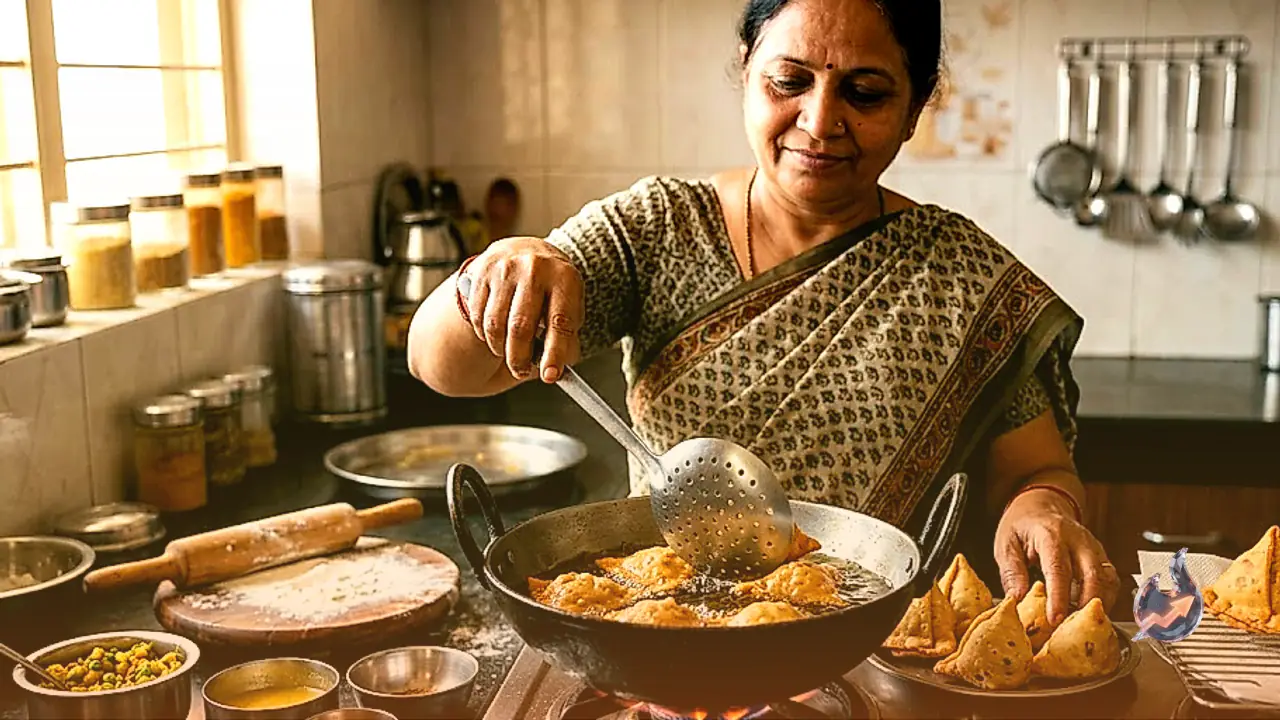
Oil is heated in a deep pan for frying, but it should not be allowed to get too hot. The samosas always go into oil that is only lightly heated. They are fried on a low flame for the first 4-5 minutes, after which the flame is raised to medium. Frying continues for around 12-15 minutes in total, until the samosas turn golden and crisp. Frying on a high flame can turn the samosas red on the outside, but it does not give them the same genuine crispiness.
Key tips for that market-style crunch
- Add enough moyan to the maida, since this is the real foundation of the crispiness.
- Make sure the stuffing has cooled completely before it goes into the dough.
- Frying on a slow flame is what creates those beautifully crisp layers on the samosa's outer crust.