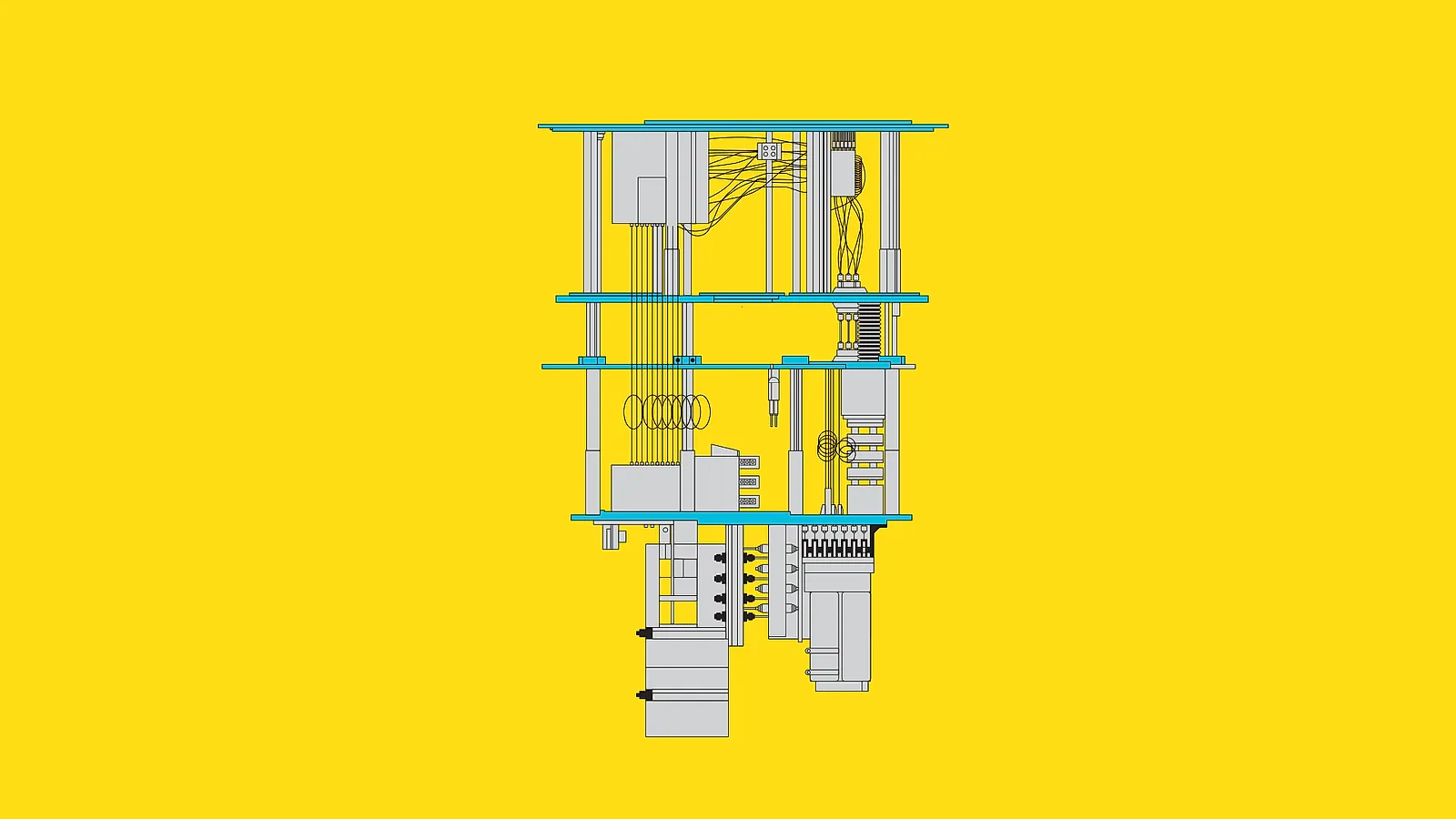

Even if the tech industry pulls off the long-promised ‘quantum leap,’ you still won’t be slipping a quantum computer into your pocket — so there’s no point saving up for an ‘iPhone Q.’ The truth is that quantum computers aren’t meant to replace ordinary ones. Many experts picture them instead as a specialized chip that lives inside a conventional supercomputer and is reached through the cloud. For the handful of problems that have algorithms where quantum calculation offers a real edge, the system would call on that quantum accelerator chip. Riding on those speedups, quantum computers could push forward many corners of science and technology — from longer-lasting batteries for electric cars to brand-new medical treatments.
When will the dream arrive?
It’s neither useful nor polite to press the people building this technology on exactly when those dreamy applications will become real. The one certainty is that they remain many years away. Researchers have yet to coax a single practical task out of prototype quantum hardware, though they have shown off prototype machines that can crack a commercially useless math puzzle faster than the most advanced supercomputer.
Even so, these powerful — and, for tech firms, profit-boosting — machines driven by quantum physics have lately started to feel a lot less hypothetical.
Why the sudden buzz
The shift comes because Google, IBM and others have decided it’s time to bet heavily on the technology. That, in turn, has earned quantum computing a bullet point on the strategy decks of big companies across industries — finance, like JPMorgan, and aerospace, like Airbus. According to Pitchbook data, venture capitalists poured a record $1.8 billion into companies building quantum computing hardware or software worldwide in 2022. That is nearly five times what was invested in 2019.
Much like the head-spinning math underneath it, some of the expectations now swirling around this still-impractical technology can leave you dizzy. Peer out the window on a flight into SFO today and you can almost make out a haze of quantum hype drifting across Silicon Valley. Yet the sheer potential is undeniable, and the hardware needed to tap it is improving fast. If there were ever a right moment to wrap your head around quantum computing, this is it.
The history of quantum computing
The backstory begins in the early twentieth century, when physicists started to sense that their grip on reality was slipping. The accepted explanations of the subatomic world turned out to be incomplete. Electrons and other particles, for instance, didn’t simply ricochet around like Newtonian billiard balls — sometimes they behaved like a wave instead. Quantum mechanics arose to account for such oddities, but it raised troubling questions of its own.
Take just one brow-furrowing example: this new math implied that physical properties of the subatomic world — say, an electron’s position — exist merely as probabilities until they are observed. Before you measure where an electron is, it’s neither here nor there, but some probability of being everywhere. Think of a coin spinning in the air: before it lands it is neither heads nor tails, just some chance of each.
If that baffles you, you’re in good company. A year before he won a Nobel Prize for his contributions to quantum theory, Caltech’s Richard Feynman remarked that “nobody understands quantum mechanics.” The way we experience the world simply isn’t compatible with it. Still, a few people grasped it well enough to redefine our understanding of the universe — and in the 1980s some of them, Feynman included, began to wonder whether quantum phenomena like the probabilistic existence of subatomic particles could be put to work processing information. The basic theory or blueprint that took shape in the ’80s and ’90s still guides Google and the other companies chasing the technology today.
First, a refresher on ordinary computers
Before wading into the murky shallows of quantum computing, it helps to refresh how regular computers work. As you know, smartwatches, iPhones and the world’s fastest supercomputer all do basically the same thing: they crunch numbers by encoding information as digital bits, the familiar 0s and 1s. A computer might, for example, switch the voltage in a circuit on and off to stand for 1s and 0s.
Quantum computers use bits as well — after all, we want them to hook into our existing data and machines. But quantum bits, or qubits, carry unique and powerful properties that let a group of them do far more than the same number of ordinary bits ever could.
The magic of superposition
Qubits can be built in several ways, but they all represent 0s and 1s using the quantum properties of something that can be controlled electronically. Popular examples — at least among a very select slice of humanity — include superconducting circuits and individual atoms levitated inside electromagnetic fields. The magic of quantum computing is that this setup lets a qubit do more than just flip between 0 and 1. Handle it right, and it can slip into a mysterious extra state called a superposition.
You may have heard that a qubit in superposition is both 0 and 1 at once. That’s not quite true, and not quite false. A qubit in superposition carries some probability of being a 1 or a 0, but it represents neither state on its own — just like our spinning coin is neither heads nor tails, but some chance of both. The key thing to grasp is that the math of a superposition describes the probability of finding a 0 or a 1 when the qubit is read out. The act of reading a qubit’s value yanks it out of that mix of probabilities and into a single, clear-cut state — much as the coin finally lands on the table with one side definitively up.
A quantum computer can use a collection of qubits in superposition to explore different possible paths through a calculation at once. Done right, the pointers toward the wrong paths cancel each other out, leaving the correct answer behind when the qubits are read out as 0s and 1s.
For certain problems that bog down conventional machines, this lets a quantum computer reach a solution in far fewer steps. Grover’s algorithm, a famous quantum search routine, could find you in a phone book of 100 million names in just 10,000 operations. A classical search that simply scrolled through every listing would need 50 million operations on average. For Grover’s and some other quantum algorithms, the bigger the starting problem — or phone book — the further behind a conventional computer is left in the dust.
So why don’t we have useful quantum computers yet?
The reason we don’t have useful quantum computers today is that qubits are extraordinarily finicky. The quantum effects they must keep under control are so delicate that a stray bit of heat or noise can flip a 0 to a 1 or wipe out a crucial superposition. That’s why qubits have to be carefully shielded and run at very cold temperatures — sometimes only fractions of a degree above absolute zero.
A major research front involves writing algorithms that let a quantum computer correct its own errors, the ones caused by glitching qubits. So far these have been hard to put into practice, because they devour so much of the processor’s power that little or nothing is left to actually tackle problems. Some researchers, most notably at Microsoft, hope to dodge the issue altogether by building a type of qubit out of clusters of electrons, known as a topological qubit. Physicists expect topological qubits to be sturdier against environmental noise and therefore less error-prone, but so far the team has struggled to make even one. After trumpeting a hardware breakthrough in 2018, Microsoft’s researchers retracted the work in 2021 once other scientists turned up experimental errors.
The race for ‘quantum advantage’
Even so, companies have shown promising capability with their limited machines. In 2019, Google used a 53-qubit quantum computer to churn out numbers following a specific mathematical pattern faster than a supercomputer could. That demonstration set off a string of so-called ‘quantum advantage’ experiments: an academic group in China announced one of its own in 2020, and the Canadian startup Xanadu announced theirs in 2022. (These were long called ‘quantum supremacy’ experiments, but many researchers chose to change the name to avoid echoing ‘white supremacy.’) Researchers have kept challenging each quantum-advantage claim by writing better classical algorithms that let ordinary computers solve the same problems faster — a contest that pushes both quantum and classical computing forward.
Meanwhile, researchers have successfully simulated small molecules using a handful of qubits. These simulations don’t yet do anything beyond the reach of classical computers, but they might if scaled up, potentially aiding the discovery of new chemicals and materials. None of these demonstrations delivers direct commercial value yet, but together they have boosted both confidence and investment in the field. After tantalizing computer scientists for 30 years, practical quantum computing may not be exactly close — but it has begun to feel a great deal closer.
What lies ahead: the NISQ era
Error-prone yet better than supercomputers at one cherry-picked task, quantum computers have entered their adolescence. How long this awkward phase lasts isn’t clear, and like human puberty it can sometimes feel as if it will drag on forever. Researchers broadly describe today’s technology as Noisy Intermediate-Scale Quantum computers — placing the field in the NISQ era (pronounced ‘nisk,’ if you want to impress at parties). Existing machines are too small and unreliable to run the field’s dream algorithms, such as Shor’s algorithm for factoring numbers.
The open question is whether researchers can wrangle these gawky teenage NISQ machines into doing something genuinely useful. Teams in both the public and private sector are betting they can: Google, IBM, Intel and Microsoft have all expanded their quantum teams, with a growing swarm of startups such as Xanadu and QuEra in hot pursuit. The US, China and the European Union each have new programs measured in the billions of dollars to spur quantum R&D. Some startups, like Rigetti and IonQ, have even started trading publicly by merging with a so-called special-purpose acquisition company, or SPAC — a quick route to cash. Their valuations have since plunged, in some cases far more than the broader pandemic correction seen across tech. It’s still unclear what quantum computing’s first killer apps will be, or when they’ll show up. But there’s a strong sense that whichever company first makes these machines useful will reap big economic and national-security advantages.
The first practical use: chemistry
Chemistry simulations may turn out to be the first real-world use for these prototype machines, as researchers work out how to make their qubits interact like electrons inside a molecule. Computer models of molecules and atoms are essential to the hunt for new drugs and materials. Yet conventional computers can’t accurately mimic how atoms and electrons behave during chemical reactions. Why? Because that behavior is governed by quantum mechanics, whose full complexity is simply too much for ordinary machines. Both Daimler and Volkswagen have begun exploring quantum computing as a way to improve battery chemistry for electric vehicles. Microsoft says other uses could include designing new catalysts to make industrial processes less energy-intensive, or even pulling carbon dioxide out of the atmosphere to blunt climate change.
The impact on encryption and AI
Cryptography researchers, too, have started bracing for quantum computers’ code-breaking powers. We’ve known since the ’90s that they could slice through the math underpinning the encryption that secures online banking, flirting and shopping. Quantum processors would need to be far more advanced to pull this off, but governments and companies want to be ready. The US National Institute of Standards and Technology is currently evaluating new encryption systems that could be rolled out to quantum-proof the internet.
Tech companies like Google are also wagering that quantum computers can make artificial intelligence more powerful. That prospect sits further off and is less well mapped than the chemistry or code-breaking applications, but researchers argue they’ll work out the details over time as they experiment with bigger quantum processors. One hope is that quantum computers could help machine-learning algorithms master complex tasks using far fewer than the millions of examples typically needed to train today’s AI systems.
For programmers, students and the rest of us
Despite all the superposition-like uncertainty over when the quantum era truly begins, Big Tech argues that programmers need to start preparing now. Google, IBM and Microsoft have all released open-source tools to help coders get comfortable writing programs for quantum hardware. IBM even offers online access to some of its quantum processors, so anyone can experiment with them. Over the long run, the big computing firms see themselves making money by charging corporations for access to data centers packed with supercooled quantum processors. Launched in 2019, Amazon Web Services offers a service that connects users over the cloud to startup-built quantum computers made from various types of qubits.
Governments and universities are also racing to train a quantum-literate workforce. In 2020, the US government launched an initiative to build a K-12 curriculum around quantum computing (it’s called Q-12). That same year, the University of New South Wales in Australia introduced the world’s first bachelor’s degree in quantum engineering. And what’s in it for the rest of us? For all its drawbacks, the age of conventional computers has helped make life safer, richer and more convenient — most of us are never more than five seconds away from a kitten video. The era of quantum computers should bring similarly sweeping, beneficial and impossible-to-predict consequences.
Other frontiers in quantum computing
Before we can even discuss what these machines might do, we have to understand the fundamental physics behind them — which is exactly what makes quantum computing so hard to explain. Today’s devices can be thrown off by the faintest environmental interference; a company called Algorithmiq is developing ways to counteract that noise and harness quantum’s power. Elsewhere, a team of physicists has entangled three photons over a considerable distance, a result that could lead to more powerful quantum cryptography.
Jobs are stirring, too: you can’t build a new industry without people to fill the roles it creates. A Congressional bill called the National Quantum Initiative seeks to have the US government invest in training the next generation of quantum computer technicians, designers and entrepreneurs. There’s also intrigue at the top — Google’s parent, Alphabet, runs a second, secretive quantum computing team inside its X unit that works on software it doesn’t talk about publicly. And one more possibility: quantum computers could become generators of pure, verifiable randomness — something essential to encryption yet notoriously hard to come by. All told, this is a high-stakes race to make these machines actually work, one that, if won, could help unravel some of the universe’s deepest mysteries and upend everything from finance to encryption.